
Africa
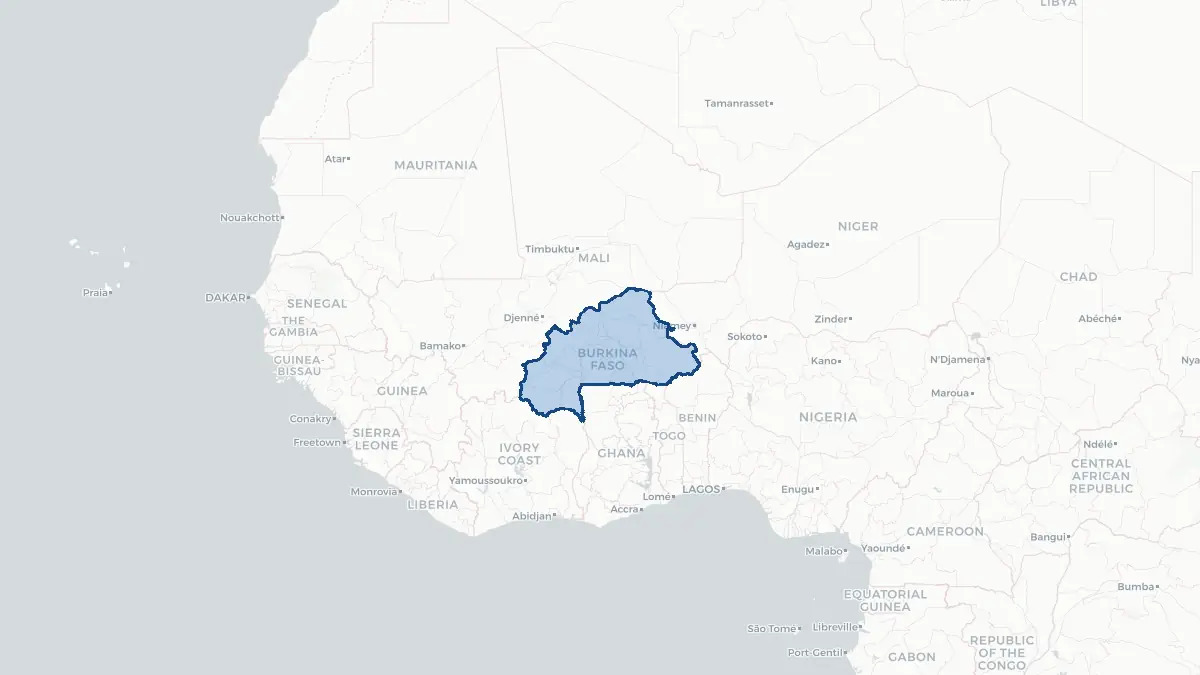
Burkina Faso — map and facts
Here you find a map of Burkina Faso, capital Ouagadougou, currency Franc and quick links to more facts about the country in Africa.
About the country
Burkina Faso on the map
About Burkina Faso
Burkina Faso is a landlocked country in West Africa with a population of approximately 23 million people. Its capital and largest city is Ouagadougou, located in the centre of the country. The nation takes its name from two principal languages: "Burkina" meaning "upright people" in Mooré and "Faso" meaning "fatherland" in Dioula — a name adopted in 1984 under President Thomas Sankara. French remains the official language of government and education. Burkina Faso is one of the world's poorest countries, heavily dependent on subsistence agriculture — particularly sorghum, millet, and cotton. It is also a significant gold producer. The country has experienced severe political instability in recent years: two military coups occurred in 2022, and since then a military junta has governed under Captain Ibrahim Traoré. A worsening Islamist insurgency linked to groups such as Jama'at Nusrat al-Islam wal-Muslimin and the Islamic State in the Greater Sahara has displaced millions of people and claimed thousands of lives. Burkina Faso has increasingly pivoted toward Russia and expelled French forces.
Geography and Landscape
Burkina Faso covers approximately 274,000 square kilometres of the western Sahel and Sudan savanna zones. The terrain is predominantly flat or gently rolling, consisting mainly of a laterite plateau between 200 and 700 metres in elevation. There are no dramatic mountain ranges; the Ténakourou peak in the southwest reaches only 749 metres — the country's highest point. Three main river systems drain the country: the Black Volta (Mouhoun), Red Volta (Nazinon), and White Volta (Nakambé), all flowing southward into Ghana and ultimately into Lake Volta. These rivers are seasonal, flowing strongly during the rainy season and drying considerably in the dry season. The Sahel zone in the north receives very little rainfall and shades into near-desert conditions, while the Sudan savanna in the south receives more rain and supports denser vegetation. The country experiences a single rainy season from roughly June to September, followed by a long dry period dominated by the harmattan, a hot dusty wind from the northeast. Desertification and land degradation are major environmental challenges.
History
The territory of Burkina Faso has been inhabited since at least the fifteenth century BC. The Mossi kingdoms, established around the twelfth to fourteenth centuries CE, became the dominant political force in the region and resisted external conquest with remarkable success for centuries. The Mossi Naba (king) remains a respected traditional authority in Burkina Faso today. French colonial forces under the command of Lieutenant-Colonel Voulet launched a brutal campaign to subdue the Mossi in the 1890s, incorporating the territory into French West Africa as Haute-Volta (Upper Volta) in 1919. The territory was briefly dissolved and divided between neighbouring colonies before being reconstituted in 1947. Independence came on 5 August 1960 under the first president, Maurice Yaméogo. The country experienced repeated military coups in subsequent decades. The most transformative figure was Captain Thomas Sankara, who ruled from 1983 to 1987, renamed the country, implemented radical pan-Africanist and socialist policies, promoted women's rights and self-sufficiency, and was assassinated in a coup led by Blaise Compaoré in 1987. Compaoré ruled for 27 years until a popular uprising removed him in 2014.
Geo Quiz
Think you know your capitals, flags, and continents? Take the quiz!
Neighbouring countries
Continue to nearby countries
More countries in the same part of the world
Africa index
Open the continent hub for Africa to see the full country list, capitals and frequently asked questions on one page.
Interactive map
Zoomable map of Burkina Faso
Country index
All countries by continent
Jump directly to the right section or keep scrolling.
Africa
58 countries- Algeria
- Angola
- Benin
- Botswana
- Burkina Faso
- Burundi
- Central African Republic
- Djibouti
- Democratic Republic of the Congo
- Egypt
- Equatorial Guinea
- Ivory Coast
- Eritrea
- Ethiopia
- Gabon
- Gambia
- Ghana
- Guinea
- Guinea-Bissau
- Cameroon
- Cape Verde
- Kenya
- Comoros
- Republic of the Congo
- Lesotho
- Liberia
- Libya
- Madagascar
- Malawi
- Mali
- Morocco
- Mauritania
- Mauritius
- Mayotte
- Mozambique
- Namibia
- Niger
- Nigeria
- Reunion
- Rwanda
- Saint Helena
- Sao Tome and Principe
- Senegal
- Seychelles
- Sierra Leone
- Somalia
- Sudan
- Swaziland
- South Africa
- South Sudan
- Tanzania
- Chad
- Togo
- Tunisia
- Uganda
- Western Sahara
- Zambia
- Zimbabwe
Asia
52 countries- Afghanistan
- Armenia
- Azerbaijan
- Bahrain
- Bangladesh
- Bhutan
- British Indian Ocean Territory
- Brunei
- Myanmar
- Philippines
- United Arab Emirates
- Georgia
- Hong Kong
- India
- Indonesia
- Iraq
- Iran
- Israel
- Japan
- Yemen
- Jordan
- Christmas Island
- Cambodia
- Kazakhstan
- China
- Kyrgyzstan
- Cocos Islands
- Kuwait
- Laos
- Lebanon
- Macau
- Malaysia
- Maldives
- Mongolia
- Nepal
- North Korea
- Oman
- Pakistan
- Palestinian Territory
- Qatar
- Saudi Arabia
- Singapore
- Sri Lanka
- South Korea
- Syria
- Tajikistan
- Taiwan
- Thailand
- Turkey
- Turkmenistan
- Uzbekistan
- Vietnam
Europe
53 countries- Albania
- Andorra
- Belgium
- Bosnia and Herzegovina
- Bulgaria
- Cyprus
- Denmark
- Estonia
- Finland
- France
- Faroe Islands
- Gibraltar
- Greece
- Guernsey
- Ireland
- Iceland
- Isle of Man
- Italy
- Jersey
- Kosovo
- Croatia
- Latvia
- Liechtenstein
- Lithuania
- Luxembourg
- Macedonia
- Malta
- Moldova
- Monaco
- Montenegro
- Netherlands
- Norway
- Poland
- Portugal
- Romania
- Russia
- San Marino
- Switzerland
- Serbia
- Slovakia
- Slovenia
- Spain
- United Kingdom
- Svalbard and Jan Mayen
- Sweden
- Czech Republic
- Germany
- Ukraine
- Hungary
- Vatican
- Belarus
- Aland Islands
- Austria
North America
42 countries- U.S. Virgin Islands
- Anguilla
- Antigua and Barbuda
- Aruba
- Bahamas
- Barbados
- Belize
- Bermuda
- Bonaire, Saint Eustatius and Saba
- British Virgin Islands
- Cayman Islands
- Costa Rica
- Curacao
- Dominica
- Dominican Republic
- El Salvador
- Grenada
- Greenland
- Guadeloupe
- Guatemala
- Haiti
- Honduras
- Jamaica
- Canada
- Cuba
- Martinique
- Mexico
- Montserrat
- Netherlands Antilles
- Nicaragua
- Panama
- Puerto Rico
- Saint Barthelemy
- Saint Kitts and Nevis
- Saint Lucia
- Saint Martin
- Saint Vincent and the Grenadines
- Saint Pierre and Miquelon
- Sint Maarten
- Trinidad and Tobago
- Turks and Caicos Islands
- United States
South America
14 countriesOceania
27 countries- American Samoa
- Australia
- Cook Islands
- Fiji
- French Polynesia
- United States Minor Outlying Islands
- Guam
- Kiribati
- Marshall Islands
- Micronesia
- Nauru
- Niue
- Northern Mariana Islands
- Norfolk Island
- New Caledonia
- New Zealand
- Palau
- Papua New Guinea
- Pitcairn
- Solomon Islands
- Samoa
- Tokelau
- Tonga
- Tuvalu
- Vanuatu
- Wallis and Futuna
- East Timor