
Asia
Malaysia — map and facts
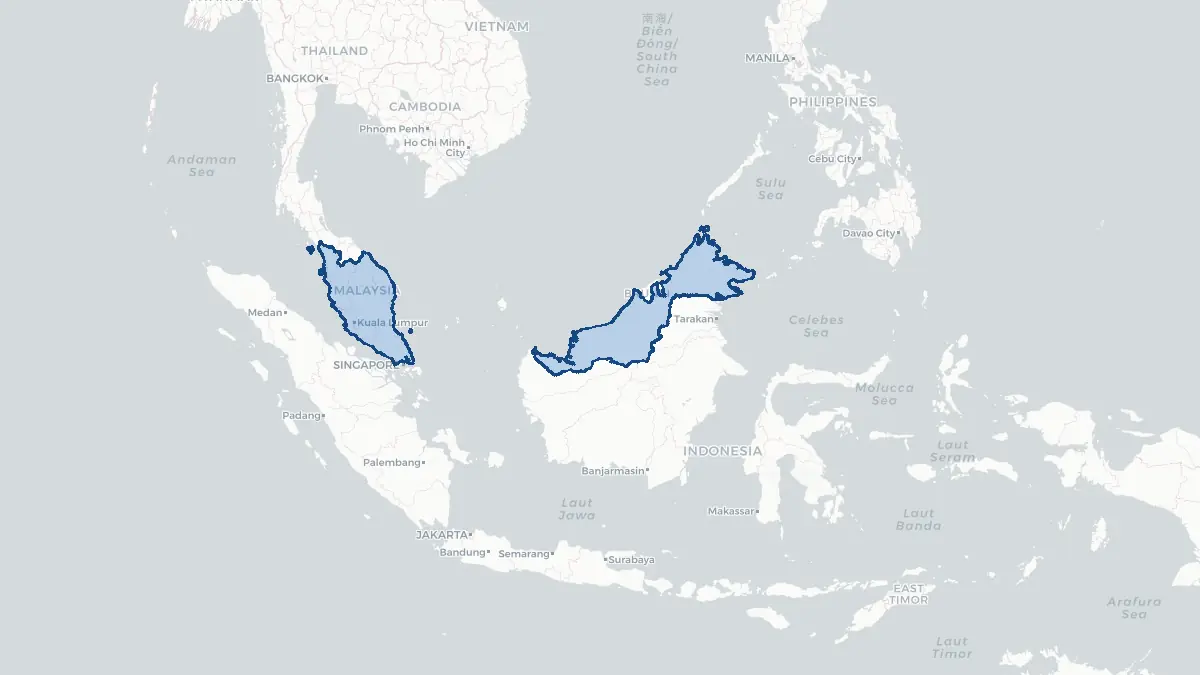
Here you find a map of Malaysia, capital Kuala Lumpur, currency Ringgit and quick links to more facts about the country in Asia.
About the country
Malaysia on the map
About Malaysia
Malaysia is a Southeast Asian nation of approximately 33 million people, comprising Peninsular Malaysia and the Bornean states of Sabah and Sarawak, separated by the South China Sea. It is a federal constitutional monarchy in which the king (Yang di-Pertuan Agong) rotates among the rulers of the nine Malay states every five years. Kuala Lumpur is the national capital and largest city. Bahasa Malaysia (Malay) is the official language, though English, Mandarin, Tamil, and other languages are widely spoken. Malaysia is an ethnically diverse country with Malay-Bumiputera, Chinese, Indian, and indigenous communities. Islam is the official religion, though freedom of worship is enshrined constitutionally. Malaysia has undergone rapid economic development since independence, transitioning from an agricultural economy to a middle-income, export-oriented industrial nation. The country is a major producer of palm oil, rubber, and liquefied natural gas, and has developed significant electronics and automotive sectors.
Geography and Landscape
Malaysia's geography is shaped by its two main regions. Peninsular Malaysia is a long, narrow landmass attached to southern Thailand, dominated by a central mountain range—the Titiwangsa Range—that runs its length, with coastal lowlands on either side. The east coast faces the South China Sea, while the west coast borders the Strait of Malacca, one of the world's most critical maritime chokepoints. Malaysian Borneo (Sabah and Sarawak) is dominated by some of the world's oldest and most biodiverse rainforests, with Mount Kinabalu (4,095 m) in Sabah being the highest peak in Southeast Asia outside New Guinea. Major rivers include the Rajang in Sarawak, the longest river in Malaysia. The climate is equatorial throughout, with high temperatures, high humidity, and abundant rainfall year-round. The country is part of the Coral Triangle and holds significant marine biodiversity around its coastal islands, including Sipadan, one of the world's premier dive destinations.
History
The Malay Peninsula has been an important trading crossroads for over two thousand years. The Malacca Sultanate, founded around 1400 CE, became one of the greatest entrepôts in Asian maritime history, facilitating trade between China, India, and the Arab world and spreading Islam throughout the region. Malacca was conquered by the Portuguese in 1511, then by the Dutch in 1641, and eventually came under British influence through the Straits Settlements and the Federated Malay States in the nineteenth and early twentieth centuries. The Japanese occupation (1941–1945) profoundly disrupted colonial order. A communist insurgency—the Malayan Emergency—followed independence in 1957. Malaysia was formed in 1963, uniting the Federation of Malaya, Singapore, Sabah, and Sarawak; Singapore departed in 1965. Under long-serving prime ministers, particularly Mahathir Mohamad (1981–2003, 2018–2020), Malaysia pursued rapid industrialisation and became a model of Southeast Asian development. Political reformasi movements have pressed for greater democracy and accountability.
Geo Quiz
Think you know your capitals, flags, and continents? Take the quiz!
Neighbouring countries
Continue to nearby countries
More countries in the same part of the world
Asia index
Open the continent hub for Asia to see the full country list, capitals and frequently asked questions on one page.
Interactive map
Zoomable map of Malaysia
Country index
All countries by continent
Jump directly to the right section or keep scrolling.
Africa
58 countries- Algeria
- Angola
- Benin
- Botswana
- Burkina Faso
- Burundi
- Central African Republic
- Djibouti
- Democratic Republic of the Congo
- Egypt
- Equatorial Guinea
- Ivory Coast
- Eritrea
- Ethiopia
- Gabon
- Gambia
- Ghana
- Guinea
- Guinea-Bissau
- Cameroon
- Cape Verde
- Kenya
- Comoros
- Republic of the Congo
- Lesotho
- Liberia
- Libya
- Madagascar
- Malawi
- Mali
- Morocco
- Mauritania
- Mauritius
- Mayotte
- Mozambique
- Namibia
- Niger
- Nigeria
- Reunion
- Rwanda
- Saint Helena
- Sao Tome and Principe
- Senegal
- Seychelles
- Sierra Leone
- Somalia
- Sudan
- Swaziland
- South Africa
- South Sudan
- Tanzania
- Chad
- Togo
- Tunisia
- Uganda
- Western Sahara
- Zambia
- Zimbabwe
Asia
52 countries- Afghanistan
- Armenia
- Azerbaijan
- Bahrain
- Bangladesh
- Bhutan
- British Indian Ocean Territory
- Brunei
- Myanmar
- Philippines
- United Arab Emirates
- Georgia
- Hong Kong
- India
- Indonesia
- Iraq
- Iran
- Israel
- Japan
- Yemen
- Jordan
- Christmas Island
- Cambodia
- Kazakhstan
- China
- Kyrgyzstan
- Cocos Islands
- Kuwait
- Laos
- Lebanon
- Macau
- Malaysia
- Maldives
- Mongolia
- Nepal
- North Korea
- Oman
- Pakistan
- Palestinian Territory
- Qatar
- Saudi Arabia
- Singapore
- Sri Lanka
- South Korea
- Syria
- Tajikistan
- Taiwan
- Thailand
- Turkey
- Turkmenistan
- Uzbekistan
- Vietnam
Europe
53 countries- Albania
- Andorra
- Belgium
- Bosnia and Herzegovina
- Bulgaria
- Cyprus
- Denmark
- Estonia
- Finland
- France
- Faroe Islands
- Gibraltar
- Greece
- Guernsey
- Ireland
- Iceland
- Isle of Man
- Italy
- Jersey
- Kosovo
- Croatia
- Latvia
- Liechtenstein
- Lithuania
- Luxembourg
- Macedonia
- Malta
- Moldova
- Monaco
- Montenegro
- Netherlands
- Norway
- Poland
- Portugal
- Romania
- Russia
- San Marino
- Switzerland
- Serbia
- Slovakia
- Slovenia
- Spain
- United Kingdom
- Svalbard and Jan Mayen
- Sweden
- Czech Republic
- Germany
- Ukraine
- Hungary
- Vatican
- Belarus
- Aland Islands
- Austria
North America
42 countries- U.S. Virgin Islands
- Anguilla
- Antigua and Barbuda
- Aruba
- Bahamas
- Barbados
- Belize
- Bermuda
- Bonaire, Saint Eustatius and Saba
- British Virgin Islands
- Cayman Islands
- Costa Rica
- Curacao
- Dominica
- Dominican Republic
- El Salvador
- Grenada
- Greenland
- Guadeloupe
- Guatemala
- Haiti
- Honduras
- Jamaica
- Canada
- Cuba
- Martinique
- Mexico
- Montserrat
- Netherlands Antilles
- Nicaragua
- Panama
- Puerto Rico
- Saint Barthelemy
- Saint Kitts and Nevis
- Saint Lucia
- Saint Martin
- Saint Vincent and the Grenadines
- Saint Pierre and Miquelon
- Sint Maarten
- Trinidad and Tobago
- Turks and Caicos Islands
- United States
South America
14 countriesOceania
27 countries- American Samoa
- Australia
- Cook Islands
- Fiji
- French Polynesia
- United States Minor Outlying Islands
- Guam
- Kiribati
- Marshall Islands
- Micronesia
- Nauru
- Niue
- Northern Mariana Islands
- Norfolk Island
- New Caledonia
- New Zealand
- Palau
- Papua New Guinea
- Pitcairn
- Solomon Islands
- Samoa
- Tokelau
- Tonga
- Tuvalu
- Vanuatu
- Wallis and Futuna
- East Timor