
Europe
Liechtenstein — map and facts
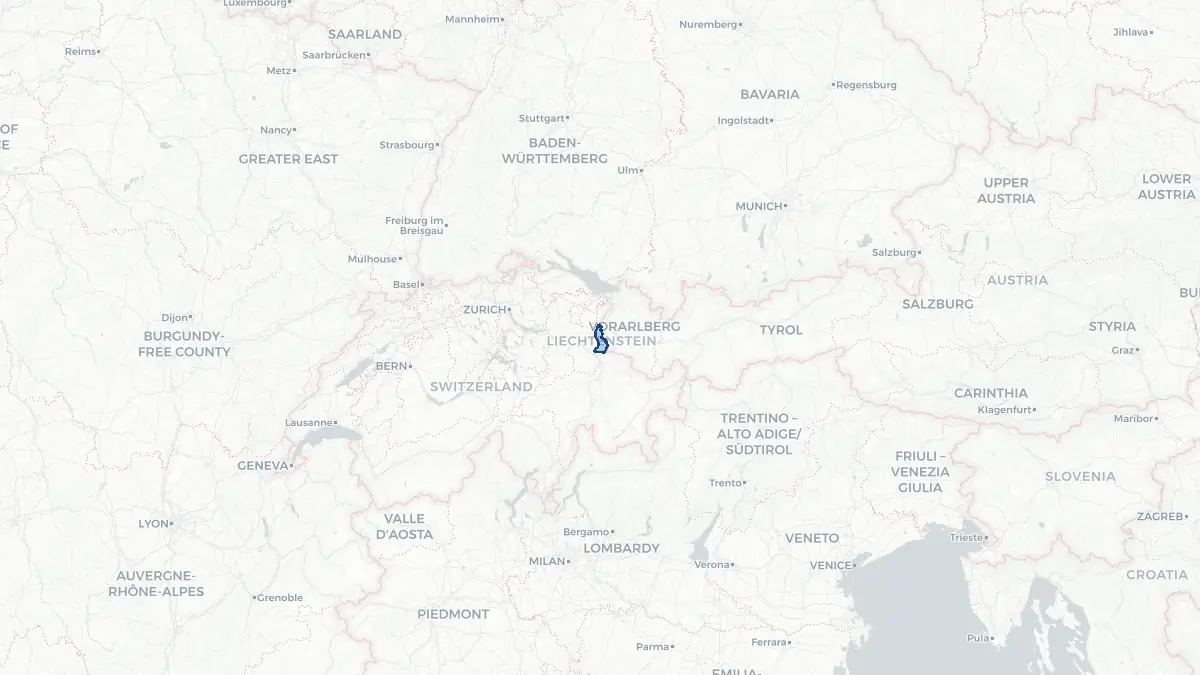
Here you find a map of Liechtenstein, capital Vaduz, currency Schweiziska franc and quick links to more facts about the country in Europe.
About the country
Liechtenstein on the map
About Liechtenstein
Liechtenstein is a tiny doubly landlocked constitutional monarchy in the Alps, sandwiched between Switzerland and Austria, with a population of approximately 38,000. Its capital is Vaduz, though the largest municipality is Schaan. It is one of the world's smallest countries by area, at just 160 square kilometres, yet has one of the highest GDP per capita figures globally, driven by financial services, precision manufacturing, and tourism. Liechtenstein is not an EU member but belongs to the European Economic Area (EEA) and the Schengen Area. It uses the Swiss franc as currency. The official language is German (specifically the Alemannic dialect). The country is governed by Prince Hans-Adam II and the Liechtenstein dynasty, which has held the territory since 1719 when Holy Roman Emperor Charles VI granted it. Liechtenstein is one of only two doubly landlocked countries in the world (along with Uzbekistan).
Geography and Landscape
Liechtenstein occupies a narrow strip of the Rhine Valley in the west and the alpine mountains of the Rätikon range in the east. The Rhine forms the entire western border with Switzerland, while the eastern highlands rise sharply to peaks above 2,500 metres, with Grauspitz (2,599 m) as the highest point. The valley floor along the Rhine is relatively flat and densely populated, containing the main towns and agricultural areas. The alpine zone in the east is forested and used for summer grazing. Despite its tiny size, the country offers skiing, hiking, and spectacular mountain scenery. The climate is alpine continental, cooler at altitude and warmer in the valley, with the Föhn wind from the south sometimes bringing mild temperatures to the valley.
History
The territory of Liechtenstein was the ancient Roman province of Raetia and later fragmented among various feudal lordships. The House of Liechtenstein, a powerful Austrian noble family, purchased the Lordship of Schellenberg in 1699 and the County of Vaduz in 1712, assembling the current territory. In 1719 Holy Roman Emperor Charles VI elevated the united lordships to a principality and granted it to the Liechtenstein family. The country gained full sovereignty in 1866 when the German Confederation dissolved. Liechtenstein dissolved its army in 1868 and has maintained neutrality and peace ever since. It remained relatively poor and agricultural until the mid-twentieth century, when low taxes and political stability attracted financial and manufacturing businesses. Women gained the right to vote in 1984.
Geo Quiz
Think you know your capitals, flags, and continents? Take the quiz!
Neighbouring countries
Continue to nearby countries
More countries in the same part of the world
Europe index
Open the continent hub for Europe to see the full country list, capitals and frequently asked questions on one page.
Interactive map
Zoomable map of Liechtenstein
Country index
All countries by continent
Jump directly to the right section or keep scrolling.
Africa
58 countries- Algeria
- Angola
- Benin
- Botswana
- Burkina Faso
- Burundi
- Central African Republic
- Djibouti
- Democratic Republic of the Congo
- Egypt
- Equatorial Guinea
- Ivory Coast
- Eritrea
- Ethiopia
- Gabon
- Gambia
- Ghana
- Guinea
- Guinea-Bissau
- Cameroon
- Cape Verde
- Kenya
- Comoros
- Republic of the Congo
- Lesotho
- Liberia
- Libya
- Madagascar
- Malawi
- Mali
- Morocco
- Mauritania
- Mauritius
- Mayotte
- Mozambique
- Namibia
- Niger
- Nigeria
- Reunion
- Rwanda
- Saint Helena
- Sao Tome and Principe
- Senegal
- Seychelles
- Sierra Leone
- Somalia
- Sudan
- Swaziland
- South Africa
- South Sudan
- Tanzania
- Chad
- Togo
- Tunisia
- Uganda
- Western Sahara
- Zambia
- Zimbabwe
Asia
52 countries- Afghanistan
- Armenia
- Azerbaijan
- Bahrain
- Bangladesh
- Bhutan
- British Indian Ocean Territory
- Brunei
- Myanmar
- Philippines
- United Arab Emirates
- Georgia
- Hong Kong
- India
- Indonesia
- Iraq
- Iran
- Israel
- Japan
- Yemen
- Jordan
- Christmas Island
- Cambodia
- Kazakhstan
- China
- Kyrgyzstan
- Cocos Islands
- Kuwait
- Laos
- Lebanon
- Macau
- Malaysia
- Maldives
- Mongolia
- Nepal
- North Korea
- Oman
- Pakistan
- Palestinian Territory
- Qatar
- Saudi Arabia
- Singapore
- Sri Lanka
- South Korea
- Syria
- Tajikistan
- Taiwan
- Thailand
- Turkey
- Turkmenistan
- Uzbekistan
- Vietnam
Europe
53 countries- Albania
- Andorra
- Belgium
- Bosnia and Herzegovina
- Bulgaria
- Cyprus
- Denmark
- Estonia
- Finland
- France
- Faroe Islands
- Gibraltar
- Greece
- Guernsey
- Ireland
- Iceland
- Isle of Man
- Italy
- Jersey
- Kosovo
- Croatia
- Latvia
- Liechtenstein
- Lithuania
- Luxembourg
- Macedonia
- Malta
- Moldova
- Monaco
- Montenegro
- Netherlands
- Norway
- Poland
- Portugal
- Romania
- Russia
- San Marino
- Switzerland
- Serbia
- Slovakia
- Slovenia
- Spain
- United Kingdom
- Svalbard and Jan Mayen
- Sweden
- Czech Republic
- Germany
- Ukraine
- Hungary
- Vatican
- Belarus
- Aland Islands
- Austria
North America
42 countries- U.S. Virgin Islands
- Anguilla
- Antigua and Barbuda
- Aruba
- Bahamas
- Barbados
- Belize
- Bermuda
- Bonaire, Saint Eustatius and Saba
- British Virgin Islands
- Cayman Islands
- Costa Rica
- Curacao
- Dominica
- Dominican Republic
- El Salvador
- Grenada
- Greenland
- Guadeloupe
- Guatemala
- Haiti
- Honduras
- Jamaica
- Canada
- Cuba
- Martinique
- Mexico
- Montserrat
- Netherlands Antilles
- Nicaragua
- Panama
- Puerto Rico
- Saint Barthelemy
- Saint Kitts and Nevis
- Saint Lucia
- Saint Martin
- Saint Vincent and the Grenadines
- Saint Pierre and Miquelon
- Sint Maarten
- Trinidad and Tobago
- Turks and Caicos Islands
- United States
South America
14 countriesOceania
27 countries- American Samoa
- Australia
- Cook Islands
- Fiji
- French Polynesia
- United States Minor Outlying Islands
- Guam
- Kiribati
- Marshall Islands
- Micronesia
- Nauru
- Niue
- Northern Mariana Islands
- Norfolk Island
- New Caledonia
- New Zealand
- Palau
- Papua New Guinea
- Pitcairn
- Solomon Islands
- Samoa
- Tokelau
- Tonga
- Tuvalu
- Vanuatu
- Wallis and Futuna
- East Timor