
Europe
Malta — map and facts
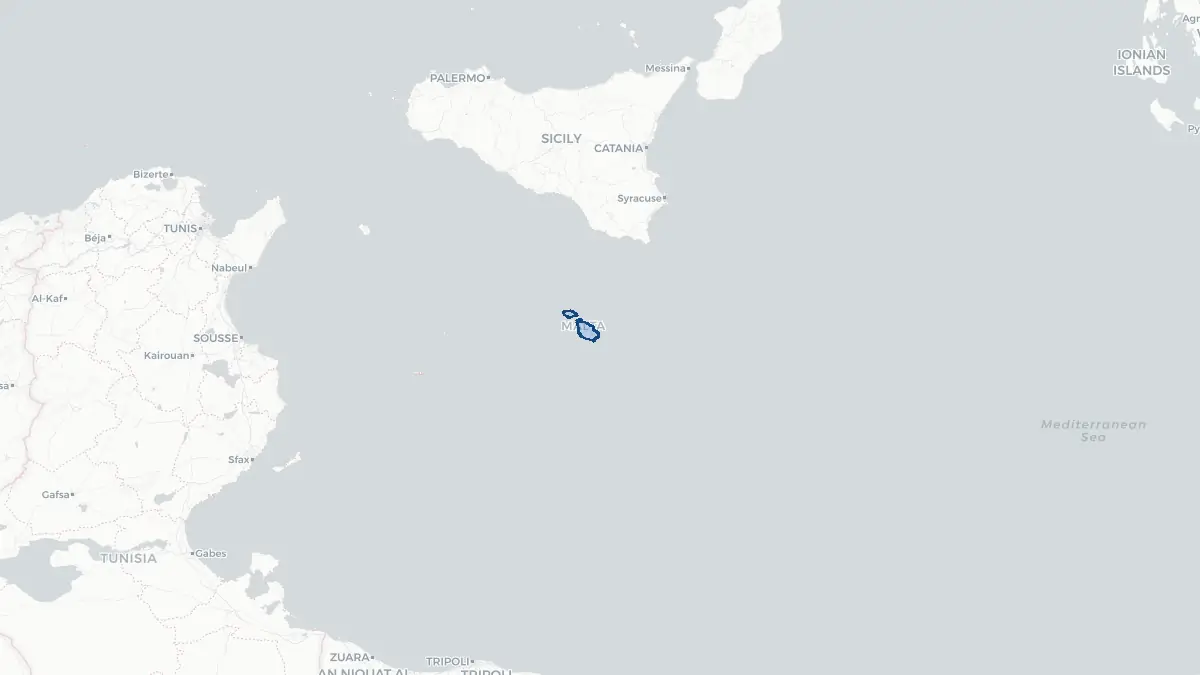
Here you find a map of Malta, capital Valletta, currency Euro and quick links to more facts about the country in Europe.
About the country
Malta on the map
About Malta
Malta is a small Mediterranean archipelago nation south of Sicily, with a population of approximately 520,000 spread across three inhabited islands: Malta, Gozo, and Comino. Its capital is Valletta, one of the smallest and most concentrated capital cities in the world and a UNESCO World Heritage Site. Malta became independent from the United Kingdom in 1964 and a republic in 1974; it joined the EU in 2004 and adopted the euro in 2008. The official languages are Maltese — a unique Semitic language written in the Latin script, with Arabic roots and significant Italian and English influence — and English. Malta is a major maritime hub, a popular tourist destination with its warm climate and archaeological sites, and a growing financial services and iGaming centre.
Geography and Landscape
Malta sits in the central Mediterranean, about 93 kilometres south of Sicily and 288 kilometres north of the Libyan coast. The islands are relatively flat, with no rivers or mountains, and the highest point is Ta' Dmejrek at 253 metres. The landscape is characterised by limestone terraces, ancient cart ruts, and dramatic cliffsides, especially on Gozo. The coastline is rugged and deeply indented with natural harbours — Grand Harbour in Valletta is one of the finest natural harbours in the Mediterranean. The islands have a hot Mediterranean climate with long, dry, sunny summers and mild, wetter winters. Fresh water is scarce; Malta relies heavily on desalination. Despite its small size, Malta has a rich biodiversity of birds and marine life, with important migratory bird routes passing through.
History
Malta has been continuously inhabited since around 5900 BC. The ?al Saflieni Hypogeum and the megalithic ?gantija temples on Gozo predate Stonehenge and the Egyptian pyramids. Phoenicians, Carthaginians, and Romans successively controlled the islands. Arab rule from 870 to 1091 left a permanent linguistic legacy in Maltese. Norman and subsequent medieval rulers were followed by the Knights of St John (Knights Hospitaller), who were granted Malta by Holy Roman Emperor Charles V in 1530 and defended the island against the Great Siege by the Ottomans in 1565. Napoleon seized Malta in 1798, but the British took control in 1800 and formally received it under the 1814 Treaty of Paris. Malta played a crucial role in the Second World War and was awarded the George Cross collectively by King George VI. Independence came on 21 September 1964.
Geo Quiz
Think you know your capitals, flags, and continents? Take the quiz!
Neighbouring countries
Continue to nearby countries
There are no registered neighbouring countries for Malta in the current database.
More countries in the same part of the world
Europe index
Open the continent hub for Europe to see the full country list, capitals and frequently asked questions on one page.
Interactive map
Zoomable map of Malta
Country index
All countries by continent
Jump directly to the right section or keep scrolling.
Africa
58 countries- Algeria
- Angola
- Benin
- Botswana
- Burkina Faso
- Burundi
- Central African Republic
- Djibouti
- Democratic Republic of the Congo
- Egypt
- Equatorial Guinea
- Ivory Coast
- Eritrea
- Ethiopia
- Gabon
- Gambia
- Ghana
- Guinea
- Guinea-Bissau
- Cameroon
- Cape Verde
- Kenya
- Comoros
- Republic of the Congo
- Lesotho
- Liberia
- Libya
- Madagascar
- Malawi
- Mali
- Morocco
- Mauritania
- Mauritius
- Mayotte
- Mozambique
- Namibia
- Niger
- Nigeria
- Reunion
- Rwanda
- Saint Helena
- Sao Tome and Principe
- Senegal
- Seychelles
- Sierra Leone
- Somalia
- Sudan
- Swaziland
- South Africa
- South Sudan
- Tanzania
- Chad
- Togo
- Tunisia
- Uganda
- Western Sahara
- Zambia
- Zimbabwe
Asia
52 countries- Afghanistan
- Armenia
- Azerbaijan
- Bahrain
- Bangladesh
- Bhutan
- British Indian Ocean Territory
- Brunei
- Myanmar
- Philippines
- United Arab Emirates
- Georgia
- Hong Kong
- India
- Indonesia
- Iraq
- Iran
- Israel
- Japan
- Yemen
- Jordan
- Christmas Island
- Cambodia
- Kazakhstan
- China
- Kyrgyzstan
- Cocos Islands
- Kuwait
- Laos
- Lebanon
- Macau
- Malaysia
- Maldives
- Mongolia
- Nepal
- North Korea
- Oman
- Pakistan
- Palestinian Territory
- Qatar
- Saudi Arabia
- Singapore
- Sri Lanka
- South Korea
- Syria
- Tajikistan
- Taiwan
- Thailand
- Turkey
- Turkmenistan
- Uzbekistan
- Vietnam
Europe
53 countries- Albania
- Andorra
- Belgium
- Bosnia and Herzegovina
- Bulgaria
- Cyprus
- Denmark
- Estonia
- Finland
- France
- Faroe Islands
- Gibraltar
- Greece
- Guernsey
- Ireland
- Iceland
- Isle of Man
- Italy
- Jersey
- Kosovo
- Croatia
- Latvia
- Liechtenstein
- Lithuania
- Luxembourg
- Macedonia
- Malta
- Moldova
- Monaco
- Montenegro
- Netherlands
- Norway
- Poland
- Portugal
- Romania
- Russia
- San Marino
- Switzerland
- Serbia
- Slovakia
- Slovenia
- Spain
- United Kingdom
- Svalbard and Jan Mayen
- Sweden
- Czech Republic
- Germany
- Ukraine
- Hungary
- Vatican
- Belarus
- Aland Islands
- Austria
North America
42 countries- U.S. Virgin Islands
- Anguilla
- Antigua and Barbuda
- Aruba
- Bahamas
- Barbados
- Belize
- Bermuda
- Bonaire, Saint Eustatius and Saba
- British Virgin Islands
- Cayman Islands
- Costa Rica
- Curacao
- Dominica
- Dominican Republic
- El Salvador
- Grenada
- Greenland
- Guadeloupe
- Guatemala
- Haiti
- Honduras
- Jamaica
- Canada
- Cuba
- Martinique
- Mexico
- Montserrat
- Netherlands Antilles
- Nicaragua
- Panama
- Puerto Rico
- Saint Barthelemy
- Saint Kitts and Nevis
- Saint Lucia
- Saint Martin
- Saint Vincent and the Grenadines
- Saint Pierre and Miquelon
- Sint Maarten
- Trinidad and Tobago
- Turks and Caicos Islands
- United States
South America
14 countriesOceania
27 countries- American Samoa
- Australia
- Cook Islands
- Fiji
- French Polynesia
- United States Minor Outlying Islands
- Guam
- Kiribati
- Marshall Islands
- Micronesia
- Nauru
- Niue
- Northern Mariana Islands
- Norfolk Island
- New Caledonia
- New Zealand
- Palau
- Papua New Guinea
- Pitcairn
- Solomon Islands
- Samoa
- Tokelau
- Tonga
- Tuvalu
- Vanuatu
- Wallis and Futuna
- East Timor