
Africa
Uganda — map and facts
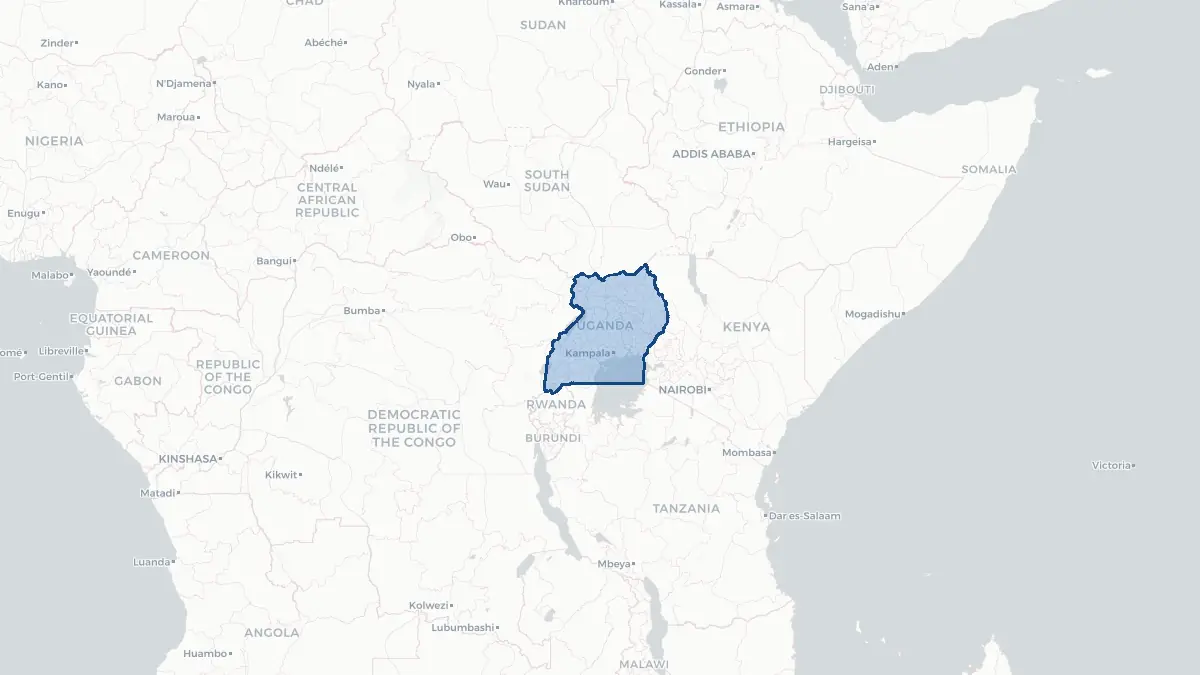
Here you find a map of Uganda, capital Kampala, currency Shilling and quick links to more facts about the country in Africa.
About the country
Uganda on the map
About Uganda
Uganda is a landlocked country in East Africa with a population of approximately 48 million people, one of the youngest and fastest-growing populations on Earth. The capital is Kampala, situated on the northern shores of Lake Victoria and serving as the country's political, commercial, and cultural hub. Uganda is a presidential republic; Yoweri Museveni has held power since 1986, making his one of the longest-running governments in the region. English and Swahili are the official languages, alongside numerous indigenous languages including Luganda. The economy is primarily agricultural, with coffee the principal export crop; tea, fish, and gold are also significant. Uganda has experienced remarkable economic growth in parts of the post-Museveni era but continues to face challenges of poverty, governance, and regional instability. The country gained independence from Britain on 9 October 1962. Uganda is known internationally for conservation achievements including the recovery of mountain gorilla populations in the Bwindi Impenetrable Forest, which together with gorilla habitat in Rwanda and the Democratic Republic of the Congo holds nearly all surviving mountain gorillas.
Geography and Landscape
Uganda lies astride the equator in the Great Lakes region of East Africa. Despite being landlocked, water dominates the landscape: Lake Victoria in the south, shared with Kenya and Tanzania, is the world's largest tropical lake and the main source of the White Nile. Lake Albert lies on the western border with the Democratic Republic of the Congo, Lake Edward straddles the southwestern border, and Lake Kyoga occupies the central plateau. The western arm of the Great Rift Valley forms Uganda's western boundary and is associated with a chain of volcanoes, including the Virunga range. The Rwenzori Mountains in the west, known as the Mountains of the Moon, contain glaciated peaks including Margherita Peak at 5,109 metres, the highest point in Uganda and third-highest in Africa. The north is mostly flat savanna, while the southwest is dominated by highland terrain and the Albertine Rift. The White Nile exits Lake Victoria at Jinja and flows north through the country. Uganda's equatorial climate produces high rainfall and supports diverse tropical ecosystems.
History
The area of present-day Uganda has been inhabited for thousands of years. The Bantu-speaking kingdoms of Buganda, Bunyoro, Ankole, and Toro emerged in the interlacustrine region between roughly the thirteenth and fifteenth centuries, with the Kingdom of Buganda becoming the most powerful by the nineteenth century. Arab traders brought Islam to the region in the mid-nineteenth century, followed by British Protestant and French Catholic missionaries. British influence formalised with the establishment of the Uganda Protectorate in 1894. The country gained independence on 9 October 1962 under Prime Minister Milton Obote. President Idi Amin seized power in a military coup in 1971, launching a brutal eight-year dictatorship characterised by mass killings, expulsion of the Asian community, and economic ruin. Tanzanian forces and Ugandan exiles ousted Amin in 1979. A period of continued instability followed until Museveni's National Resistance Army took power in 1986. Northern Uganda was devastated by the insurgency of Joseph Kony's Lord's Resistance Army from the late 1980s to the 2000s.
Geo Quiz
Think you know your capitals, flags, and continents? Take the quiz!
Neighbouring countries
Continue to nearby countries
More countries in the same part of the world
Africa index
Open the continent hub for Africa to see the full country list, capitals and frequently asked questions on one page.
Interactive map
Zoomable map of Uganda
Country index
All countries by continent
Jump directly to the right section or keep scrolling.
Africa
58 countries- Algeria
- Angola
- Benin
- Botswana
- Burkina Faso
- Burundi
- Central African Republic
- Djibouti
- Democratic Republic of the Congo
- Egypt
- Equatorial Guinea
- Ivory Coast
- Eritrea
- Ethiopia
- Gabon
- Gambia
- Ghana
- Guinea
- Guinea-Bissau
- Cameroon
- Cape Verde
- Kenya
- Comoros
- Republic of the Congo
- Lesotho
- Liberia
- Libya
- Madagascar
- Malawi
- Mali
- Morocco
- Mauritania
- Mauritius
- Mayotte
- Mozambique
- Namibia
- Niger
- Nigeria
- Reunion
- Rwanda
- Saint Helena
- Sao Tome and Principe
- Senegal
- Seychelles
- Sierra Leone
- Somalia
- Sudan
- Swaziland
- South Africa
- South Sudan
- Tanzania
- Chad
- Togo
- Tunisia
- Uganda
- Western Sahara
- Zambia
- Zimbabwe
Asia
52 countries- Afghanistan
- Armenia
- Azerbaijan
- Bahrain
- Bangladesh
- Bhutan
- British Indian Ocean Territory
- Brunei
- Myanmar
- Philippines
- United Arab Emirates
- Georgia
- Hong Kong
- India
- Indonesia
- Iraq
- Iran
- Israel
- Japan
- Yemen
- Jordan
- Christmas Island
- Cambodia
- Kazakhstan
- China
- Kyrgyzstan
- Cocos Islands
- Kuwait
- Laos
- Lebanon
- Macau
- Malaysia
- Maldives
- Mongolia
- Nepal
- North Korea
- Oman
- Pakistan
- Palestinian Territory
- Qatar
- Saudi Arabia
- Singapore
- Sri Lanka
- South Korea
- Syria
- Tajikistan
- Taiwan
- Thailand
- Turkey
- Turkmenistan
- Uzbekistan
- Vietnam
Europe
53 countries- Albania
- Andorra
- Belgium
- Bosnia and Herzegovina
- Bulgaria
- Cyprus
- Denmark
- Estonia
- Finland
- France
- Faroe Islands
- Gibraltar
- Greece
- Guernsey
- Ireland
- Iceland
- Isle of Man
- Italy
- Jersey
- Kosovo
- Croatia
- Latvia
- Liechtenstein
- Lithuania
- Luxembourg
- Macedonia
- Malta
- Moldova
- Monaco
- Montenegro
- Netherlands
- Norway
- Poland
- Portugal
- Romania
- Russia
- San Marino
- Switzerland
- Serbia
- Slovakia
- Slovenia
- Spain
- United Kingdom
- Svalbard and Jan Mayen
- Sweden
- Czech Republic
- Germany
- Ukraine
- Hungary
- Vatican
- Belarus
- Aland Islands
- Austria
North America
42 countries- U.S. Virgin Islands
- Anguilla
- Antigua and Barbuda
- Aruba
- Bahamas
- Barbados
- Belize
- Bermuda
- Bonaire, Saint Eustatius and Saba
- British Virgin Islands
- Cayman Islands
- Costa Rica
- Curacao
- Dominica
- Dominican Republic
- El Salvador
- Grenada
- Greenland
- Guadeloupe
- Guatemala
- Haiti
- Honduras
- Jamaica
- Canada
- Cuba
- Martinique
- Mexico
- Montserrat
- Netherlands Antilles
- Nicaragua
- Panama
- Puerto Rico
- Saint Barthelemy
- Saint Kitts and Nevis
- Saint Lucia
- Saint Martin
- Saint Vincent and the Grenadines
- Saint Pierre and Miquelon
- Sint Maarten
- Trinidad and Tobago
- Turks and Caicos Islands
- United States
South America
14 countriesOceania
27 countries- American Samoa
- Australia
- Cook Islands
- Fiji
- French Polynesia
- United States Minor Outlying Islands
- Guam
- Kiribati
- Marshall Islands
- Micronesia
- Nauru
- Niue
- Northern Mariana Islands
- Norfolk Island
- New Caledonia
- New Zealand
- Palau
- Papua New Guinea
- Pitcairn
- Solomon Islands
- Samoa
- Tokelau
- Tonga
- Tuvalu
- Vanuatu
- Wallis and Futuna
- East Timor