
Asia
Philippines — map and facts
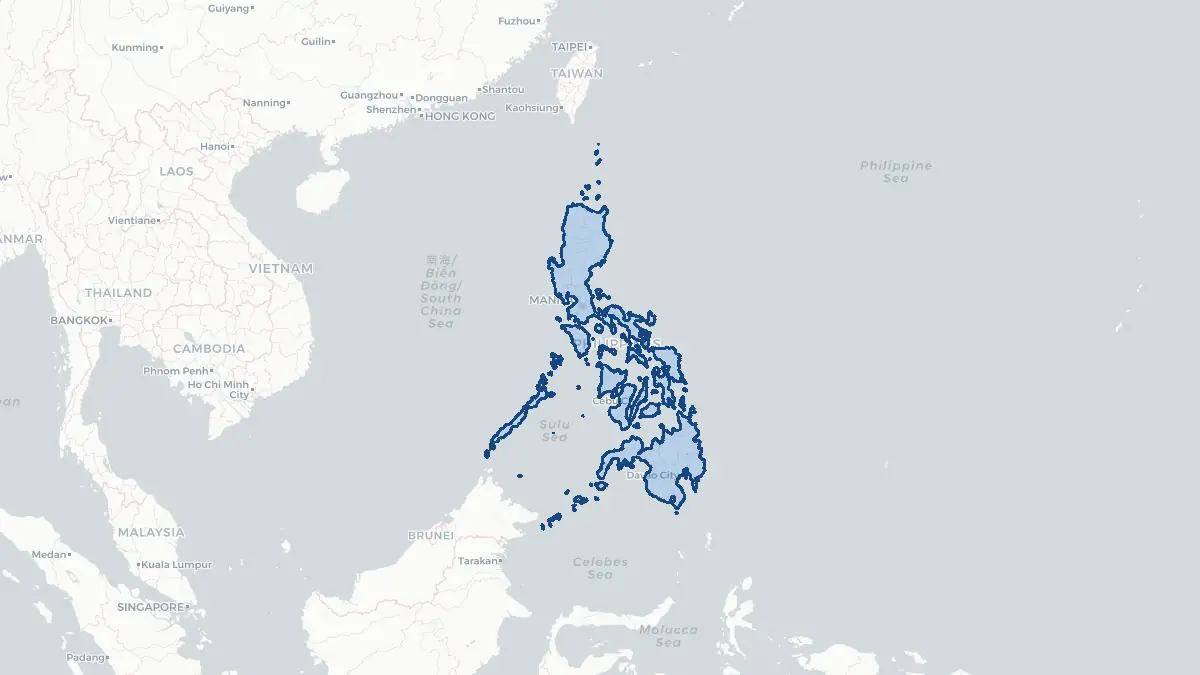
Here you find a map of Philippines, capital Manila, currency Peso and quick links to more facts about the country in Asia.
About the country
Philippines on the map
About the Philippines
The Philippines is a Southeast Asian archipelago nation consisting of approximately 7,641 islands, with a population of over 115 million people—making it the world's thirteenth most populous country. It is a unitary presidential constitutional republic, with Manila as the capital and Metro Manila as the premier urban agglomeration; Quezon City is technically the most populous city within that region. Filipino (based on Tagalog) and English are both official languages. The Philippines is a predominantly Christian nation—the only one in Southeast Asia—with Roman Catholicism practised by around 80% of the population, a legacy of more than three centuries of Spanish colonisation. The Philippines is also noted for its diaspora, with millions of overseas Filipino workers remitting significant income home. The economy has grown substantially in recent decades, driven by business process outsourcing (BPO), remittances, electronics manufacturing, and agriculture. Filipino culture is a rich blend of Malay, Spanish, Chinese, and American influences.
Geography and Landscape
The Philippine archipelago is spread across the western Pacific Ocean and is divided into three main geographical divisions: Luzon in the north, the Visayas in the centre, and Mindanao in the south. The terrain is predominantly mountainous and volcanic; the country lies along the Pacific Ring of Fire and is one of the most volcanically and seismically active nations in the world. Mount Apo (2,954 m) on Mindanao is the highest peak. The Philippines experiences frequent typhoons (an average of 20 per year), which strike primarily the eastern coasts. The country has an extensive coastline of over 36,000 km, and its waters host extraordinary marine biodiversity—particularly in the Tubbataha Reef and the Coral Triangle, of which the Philippines is a central part. Major rivers include the Cagayan and Pampanga in Luzon. The climate is tropical throughout, with a wet season driven by the southwest monsoon and a dry season from November to April across most of the country.
History
Archaeological evidence places human habitation in the Philippines at least 67,000 years ago. Before Spanish colonisation, the islands were home to various indigenous groups and were linked to trade networks extending to China, Brunei, and the Malay world. Ferdinand Magellan arrived in 1521 during his circumnavigation voyage; he was killed at the Battle of Mactan by the chieftain Lapu-Lapu. Full Spanish colonisation began in 1565 under Miguel López de Legazpi. The Spanish period lasted over 333 years, profoundly shaping Filipino religion, culture, and language. The Philippine Revolution of 1896 and the Spanish-American War of 1898 ended Spanish rule; the Philippines was ceded to the United States, which suppressed a Filipino independence movement in a brutal war. The Japanese occupation (1941–1945) caused immense suffering. Independence was granted on 4 July 1946. The authoritarian rule of Ferdinand Marcos (1972–1986) ended with the peaceful People Power Revolution. The Philippines has since navigated democratic and authoritarian tendencies, most recently under the Duterte administration (2016–2022) and the presidency of Ferdinand Marcos Jr.
Geo Quiz
Think you know your capitals, flags, and continents? Take the quiz!
Neighbouring countries
Continue to nearby countries
There are no registered neighbouring countries for Philippines in the current database.
More countries in the same part of the world
Asia index
Open the continent hub for Asia to see the full country list, capitals and frequently asked questions on one page.
Interactive map
Zoomable map of Philippines
Country index
All countries by continent
Jump directly to the right section or keep scrolling.
Africa
58 countries- Algeria
- Angola
- Benin
- Botswana
- Burkina Faso
- Burundi
- Central African Republic
- Djibouti
- Democratic Republic of the Congo
- Egypt
- Equatorial Guinea
- Ivory Coast
- Eritrea
- Ethiopia
- Gabon
- Gambia
- Ghana
- Guinea
- Guinea-Bissau
- Cameroon
- Cape Verde
- Kenya
- Comoros
- Republic of the Congo
- Lesotho
- Liberia
- Libya
- Madagascar
- Malawi
- Mali
- Morocco
- Mauritania
- Mauritius
- Mayotte
- Mozambique
- Namibia
- Niger
- Nigeria
- Reunion
- Rwanda
- Saint Helena
- Sao Tome and Principe
- Senegal
- Seychelles
- Sierra Leone
- Somalia
- Sudan
- Swaziland
- South Africa
- South Sudan
- Tanzania
- Chad
- Togo
- Tunisia
- Uganda
- Western Sahara
- Zambia
- Zimbabwe
Asia
52 countries- Afghanistan
- Armenia
- Azerbaijan
- Bahrain
- Bangladesh
- Bhutan
- British Indian Ocean Territory
- Brunei
- Myanmar
- Philippines
- United Arab Emirates
- Georgia
- Hong Kong
- India
- Indonesia
- Iraq
- Iran
- Israel
- Japan
- Yemen
- Jordan
- Christmas Island
- Cambodia
- Kazakhstan
- China
- Kyrgyzstan
- Cocos Islands
- Kuwait
- Laos
- Lebanon
- Macau
- Malaysia
- Maldives
- Mongolia
- Nepal
- North Korea
- Oman
- Pakistan
- Palestinian Territory
- Qatar
- Saudi Arabia
- Singapore
- Sri Lanka
- South Korea
- Syria
- Tajikistan
- Taiwan
- Thailand
- Turkey
- Turkmenistan
- Uzbekistan
- Vietnam
Europe
53 countries- Albania
- Andorra
- Belgium
- Bosnia and Herzegovina
- Bulgaria
- Cyprus
- Denmark
- Estonia
- Finland
- France
- Faroe Islands
- Gibraltar
- Greece
- Guernsey
- Ireland
- Iceland
- Isle of Man
- Italy
- Jersey
- Kosovo
- Croatia
- Latvia
- Liechtenstein
- Lithuania
- Luxembourg
- Macedonia
- Malta
- Moldova
- Monaco
- Montenegro
- Netherlands
- Norway
- Poland
- Portugal
- Romania
- Russia
- San Marino
- Switzerland
- Serbia
- Slovakia
- Slovenia
- Spain
- United Kingdom
- Svalbard and Jan Mayen
- Sweden
- Czech Republic
- Germany
- Ukraine
- Hungary
- Vatican
- Belarus
- Aland Islands
- Austria
North America
42 countries- U.S. Virgin Islands
- Anguilla
- Antigua and Barbuda
- Aruba
- Bahamas
- Barbados
- Belize
- Bermuda
- Bonaire, Saint Eustatius and Saba
- British Virgin Islands
- Cayman Islands
- Costa Rica
- Curacao
- Dominica
- Dominican Republic
- El Salvador
- Grenada
- Greenland
- Guadeloupe
- Guatemala
- Haiti
- Honduras
- Jamaica
- Canada
- Cuba
- Martinique
- Mexico
- Montserrat
- Netherlands Antilles
- Nicaragua
- Panama
- Puerto Rico
- Saint Barthelemy
- Saint Kitts and Nevis
- Saint Lucia
- Saint Martin
- Saint Vincent and the Grenadines
- Saint Pierre and Miquelon
- Sint Maarten
- Trinidad and Tobago
- Turks and Caicos Islands
- United States
South America
14 countriesOceania
27 countries- American Samoa
- Australia
- Cook Islands
- Fiji
- French Polynesia
- United States Minor Outlying Islands
- Guam
- Kiribati
- Marshall Islands
- Micronesia
- Nauru
- Niue
- Northern Mariana Islands
- Norfolk Island
- New Caledonia
- New Zealand
- Palau
- Papua New Guinea
- Pitcairn
- Solomon Islands
- Samoa
- Tokelau
- Tonga
- Tuvalu
- Vanuatu
- Wallis and Futuna
- East Timor