
Africa
Gambia — map and facts
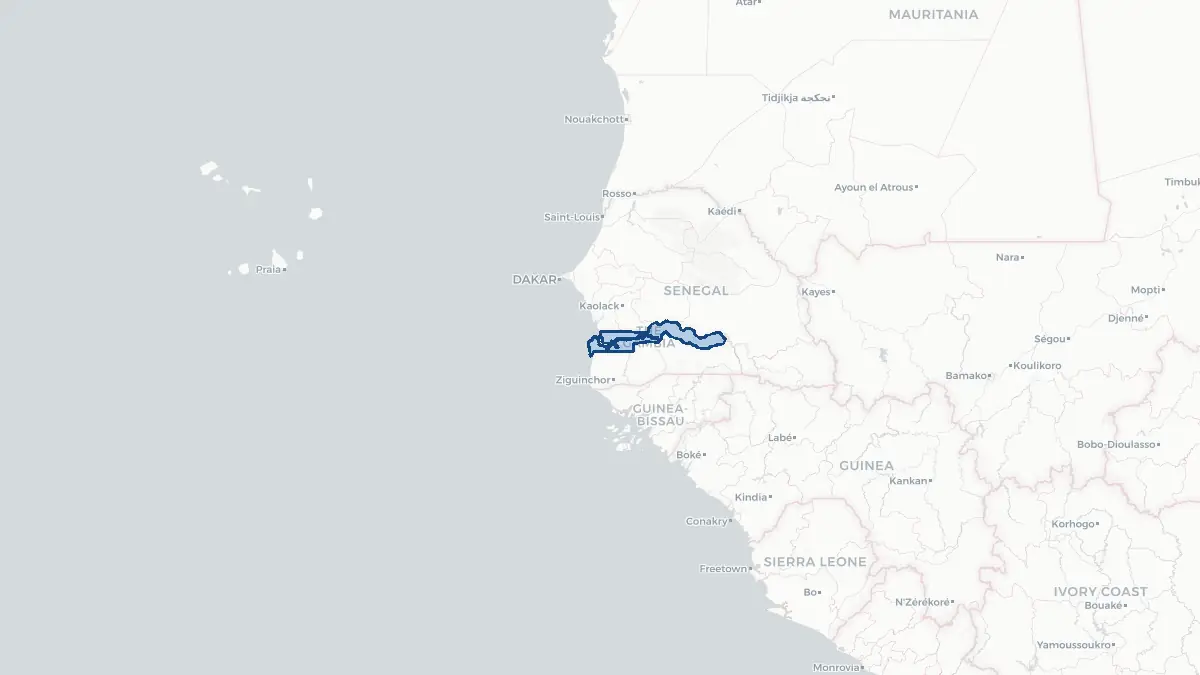
Here you find a map of Gambia, capital Banjul, currency Dalasi and quick links to more facts about the country in Africa.
About the country
Gambia on the map
About Gambia
The Gambia is the smallest country on mainland Africa, a narrow sliver of territory no wider than 50 kilometres that follows the Gambia River inland from the Atlantic coast for roughly 320 kilometres, almost entirely surrounded by Senegal. Its capital is Banjul, though the greater metropolitan area centred on Serekunda is far larger, and the total population stands at around 2.7 million. The Gambia is a predominantly Muslim country with a rich diversity of ethnic groups, including the Mandinka, Fula, Wolof, Jola, and Serahule. English is the official language. The economy depends heavily on tourism, groundnut exports, remittances, and subsistence agriculture. The country gained independence from Britain on 18 February 1965 and joined Senegal in the short-lived Senegambia Confederation from 1982 to 1989. From 1994 to 2017, The Gambia was ruled by Yahya Jammeh, whose authoritarian government was marked by human rights abuses. Following his defeat in the 2016 presidential election, Jammeh eventually went into exile and Adama Barrow assumed the presidency, steering the country toward democratic reform.
Geography and Landscape
The Gambia's extraordinary geography is defined almost entirely by the Gambia River, one of West Africa's most navigable waterways. The river rises in the Fouta Djallon highlands of Guinea and flows westward for approximately 1,120 kilometres before emptying into the Atlantic Ocean at Banjul. The country itself extends along roughly 320 kilometres of the river's lower course, bordered north and south by Senegalese territory. The terrain is low-lying, rarely rising above 50 metres, and consists chiefly of riverine floodplains, tidal creeks, mangrove swamps near the coast, and wooded savanna inland. The climate is tropical, characterised by a distinct wet season from June to October, driven by the West African monsoon, and a dry season from November to May when the dry Harmattan wind blows from the Sahara. Annual rainfall averages around 1,000 millimetres near the coast and decreases inland. The river supports rich fisheries and wetlands that attract migratory birds in great numbers, making parts of The Gambia notable for ecotourism.
History
The Gambia River valley was home to several successive empires and trading states. The Mali Empire held sway over the region in the thirteenth and fourteenth centuries, followed by the Wolof and Mandinka kingdoms. Portuguese explorers reached the river mouth in 1455, and European interest in the region grew as the transatlantic slave trade expanded. Britain and France competed for control of the river throughout the seventeenth and eighteenth centuries. Britain established Fort James on an island in the river in 1661 and eventually consolidated control of the region. The Gambia became a British Crown Colony in 1821, one of Britain's smallest and most economically marginal African possessions. Independence came on 18 February 1965, with Dawda Jawara serving as prime minister and later president until 1994. That year, Lieutenant Yahya Jammeh seized power in a bloodless coup and governed for over two decades, becoming increasingly repressive. His surprise electoral defeat in December 2016 to Adama Barrow, and subsequent coerced exile to Equatorial Guinea in January 2017, marked a pivotal democratic transition.
Geo Quiz
Think you know your capitals, flags, and continents? Take the quiz!
Neighbouring countries
Continue to nearby countries
More countries in the same part of the world
Africa index
Open the continent hub for Africa to see the full country list, capitals and frequently asked questions on one page.
Interactive map
Zoomable map of Gambia
Country index
All countries by continent
Jump directly to the right section or keep scrolling.
Africa
58 countries- Algeria
- Angola
- Benin
- Botswana
- Burkina Faso
- Burundi
- Central African Republic
- Djibouti
- Democratic Republic of the Congo
- Egypt
- Equatorial Guinea
- Ivory Coast
- Eritrea
- Ethiopia
- Gabon
- Gambia
- Ghana
- Guinea
- Guinea-Bissau
- Cameroon
- Cape Verde
- Kenya
- Comoros
- Republic of the Congo
- Lesotho
- Liberia
- Libya
- Madagascar
- Malawi
- Mali
- Morocco
- Mauritania
- Mauritius
- Mayotte
- Mozambique
- Namibia
- Niger
- Nigeria
- Reunion
- Rwanda
- Saint Helena
- Sao Tome and Principe
- Senegal
- Seychelles
- Sierra Leone
- Somalia
- Sudan
- Swaziland
- South Africa
- South Sudan
- Tanzania
- Chad
- Togo
- Tunisia
- Uganda
- Western Sahara
- Zambia
- Zimbabwe
Asia
52 countries- Afghanistan
- Armenia
- Azerbaijan
- Bahrain
- Bangladesh
- Bhutan
- British Indian Ocean Territory
- Brunei
- Myanmar
- Philippines
- United Arab Emirates
- Georgia
- Hong Kong
- India
- Indonesia
- Iraq
- Iran
- Israel
- Japan
- Yemen
- Jordan
- Christmas Island
- Cambodia
- Kazakhstan
- China
- Kyrgyzstan
- Cocos Islands
- Kuwait
- Laos
- Lebanon
- Macau
- Malaysia
- Maldives
- Mongolia
- Nepal
- North Korea
- Oman
- Pakistan
- Palestinian Territory
- Qatar
- Saudi Arabia
- Singapore
- Sri Lanka
- South Korea
- Syria
- Tajikistan
- Taiwan
- Thailand
- Turkey
- Turkmenistan
- Uzbekistan
- Vietnam
Europe
53 countries- Albania
- Andorra
- Belgium
- Bosnia and Herzegovina
- Bulgaria
- Cyprus
- Denmark
- Estonia
- Finland
- France
- Faroe Islands
- Gibraltar
- Greece
- Guernsey
- Ireland
- Iceland
- Isle of Man
- Italy
- Jersey
- Kosovo
- Croatia
- Latvia
- Liechtenstein
- Lithuania
- Luxembourg
- Macedonia
- Malta
- Moldova
- Monaco
- Montenegro
- Netherlands
- Norway
- Poland
- Portugal
- Romania
- Russia
- San Marino
- Switzerland
- Serbia
- Slovakia
- Slovenia
- Spain
- United Kingdom
- Svalbard and Jan Mayen
- Sweden
- Czech Republic
- Germany
- Ukraine
- Hungary
- Vatican
- Belarus
- Aland Islands
- Austria
North America
42 countries- U.S. Virgin Islands
- Anguilla
- Antigua and Barbuda
- Aruba
- Bahamas
- Barbados
- Belize
- Bermuda
- Bonaire, Saint Eustatius and Saba
- British Virgin Islands
- Cayman Islands
- Costa Rica
- Curacao
- Dominica
- Dominican Republic
- El Salvador
- Grenada
- Greenland
- Guadeloupe
- Guatemala
- Haiti
- Honduras
- Jamaica
- Canada
- Cuba
- Martinique
- Mexico
- Montserrat
- Netherlands Antilles
- Nicaragua
- Panama
- Puerto Rico
- Saint Barthelemy
- Saint Kitts and Nevis
- Saint Lucia
- Saint Martin
- Saint Vincent and the Grenadines
- Saint Pierre and Miquelon
- Sint Maarten
- Trinidad and Tobago
- Turks and Caicos Islands
- United States
South America
14 countriesOceania
27 countries- American Samoa
- Australia
- Cook Islands
- Fiji
- French Polynesia
- United States Minor Outlying Islands
- Guam
- Kiribati
- Marshall Islands
- Micronesia
- Nauru
- Niue
- Northern Mariana Islands
- Norfolk Island
- New Caledonia
- New Zealand
- Palau
- Papua New Guinea
- Pitcairn
- Solomon Islands
- Samoa
- Tokelau
- Tonga
- Tuvalu
- Vanuatu
- Wallis and Futuna
- East Timor