
Africa
Mali — map and facts
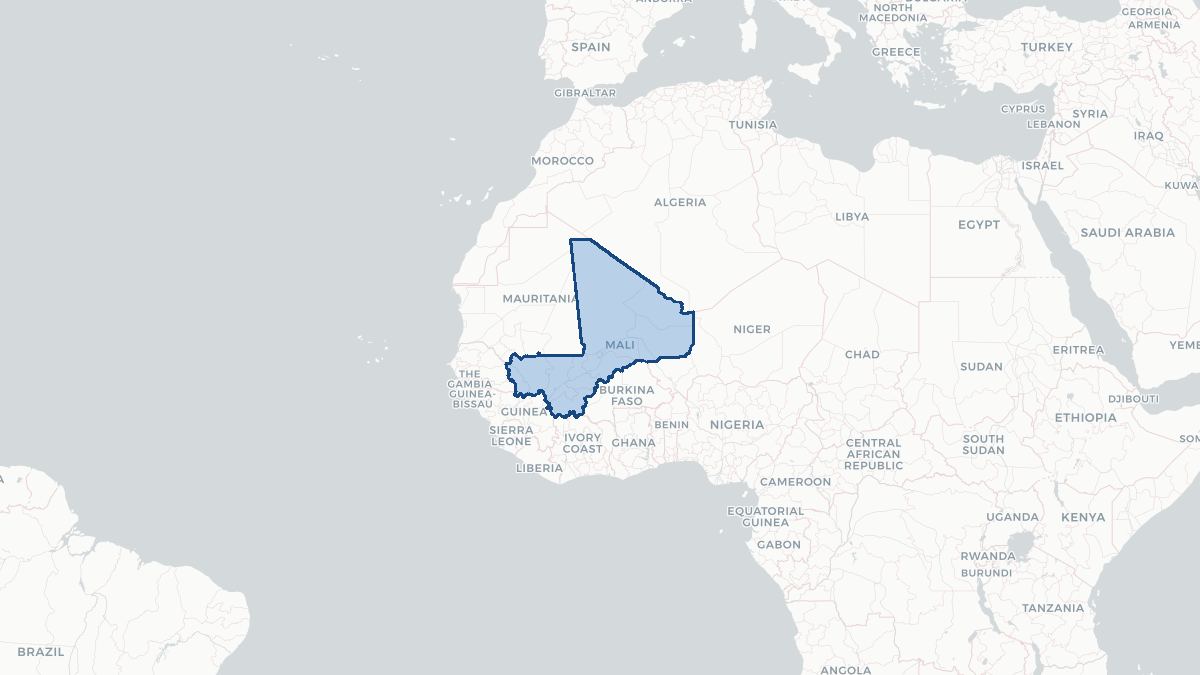
Here you find a map of Mali, capital Bamako, currency Franc and quick links to more facts about the country in Africa.
Mini-quiz
Test yourself: 3 questions about Mali
About the country
Mali on the map
About Mali
Mali is a vast landlocked country in West Africa, with a population of approximately 23 million. The capital and largest city is Bamako, situated on the Niger River in the southwest. French is the official language, though Bambara and dozens of other indigenous languages are widely spoken. Once the heart of medieval empires that controlled trans-Saharan trade, Mali is today one of the world's poorest countries, grappling with entrenched poverty, desertification, and a severe security crisis. Since 2012, the northern and central regions have been destabilized by Tuareg rebellions, jihadist insurgencies linked to al-Qaeda and the Islamic State, and intercommunal violence. Two military coups occurred in 2020 and 2021, bringing Colonel Assimi Goïta to power. The junta government has expelled French and UN peacekeeping forces, pivoting toward Russia for security partnerships. Gold, cotton, and livestock are significant exports, though violence has severely disrupted the economy and displaced millions of people.
Geography and Landscape
Mali covers approximately 1.24 million square kilometres, making it one of the largest countries in Africa. The landscape can be broadly divided into three zones. The southern and most populated region has a Sudanian savanna climate with reliable rainfall and the Niger and Bani rivers flowing through, creating fertile floodplains known as the Inner Niger Delta — a vast wetland of extraordinary ecological importance. The central zone is semi-arid Sahel, a transitional belt of scrub and grassland prone to drought. The northern two-thirds of the country is occupied by the Sahara Desert, featuring the Adrar des Ifoghas plateau and reaching into the Tanezrouft, one of the most desolate places on Earth. The Niger River enters Mali from Guinea in the southwest, executes a great northward bend approaching the Sahara before turning southeast toward Niger and Nigeria. The Hombori Tondo, near the town of Hombori, is Mali's highest point at 1,155 metres.
History
Mali's territory was home to the Ghana Empire, which controlled gold and salt trade from around the 6th to 13th centuries. The Mali Empire, founded by Sundiata Keita around 1235, succeeded it and reached its peak under Mansa Musa, whose 1324 pilgrimage to Mecca — accompanied by an enormous retinue bearing vast quantities of gold — famously destabilised gold prices across North Africa and the Middle East. Timbuktu and Djenné became major centres of Islamic scholarship. The Songhai Empire later superseded Mali, controlling much of West Africa until Moroccan forces destroyed it in 1591. French colonial expansion reached the region in the 1880s, and the colony of French Sudan was incorporated into French West Africa. Independence was declared on 22 September 1960 after a brief federation with Senegal collapsed. Modibo Keïta led the First Republic, followed by a series of coups. Democratic reform in 1991 opened a period of multiparty governance, but the 2012 Tuareg rebellion and subsequent jihadist insurgency destabilized the north, triggering further coups.
Questions about Mali
What is the capital of Mali?
Bamako is the capital of Mali.
What currency is used in Mali?
Franc (XOF) is the currency of Mali.
What languages are spoken in Mali?
Languages spoken in Mali: fr-ML,bm.
Which countries border Mali?
Mali borders Senegal, Niger, Algeria, Ivory Coast, Guinea, Mauritania, Burkina Faso.
In which continent is Mali?
Mali is located in Africa.
Neighbouring countries
Continue to nearby countries
More countries in the same part of the world
Africa index
Open the continent hub for Africa to see the full country list, capitals and frequently asked questions on one page.
Interactive map
Zoomable map of Mali
Country index
All countries by continent
Jump directly to the right section or keep scrolling.
Africa
58 countries- Algeria
- Angola
- Benin
- Botswana
- Burkina Faso
- Burundi
- Central African Republic
- Djibouti
- Democratic Republic of the Congo
- Egypt
- Equatorial Guinea
- Ivory Coast
- Eritrea
- Eswatini
- Ethiopia
- Gabon
- Gambia
- Ghana
- Guinea
- Guinea-Bissau
- Cameroon
- Cape Verde
- Kenya
- Comoros
- Republic of the Congo
- Lesotho
- Liberia
- Libya
- Madagascar
- Malawi
- Mali
- Morocco
- Mauritania
- Mauritius
- Mayotte
- Mozambique
- Namibia
- Niger
- Nigeria
- Reunion
- Rwanda
- Saint Helena
- Sao Tome and Principe
- Senegal
- Seychelles
- Sierra Leone
- Somalia
- Sudan
- South Africa
- South Sudan
- Tanzania
- Chad
- Togo
- Tunisia
- Uganda
- Western Sahara
- Zambia
- Zimbabwe
Asia
52 countries- Afghanistan
- Armenia
- Azerbaijan
- Bahrain
- Bangladesh
- Bhutan
- British Indian Ocean Territory
- Brunei
- Philippines
- United Arab Emirates
- Georgia
- Hong Kong
- India
- Indonesia
- Iraq
- Iran
- Israel
- Japan
- Yemen
- Jordan
- Christmas Island
- Cambodia
- Kazakhstan
- China
- Kyrgyzstan
- Cocos Islands
- Kuwait
- Laos
- Lebanon
- Macau
- Malaysia
- Maldives
- Mongolia
- Myanmar
- Nepal
- North Korea
- Oman
- Pakistan
- Palestinian Territory
- Qatar
- Saudi Arabia
- Singapore
- Sri Lanka
- South Korea
- Syria
- Tajikistan
- Taiwan
- Thailand
- Turkey
- Turkmenistan
- Uzbekistan
- Vietnam
Europe
53 countries- Albania
- Andorra
- Belarus
- Belgium
- Bosnia and Herzegovina
- Bulgaria
- Cyprus
- Denmark
- Estonia
- Finland
- France
- Faroe Islands
- Gibraltar
- Greece
- Guernsey
- Ireland
- Iceland
- Isle of Man
- Italy
- Jersey
- Kosovo
- Croatia
- Latvia
- Liechtenstein
- Lithuania
- Luxembourg
- Malta
- Moldova
- Monaco
- Montenegro
- Netherlands
- North Macedonia
- Norway
- Poland
- Portugal
- Romania
- Russia
- San Marino
- Switzerland
- Serbia
- Slovakia
- Slovenia
- Spain
- United Kingdom
- Svalbard and Jan Mayen
- Sweden
- Czech Republic
- Germany
- Ukraine
- Hungary
- Vatican
- Aland Islands
- Austria
North America
42 countries- U.S. Virgin Islands
- Anguilla
- Antigua and Barbuda
- Aruba
- Bahamas
- Barbados
- Belize
- Bermuda
- Bonaire, Saint Eustatius and Saba
- British Virgin Islands
- Cayman Islands
- Costa Rica
- Curacao
- Dominica
- Dominican Republic
- El Salvador
- Grenada
- Greenland
- Guadeloupe
- Guatemala
- Haiti
- Honduras
- Jamaica
- Canada
- Cuba
- Martinique
- Mexico
- Montserrat
- Netherlands Antilles
- Nicaragua
- Panama
- Puerto Rico
- Saint Barthelemy
- Saint Kitts and Nevis
- Saint Lucia
- Saint Martin
- Saint Vincent and the Grenadines
- Saint Pierre and Miquelon
- Sint Maarten
- Trinidad and Tobago
- Turks and Caicos Islands
- United States
South America
14 countriesOceania
27 countries- American Samoa
- Australia
- Cook Islands
- Fiji
- French Polynesia
- United States Minor Outlying Islands
- Guam
- Kiribati
- Marshall Islands
- Micronesia
- Nauru
- Niue
- Northern Mariana Islands
- Norfolk Island
- New Caledonia
- New Zealand
- Palau
- Papua New Guinea
- Pitcairn
- Solomon Islands
- Samoa
- Tokelau
- Tonga
- Tuvalu
- Vanuatu
- Wallis and Futuna
- East Timor