
Asia
Kyrgyzstan — map and facts
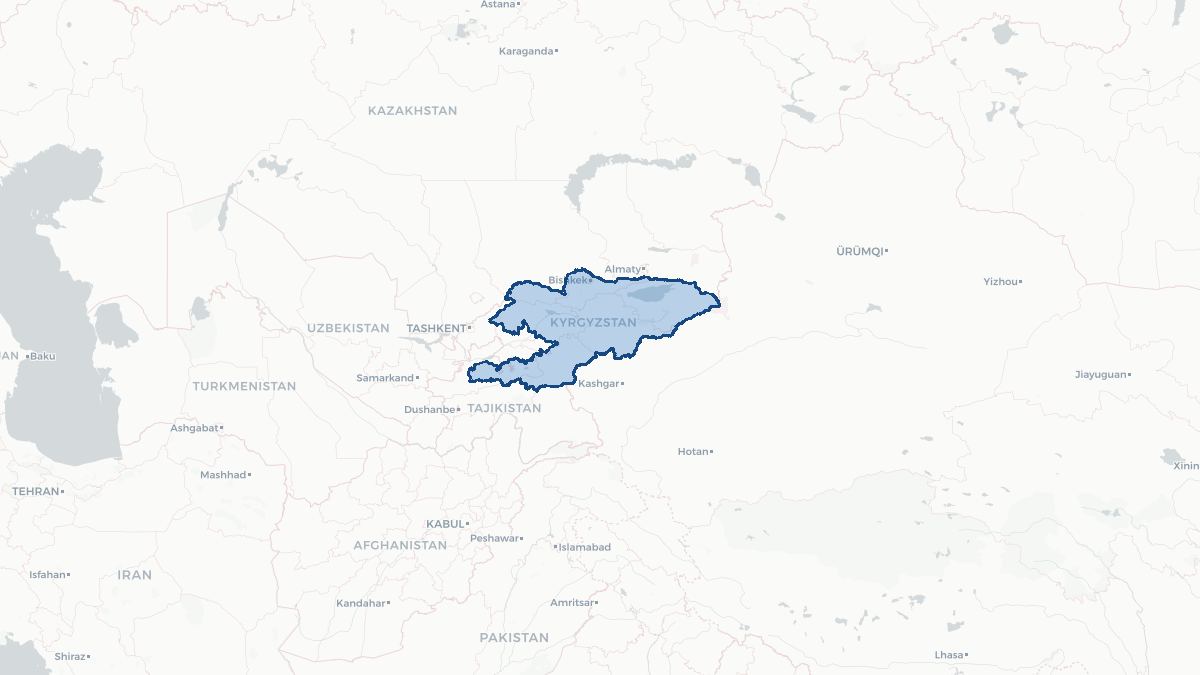
Here you find a map of Kyrgyzstan, capital Bishkek, currency kirgizistansk som and quick links to more facts about the country in Asia.
Mini-quiz
Test yourself: 3 questions about Kyrgyzstan
About the country
Kyrgyzstan on the map
About Kyrgyzstan
Kyrgyzstan is a landlocked republic in Central Asia with a population of approximately 7 million people. Bishkek is the capital and largest city. The country is a presidential republic, though it has experienced significant political turbulence since independence, including three revolutions in 2005, 2010, and 2020 that each resulted in the ousting of the incumbent president. Sadyr Japarov has served as president since 2021. The economy is small and remains heavily dependent on gold mining, agriculture, and remittances from Kyrgyz citizens working abroad, particularly in Russia. The Kumtor gold mine has been one of the single largest contributors to the national economy. Kyrgyzstan is among the poorer countries in the post-Soviet space, with significant rural poverty. Kyrgyz and Russian are both official languages. The country is a member of the Eurasian Economic Union and hosts Russian and formerly American military installations. Islam is the predominant religion.
Geography and Landscape
Kyrgyzstan is one of the most mountainous countries in the world, with over 90 percent of its territory lying above 1,500 metres. The country is located in the heart of the Tian Shan mountain system, which dominates the landscape entirely. The highest peak, Jengish Chokusu (formerly Victory Peak or Pik Pobedy), reaches 7,439 metres on the border with China, while Khan Tengri on the Kazakh border reaches 6,995 metres. The Fergana Valley in the southwest, shared with Uzbekistan and Tajikistan, is the most densely populated and agriculturally productive area. Issyk-Kul, one of the world's largest alpine lakes, lies in the northeast at approximately 1,607 metres elevation and does not freeze despite its altitude, a phenomenon related to its depth and slight salinity. The Naryn River, a major tributary of the Syr Darya, flows through the country. The climate varies dramatically with altitude, from continental semi-arid in the valleys to alpine and subarctic in the high mountains.
History
The territory of modern Kyrgyzstan has been inhabited since ancient times, with evidence of human settlement dating back thousands of years. The Kyrgyz people are a Turkic people whose historical homeland is considered to be in the region of the Yenisei River in Siberia; they migrated gradually southward over centuries, reaching the Tian Shan by around the fifteenth to sixteenth centuries. The Manas Epic, a monumental oral literary tradition considered the world's longest epic poem, is central to Kyrgyz cultural identity. The region was successively dominated by the Mongol Empire, the Chagatai Khanate, and the Kokand Khanate before Russian imperial forces conquered the area between the 1850s and 1870s. Soviet power was established after significant resistance, including a major uprising in 1916 against Russian mobilisation orders and subsequent revolts in the 1920s. The Kirghiz Soviet Socialist Republic was established in 1936. Soviet collectivisation disrupted traditional nomadic pastoralism profoundly. Kyrgyzstan declared independence on 31 August 1991 as the USSR dissolved.
Questions about Kyrgyzstan
What is the capital of Kyrgyzstan?
Bishkek is the capital of Kyrgyzstan.
What currency is used in Kyrgyzstan?
Som (KGS) is the currency of Kyrgyzstan.
What languages are spoken in Kyrgyzstan?
Languages spoken in Kyrgyzstan: ky,uz,ru.
Which countries border Kyrgyzstan?
Kyrgyzstan borders China, Tajikistan, Uzbekistan, Kazakhstan.
In which continent is Kyrgyzstan?
Kyrgyzstan is located in Asia.
Neighbouring countries
Continue to nearby countries
More countries in the same part of the world
Asia index
Open the continent hub for Asia to see the full country list, capitals and frequently asked questions on one page.
Interactive map
Zoomable map of Kyrgyzstan
Country index
All countries by continent
Jump directly to the right section or keep scrolling.
Africa
58 countries- Algeria
- Angola
- Benin
- Botswana
- Burkina Faso
- Burundi
- Central African Republic
- Djibouti
- Democratic Republic of the Congo
- Egypt
- Equatorial Guinea
- Ivory Coast
- Eritrea
- Eswatini
- Ethiopia
- Gabon
- Gambia
- Ghana
- Guinea
- Guinea-Bissau
- Cameroon
- Cape Verde
- Kenya
- Comoros
- Republic of the Congo
- Lesotho
- Liberia
- Libya
- Madagascar
- Malawi
- Mali
- Morocco
- Mauritania
- Mauritius
- Mayotte
- Mozambique
- Namibia
- Niger
- Nigeria
- Reunion
- Rwanda
- Saint Helena
- Sao Tome and Principe
- Senegal
- Seychelles
- Sierra Leone
- Somalia
- Sudan
- South Africa
- South Sudan
- Tanzania
- Chad
- Togo
- Tunisia
- Uganda
- Western Sahara
- Zambia
- Zimbabwe
Asia
52 countries- Afghanistan
- Armenia
- Azerbaijan
- Bahrain
- Bangladesh
- Bhutan
- British Indian Ocean Territory
- Brunei
- Philippines
- United Arab Emirates
- Georgia
- Hong Kong
- India
- Indonesia
- Iraq
- Iran
- Israel
- Japan
- Yemen
- Jordan
- Christmas Island
- Cambodia
- Kazakhstan
- China
- Kyrgyzstan
- Cocos Islands
- Kuwait
- Laos
- Lebanon
- Macau
- Malaysia
- Maldives
- Mongolia
- Myanmar
- Nepal
- North Korea
- Oman
- Pakistan
- Palestinian Territory
- Qatar
- Saudi Arabia
- Singapore
- Sri Lanka
- South Korea
- Syria
- Tajikistan
- Taiwan
- Thailand
- Turkey
- Turkmenistan
- Uzbekistan
- Vietnam
Europe
53 countries- Albania
- Andorra
- Belarus
- Belgium
- Bosnia and Herzegovina
- Bulgaria
- Cyprus
- Denmark
- Estonia
- Finland
- France
- Faroe Islands
- Gibraltar
- Greece
- Guernsey
- Ireland
- Iceland
- Isle of Man
- Italy
- Jersey
- Kosovo
- Croatia
- Latvia
- Liechtenstein
- Lithuania
- Luxembourg
- Malta
- Moldova
- Monaco
- Montenegro
- Netherlands
- North Macedonia
- Norway
- Poland
- Portugal
- Romania
- Russia
- San Marino
- Switzerland
- Serbia
- Slovakia
- Slovenia
- Spain
- United Kingdom
- Svalbard and Jan Mayen
- Sweden
- Czech Republic
- Germany
- Ukraine
- Hungary
- Vatican
- Aland Islands
- Austria
North America
42 countries- U.S. Virgin Islands
- Anguilla
- Antigua and Barbuda
- Aruba
- Bahamas
- Barbados
- Belize
- Bermuda
- Bonaire, Saint Eustatius and Saba
- British Virgin Islands
- Cayman Islands
- Costa Rica
- Curacao
- Dominica
- Dominican Republic
- El Salvador
- Grenada
- Greenland
- Guadeloupe
- Guatemala
- Haiti
- Honduras
- Jamaica
- Canada
- Cuba
- Martinique
- Mexico
- Montserrat
- Netherlands Antilles
- Nicaragua
- Panama
- Puerto Rico
- Saint Barthelemy
- Saint Kitts and Nevis
- Saint Lucia
- Saint Martin
- Saint Vincent and the Grenadines
- Saint Pierre and Miquelon
- Sint Maarten
- Trinidad and Tobago
- Turks and Caicos Islands
- United States
South America
14 countriesOceania
27 countries- American Samoa
- Australia
- Cook Islands
- Fiji
- French Polynesia
- United States Minor Outlying Islands
- Guam
- Kiribati
- Marshall Islands
- Micronesia
- Nauru
- Niue
- Northern Mariana Islands
- Norfolk Island
- New Caledonia
- New Zealand
- Palau
- Papua New Guinea
- Pitcairn
- Solomon Islands
- Samoa
- Tokelau
- Tonga
- Tuvalu
- Vanuatu
- Wallis and Futuna
- East Timor