
North America
Turks and Caicos Islands — map and facts
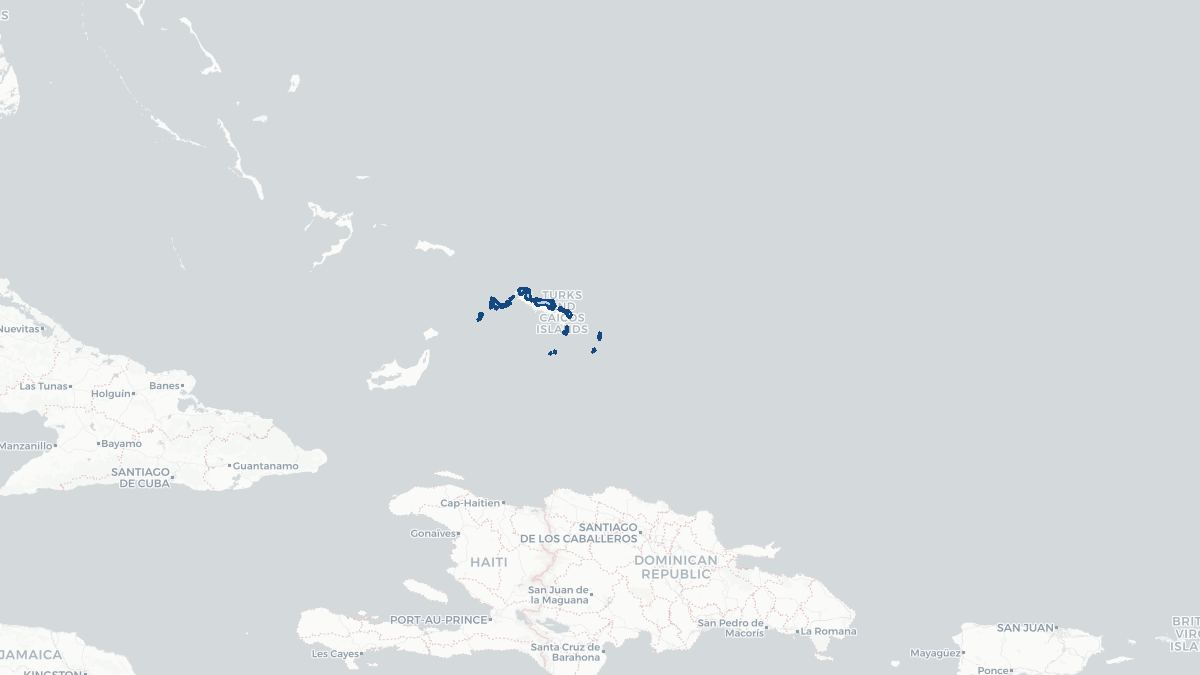
Here you find a map of Turks and Caicos Islands, capital Cockburn Town, currency US Dollar and quick links to more facts about the country in North America.
Mini-quiz
Test yourself: 3 questions about Turks and Caicos Islands
About the country
Turks and Caicos Islands on the map
About Turks and Caicos Islands
The Turks and Caicos Islands is a British Overseas Territory located in the Atlantic Ocean, southeast of the Bahamas and north of Hispaniola. The capital is Cockburn Town on Grand Turk island, while the economic and commercial hub is Providenciales, commonly known as "Provo." The population is approximately 45,000, a diverse mix of indigenous Belongers, Haitian migrants, and residents from North America and the United Kingdom attracted by the financial services sector and tourism industry. The territory is governed by an appointed Governor representing the British Crown, alongside an elected House of Assembly and Premier. The economy is largely driven by tourism—anchored by Providenciales' Grace Bay, consistently ranked among the world's finest beaches—and offshore financial services, including banking and insurance. The islands use the U.S. dollar as their currency. There is a long-standing aspiration among some residents for closer ties with or accession to the Bahamas.
Geography and Landscape
The Turks and Caicos Islands comprise two island groups separated by the Columbus Passage. The Turks Islands—Grand Turk and Salt Cay—lie to the east and are relatively small, flat, and arid. The larger Caicos Islands group to the west includes Providenciales, North Caicos, Middle Caicos, East Caicos, South Caicos, and West Caicos. The islands are predominantly low-lying coral and limestone, rarely exceeding 50 metres in elevation. They are surrounded by shallow turquoise banks and some of the most extensive coral reef systems in the Atlantic, including the third-longest barrier reef in the world. The total land area is approximately 948 square kilometres. The climate is subtropical, warm and dry, moderated by trade winds, with hurricane season from June to November posing a periodic threat.
History
Archaeological evidence suggests the islands were inhabited by the Lucayan people (a Taíno subgroup) before European contact. Columbus may have made his first Caribbean landfall near Grand Turk in 1492, though this remains debated. The Lucayans were wiped out within decades of European arrival through enslavement and disease. Salt production attracted settlers from Bermuda in the late 17th century, and the islands became a contested territory between Britain, France, and Spain. Britain formally claimed the territory in the 18th century; it was administered variously from the Bahamas and Jamaica before becoming a separate Crown Colony. The abolition of slavery ended the plantation economy. Cotton was briefly important, followed by salt extraction and sponging. The modern economy began to emerge in the latter 20th century with the development of tourism and offshore finance. A period of direct British rule from 2009 to 2012 was imposed following corruption allegations against the local government.
Questions about Turks and Caicos Islands
What is the capital of Turks and Caicos Islands?
Cockburn Town is the capital of Turks and Caicos Islands.
What currency is used in Turks and Caicos Islands?
Dollar (USD) is the currency of Turks and Caicos Islands.
What languages are spoken in Turks and Caicos Islands?
Languages spoken in Turks and Caicos Islands: en-TC.
In which continent is Turks and Caicos Islands?
Turks and Caicos Islands is located in North America.
Neighbouring countries
Continue to nearby countries
There are no registered neighbouring countries for Turks and Caicos Islands in the current database.
More countries in the same part of the world
North America index
Open the continent hub for North America to see the full country list, capitals and frequently asked questions on one page.
Interactive map
Zoomable map of Turks and Caicos Islands
Country index
All countries by continent
Jump directly to the right section or keep scrolling.
Africa
58 countries- Algeria
- Angola
- Benin
- Botswana
- Burkina Faso
- Burundi
- Central African Republic
- Djibouti
- Democratic Republic of the Congo
- Egypt
- Equatorial Guinea
- Ivory Coast
- Eritrea
- Eswatini
- Ethiopia
- Gabon
- Gambia
- Ghana
- Guinea
- Guinea-Bissau
- Cameroon
- Cape Verde
- Kenya
- Comoros
- Republic of the Congo
- Lesotho
- Liberia
- Libya
- Madagascar
- Malawi
- Mali
- Morocco
- Mauritania
- Mauritius
- Mayotte
- Mozambique
- Namibia
- Niger
- Nigeria
- Reunion
- Rwanda
- Saint Helena
- Sao Tome and Principe
- Senegal
- Seychelles
- Sierra Leone
- Somalia
- Sudan
- South Africa
- South Sudan
- Tanzania
- Chad
- Togo
- Tunisia
- Uganda
- Western Sahara
- Zambia
- Zimbabwe
Asia
52 countries- Afghanistan
- Armenia
- Azerbaijan
- Bahrain
- Bangladesh
- Bhutan
- British Indian Ocean Territory
- Brunei
- Philippines
- United Arab Emirates
- Georgia
- Hong Kong
- India
- Indonesia
- Iraq
- Iran
- Israel
- Japan
- Yemen
- Jordan
- Christmas Island
- Cambodia
- Kazakhstan
- China
- Kyrgyzstan
- Cocos Islands
- Kuwait
- Laos
- Lebanon
- Macau
- Malaysia
- Maldives
- Mongolia
- Myanmar
- Nepal
- North Korea
- Oman
- Pakistan
- Palestinian Territory
- Qatar
- Saudi Arabia
- Singapore
- Sri Lanka
- South Korea
- Syria
- Tajikistan
- Taiwan
- Thailand
- Turkey
- Turkmenistan
- Uzbekistan
- Vietnam
Europe
53 countries- Albania
- Andorra
- Belarus
- Belgium
- Bosnia and Herzegovina
- Bulgaria
- Cyprus
- Denmark
- Estonia
- Finland
- France
- Faroe Islands
- Gibraltar
- Greece
- Guernsey
- Ireland
- Iceland
- Isle of Man
- Italy
- Jersey
- Kosovo
- Croatia
- Latvia
- Liechtenstein
- Lithuania
- Luxembourg
- Malta
- Moldova
- Monaco
- Montenegro
- Netherlands
- North Macedonia
- Norway
- Poland
- Portugal
- Romania
- Russia
- San Marino
- Switzerland
- Serbia
- Slovakia
- Slovenia
- Spain
- United Kingdom
- Svalbard and Jan Mayen
- Sweden
- Czech Republic
- Germany
- Ukraine
- Hungary
- Vatican
- Aland Islands
- Austria
North America
42 countries- U.S. Virgin Islands
- Anguilla
- Antigua and Barbuda
- Aruba
- Bahamas
- Barbados
- Belize
- Bermuda
- Bonaire, Saint Eustatius and Saba
- British Virgin Islands
- Cayman Islands
- Costa Rica
- Curacao
- Dominica
- Dominican Republic
- El Salvador
- Grenada
- Greenland
- Guadeloupe
- Guatemala
- Haiti
- Honduras
- Jamaica
- Canada
- Cuba
- Martinique
- Mexico
- Montserrat
- Netherlands Antilles
- Nicaragua
- Panama
- Puerto Rico
- Saint Barthelemy
- Saint Kitts and Nevis
- Saint Lucia
- Saint Martin
- Saint Vincent and the Grenadines
- Saint Pierre and Miquelon
- Sint Maarten
- Trinidad and Tobago
- Turks and Caicos Islands
- United States
South America
14 countriesOceania
27 countries- American Samoa
- Australia
- Cook Islands
- Fiji
- French Polynesia
- United States Minor Outlying Islands
- Guam
- Kiribati
- Marshall Islands
- Micronesia
- Nauru
- Niue
- Northern Mariana Islands
- Norfolk Island
- New Caledonia
- New Zealand
- Palau
- Papua New Guinea
- Pitcairn
- Solomon Islands
- Samoa
- Tokelau
- Tonga
- Tuvalu
- Vanuatu
- Wallis and Futuna
- East Timor