
Europe
Russia — map and facts
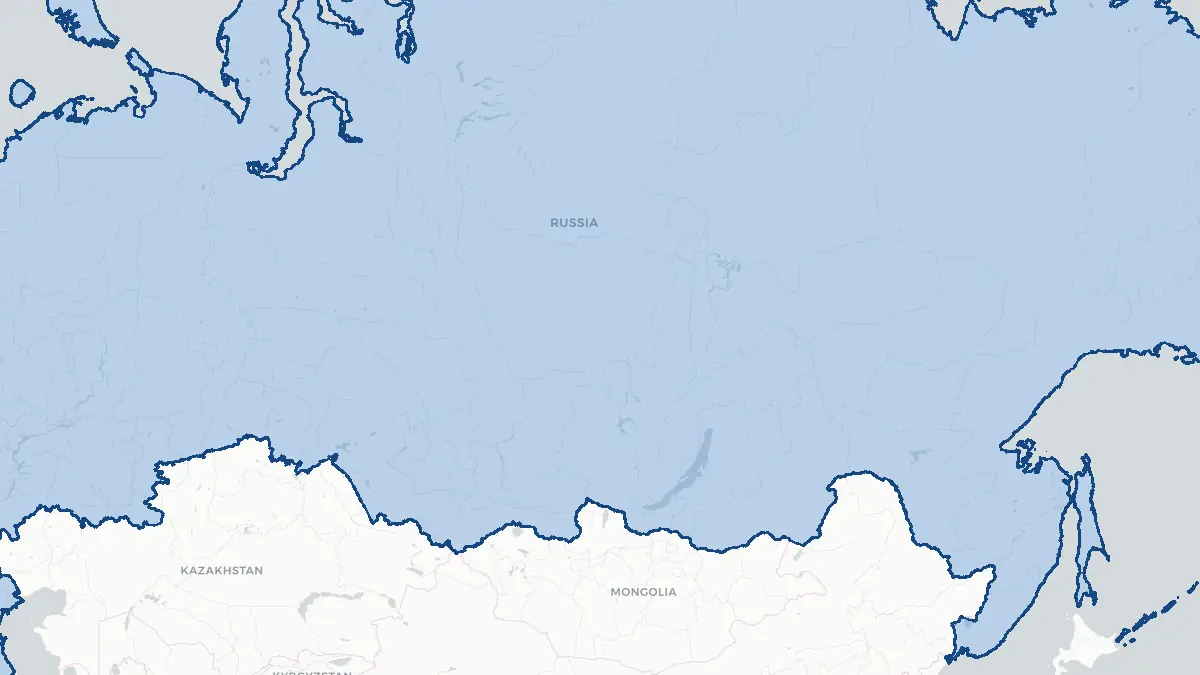
Here you find a map of Russia, capital Moscow, currency Rysk rubel and quick links to more facts about the country in Europe.
About the country
Russia on the map
Russia is the world's largest country by area, spanning eleven time zones from Eastern Europe to the Pacific coast of Asia. Covering over 17 million km², Russia encompasses an extraordinary range of landscapes, climates, and cultures. The capital is Moscow, Europe's most populous city. The currency is the Russian ruble (RUB). Russia is a permanent member of the UN Security Council and one of the world's major nuclear and energy powers.
About Russia
Russia, officially the Russian Federation, is a federal semi-presidential republic in northern Eurasia. It is the world's largest country, covering approximately 11% of the Earth's total land surface. Russia shares borders with 14 countries, including Norway and Finland to the north-west, Belarus and Ukraine to the west, Kazakhstan, China, and Mongolia to the south, and is separated from the United States (Alaska) by the Bering Strait to the east.
Geography and landscape
Russia spans approximately 17.1 million km² across both Europe and Asia. The Ural Mountains form the traditional boundary between the two continents. The European part contains the North European Plain and the Volga River (Europe's longest, at 3,531 km). The vast Siberian plain extends east of the Urals, drained by major rivers including the Ob, the Yenisei, and the Lena. Lake Baikal in eastern Siberia is the world's deepest lake and holds roughly 20% of the world's unfrozen fresh water. Permafrost covers about 60% of the country's land area.
History
Slavic peoples have inhabited the region for over 1,500 years. The Kievan Rus, established in the 9th century, is considered the predecessor state of Russia, Ukraine, and Belarus. Ivan the Terrible became the first Tsar in 1547. The Romanov dynasty ruled from 1613 until the Russian Revolution of 1917, which led to the creation of the Soviet Union (USSR) in 1922. The USSR became a global superpower; the Soviet Union's losses in the Second World War exceeded 25 million. The Soviet Union collapsed in 1991, and Russia emerged as an independent state.
Economy and currency
Russia's economy is heavily dependent on natural resources — oil and natural gas account for a large share of export revenues. Russia is the world's second largest natural gas producer and one of the top three oil producers. Other significant sectors include metals and mining, defence industry, agriculture, and nuclear technology. The Russian ruble (RUB) is the national currency.
Culture and language
Russian is the official language and the world's eighth most spoken language. Russia's cultural heritage spans literature (Tolstoy, Dostoevsky, Chekhov, Pushkin), music (Tchaikovsky, Stravinsky, Rachmaninoff), ballet (Bolshoi, Mariinsky), visual arts, and theatre. The Russian Orthodox Church has been central to culture and national identity for over a millennium. Ice hockey and football are the dominant sports.
Frequently asked questions
What is the capital of Russia? Moscow, the largest city in Russia and in Europe.
What currency does Russia use? The Russian ruble (RUB).
How large is Russia? Russia covers approximately 17.1 million km² — the world's largest country, nearly twice the size of either the United States or China.
Does Russia span two continents? Yes. Russia spans both Europe and Asia; the Ural Mountains form the conventional dividing line.
What is Lake Baikal? Lake Baikal in Siberia is the world's deepest lake (1,642 m) and holds approximately 20% of the world's unfrozen surface fresh water. It is a UNESCO World Heritage Site.
Geo Quiz
Think you know your capitals, flags, and continents? Take the quiz!
Neighbouring countries
Continue to nearby countries
More countries in the same part of the world
Europe index
Open the continent hub for Europe to see the full country list, capitals and frequently asked questions on one page.
Interactive map
Zoomable map of Russia
Country index
All countries by continent
Jump directly to the right section or keep scrolling.
Africa
58 countries- Algeria
- Angola
- Benin
- Botswana
- Burkina Faso
- Burundi
- Central African Republic
- Djibouti
- Democratic Republic of the Congo
- Egypt
- Equatorial Guinea
- Ivory Coast
- Eritrea
- Ethiopia
- Gabon
- Gambia
- Ghana
- Guinea
- Guinea-Bissau
- Cameroon
- Cape Verde
- Kenya
- Comoros
- Republic of the Congo
- Lesotho
- Liberia
- Libya
- Madagascar
- Malawi
- Mali
- Morocco
- Mauritania
- Mauritius
- Mayotte
- Mozambique
- Namibia
- Niger
- Nigeria
- Reunion
- Rwanda
- Saint Helena
- Sao Tome and Principe
- Senegal
- Seychelles
- Sierra Leone
- Somalia
- Sudan
- Swaziland
- South Africa
- South Sudan
- Tanzania
- Chad
- Togo
- Tunisia
- Uganda
- Western Sahara
- Zambia
- Zimbabwe
Asia
52 countries- Afghanistan
- Armenia
- Azerbaijan
- Bahrain
- Bangladesh
- Bhutan
- British Indian Ocean Territory
- Brunei
- Myanmar
- Philippines
- United Arab Emirates
- Georgia
- Hong Kong
- India
- Indonesia
- Iraq
- Iran
- Israel
- Japan
- Yemen
- Jordan
- Christmas Island
- Cambodia
- Kazakhstan
- China
- Kyrgyzstan
- Cocos Islands
- Kuwait
- Laos
- Lebanon
- Macau
- Malaysia
- Maldives
- Mongolia
- Nepal
- North Korea
- Oman
- Pakistan
- Palestinian Territory
- Qatar
- Saudi Arabia
- Singapore
- Sri Lanka
- South Korea
- Syria
- Tajikistan
- Taiwan
- Thailand
- Turkey
- Turkmenistan
- Uzbekistan
- Vietnam
Europe
53 countries- Albania
- Andorra
- Belgium
- Bosnia and Herzegovina
- Bulgaria
- Cyprus
- Denmark
- Estonia
- Finland
- France
- Faroe Islands
- Gibraltar
- Greece
- Guernsey
- Ireland
- Iceland
- Isle of Man
- Italy
- Jersey
- Kosovo
- Croatia
- Latvia
- Liechtenstein
- Lithuania
- Luxembourg
- Macedonia
- Malta
- Moldova
- Monaco
- Montenegro
- Netherlands
- Norway
- Poland
- Portugal
- Romania
- Russia
- San Marino
- Switzerland
- Serbia
- Slovakia
- Slovenia
- Spain
- United Kingdom
- Svalbard and Jan Mayen
- Sweden
- Czech Republic
- Germany
- Ukraine
- Hungary
- Vatican
- Belarus
- Aland Islands
- Austria
North America
42 countries- U.S. Virgin Islands
- Anguilla
- Antigua and Barbuda
- Aruba
- Bahamas
- Barbados
- Belize
- Bermuda
- Bonaire, Saint Eustatius and Saba
- British Virgin Islands
- Cayman Islands
- Costa Rica
- Curacao
- Dominica
- Dominican Republic
- El Salvador
- Grenada
- Greenland
- Guadeloupe
- Guatemala
- Haiti
- Honduras
- Jamaica
- Canada
- Cuba
- Martinique
- Mexico
- Montserrat
- Netherlands Antilles
- Nicaragua
- Panama
- Puerto Rico
- Saint Barthelemy
- Saint Kitts and Nevis
- Saint Lucia
- Saint Martin
- Saint Vincent and the Grenadines
- Saint Pierre and Miquelon
- Sint Maarten
- Trinidad and Tobago
- Turks and Caicos Islands
- United States
South America
14 countriesOceania
27 countries- American Samoa
- Australia
- Cook Islands
- Fiji
- French Polynesia
- United States Minor Outlying Islands
- Guam
- Kiribati
- Marshall Islands
- Micronesia
- Nauru
- Niue
- Northern Mariana Islands
- Norfolk Island
- New Caledonia
- New Zealand
- Palau
- Papua New Guinea
- Pitcairn
- Solomon Islands
- Samoa
- Tokelau
- Tonga
- Tuvalu
- Vanuatu
- Wallis and Futuna
- East Timor