
Africa
Kenya — map and facts
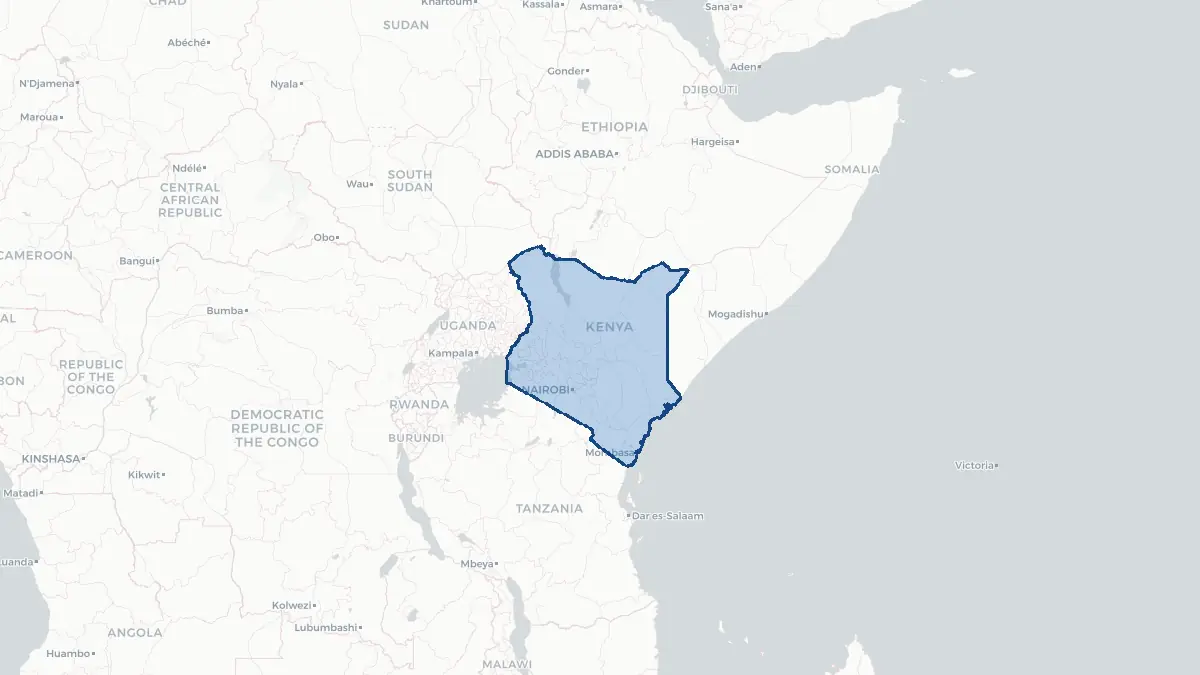
Here you find a map of Kenya, capital Nairobi, currency Shilling and quick links to more facts about the country in Africa.
About the country
Kenya on the map
About Kenya
Kenya is an East African nation straddling the equator, with a population of approximately 56 million people. It is a presidential constitutional republic and one of Africa's most significant economies, with Nairobi serving as both the capital and the continent's leading financial and technology hub—a status reinforced by a thriving startup ecosystem earning the city the nickname "Silicon Savannah." Swahili and English are both official languages, and the country is home to more than 40 distinct ethnic groups, the largest being the Kikuyu, Luhya, Luo, and Kalenjin. Kenya gained independence from Britain in 1963. The economy rests on tourism, tea and coffee exports, horticulture, manufacturing, and a rapidly expanding digital sector. Kenya produces world-class long-distance runners who have dominated global athletics for decades. The country faces challenges including inequality, corruption, unemployment, and periodic ethnic-political tensions, but maintains a vibrant civil society and a free press that are among the strongest in sub-Saharan Africa.
Geography and Landscape
Kenya's geography is extraordinarily varied. The Great Rift Valley bisects the country from north to south, forming a dramatic escarpment landscape with a chain of lakes—including Lake Turkana (the world's largest permanent desert lake), Lake Nakuru, and Lake Naivasha. Mount Kenya (5,199 m) is the country's highest peak and Africa's second-highest mountain, an ancient extinct volcano straddling the equator whose glaciers are rapidly retreating. The Kenyan Highlands to the west of the Rift are fertile, well-watered, and home to the majority of the population. To the east and southeast lie the vast semi-arid and arid lowlands, including the Tsavo plains. The Indian Ocean coastline in the south is characterised by white beaches, coral reefs, and historic Swahili port towns. Lake Victoria—Africa's largest lake and the world's second-largest freshwater lake—borders Kenya in the west. Wildlife-rich savannah parks such as the Masai Mara are globally iconic.
History
Kenya has been home to some of the earliest known hominid fossils, with discoveries around Lake Turkana dating back nearly four million years. Bantu-speaking peoples migrated into the region over two millennia ago, and Nilotic and Cushitic communities also settled various parts of the country. Arab and Persian traders established coastal settlements from the eighth century, and Swahili civilisation flourished along the coast. The Portuguese arrived in the late fifteenth century and were eventually displaced by the Omani Arabs. Britain declared the region the East Africa Protectorate in 1895 and later the Colony of Kenya. The arrival of Indian labourers for the Uganda Railway transformed the demographics of the interior. The Mau Mau uprising (1952–1960), a Kikuyu-led armed resistance against British colonial rule, led to independence on 12 December 1963, with Jomo Kenyatta as the first prime minister and later president. Post-independence history included authoritarian single-party rule under Daniel arap Moi (1978–2002), a transition to multiparty democracy, and a landmark new constitution in 2010.
Geo Quiz
Think you know your capitals, flags, and continents? Take the quiz!
Neighbouring countries
Continue to nearby countries
More countries in the same part of the world
Africa index
Open the continent hub for Africa to see the full country list, capitals and frequently asked questions on one page.
Interactive map
Zoomable map of Kenya
Country index
All countries by continent
Jump directly to the right section or keep scrolling.
Africa
58 countries- Algeria
- Angola
- Benin
- Botswana
- Burkina Faso
- Burundi
- Central African Republic
- Djibouti
- Democratic Republic of the Congo
- Egypt
- Equatorial Guinea
- Ivory Coast
- Eritrea
- Ethiopia
- Gabon
- Gambia
- Ghana
- Guinea
- Guinea-Bissau
- Cameroon
- Cape Verde
- Kenya
- Comoros
- Republic of the Congo
- Lesotho
- Liberia
- Libya
- Madagascar
- Malawi
- Mali
- Morocco
- Mauritania
- Mauritius
- Mayotte
- Mozambique
- Namibia
- Niger
- Nigeria
- Reunion
- Rwanda
- Saint Helena
- Sao Tome and Principe
- Senegal
- Seychelles
- Sierra Leone
- Somalia
- Sudan
- Swaziland
- South Africa
- South Sudan
- Tanzania
- Chad
- Togo
- Tunisia
- Uganda
- Western Sahara
- Zambia
- Zimbabwe
Asia
52 countries- Afghanistan
- Armenia
- Azerbaijan
- Bahrain
- Bangladesh
- Bhutan
- British Indian Ocean Territory
- Brunei
- Myanmar
- Philippines
- United Arab Emirates
- Georgia
- Hong Kong
- India
- Indonesia
- Iraq
- Iran
- Israel
- Japan
- Yemen
- Jordan
- Christmas Island
- Cambodia
- Kazakhstan
- China
- Kyrgyzstan
- Cocos Islands
- Kuwait
- Laos
- Lebanon
- Macau
- Malaysia
- Maldives
- Mongolia
- Nepal
- North Korea
- Oman
- Pakistan
- Palestinian Territory
- Qatar
- Saudi Arabia
- Singapore
- Sri Lanka
- South Korea
- Syria
- Tajikistan
- Taiwan
- Thailand
- Turkey
- Turkmenistan
- Uzbekistan
- Vietnam
Europe
53 countries- Albania
- Andorra
- Belgium
- Bosnia and Herzegovina
- Bulgaria
- Cyprus
- Denmark
- Estonia
- Finland
- France
- Faroe Islands
- Gibraltar
- Greece
- Guernsey
- Ireland
- Iceland
- Isle of Man
- Italy
- Jersey
- Kosovo
- Croatia
- Latvia
- Liechtenstein
- Lithuania
- Luxembourg
- Macedonia
- Malta
- Moldova
- Monaco
- Montenegro
- Netherlands
- Norway
- Poland
- Portugal
- Romania
- Russia
- San Marino
- Switzerland
- Serbia
- Slovakia
- Slovenia
- Spain
- United Kingdom
- Svalbard and Jan Mayen
- Sweden
- Czech Republic
- Germany
- Ukraine
- Hungary
- Vatican
- Belarus
- Aland Islands
- Austria
North America
42 countries- U.S. Virgin Islands
- Anguilla
- Antigua and Barbuda
- Aruba
- Bahamas
- Barbados
- Belize
- Bermuda
- Bonaire, Saint Eustatius and Saba
- British Virgin Islands
- Cayman Islands
- Costa Rica
- Curacao
- Dominica
- Dominican Republic
- El Salvador
- Grenada
- Greenland
- Guadeloupe
- Guatemala
- Haiti
- Honduras
- Jamaica
- Canada
- Cuba
- Martinique
- Mexico
- Montserrat
- Netherlands Antilles
- Nicaragua
- Panama
- Puerto Rico
- Saint Barthelemy
- Saint Kitts and Nevis
- Saint Lucia
- Saint Martin
- Saint Vincent and the Grenadines
- Saint Pierre and Miquelon
- Sint Maarten
- Trinidad and Tobago
- Turks and Caicos Islands
- United States
South America
14 countriesOceania
27 countries- American Samoa
- Australia
- Cook Islands
- Fiji
- French Polynesia
- United States Minor Outlying Islands
- Guam
- Kiribati
- Marshall Islands
- Micronesia
- Nauru
- Niue
- Northern Mariana Islands
- Norfolk Island
- New Caledonia
- New Zealand
- Palau
- Papua New Guinea
- Pitcairn
- Solomon Islands
- Samoa
- Tokelau
- Tonga
- Tuvalu
- Vanuatu
- Wallis and Futuna
- East Timor