
Europe
Latvia — map and facts
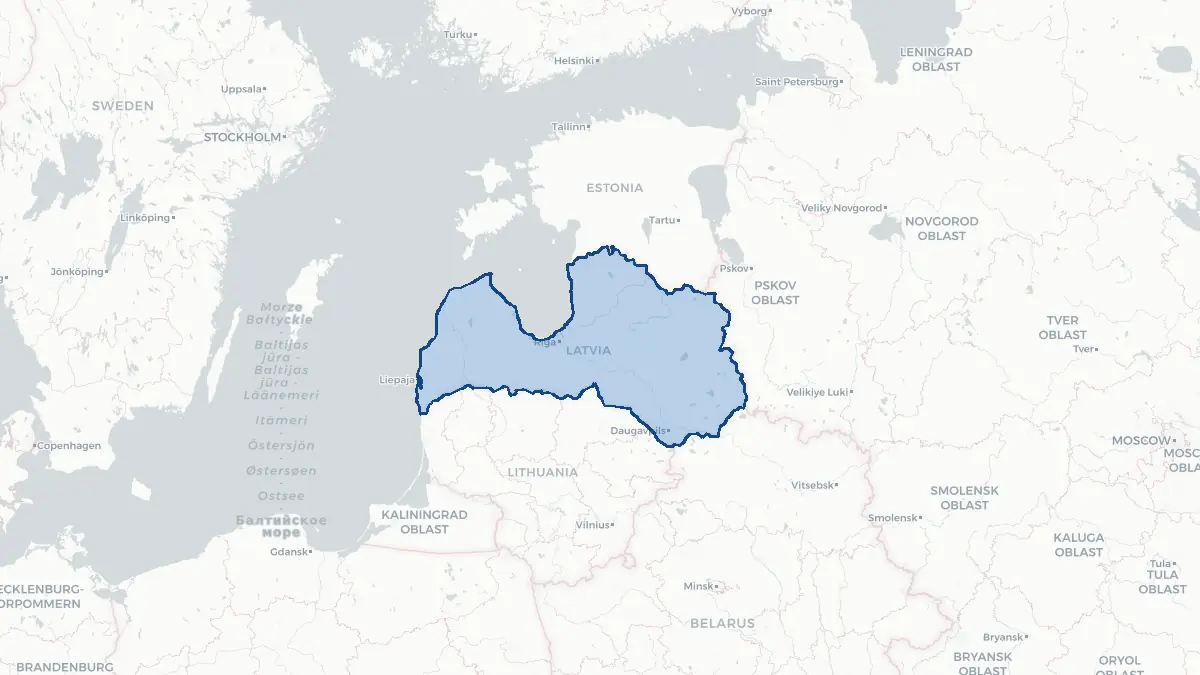
Here you find a map of Latvia, capital Riga, currency Euro and quick links to more facts about the country in Europe.
About the country
Latvia on the map
About Latvia
Latvia is a Baltic state of approximately 1.9 million people in northeastern Europe, bordering Estonia, Russia, Belarus, and Lithuania, with a coastline on the Baltic Sea. Its capital, Riga, is the largest city in the Baltic states and a UNESCO World Heritage Site for its Art Nouveau architecture. Latvia regained independence from the Soviet Union in 1991 and joined both NATO and the EU in 2004. The official language is Latvian, a Baltic language and one of the oldest living Indo-European languages. The country has experienced significant emigration since EU accession, reducing its population. The economy is diversified, with strong logistics, manufacturing, IT, and financial services sectors. Latvia adopted the euro in 2014. The country has a significant Russian-speaking minority, constituting about a quarter of the population, which has been a persistent social and political issue.
Geography and Landscape
Latvia is relatively flat, with gently rolling plains, forests covering over half the territory, and numerous rivers and lakes. The highest point is Gaizi?kalns at just 312 metres. The Daugava (Western Dvina) is the principal river, flowing through Riga. Other major rivers include the Gauja, whose valley forms the Gauja National Park — Latvia's largest. The Baltic coast offers sandy beaches and dunes, with the resort town of J?rmala near Riga among the most popular. Latvia has extensive agricultural land in the south and east. The climate is temperate, influenced by the Baltic Sea: mild summers, cold winters with significant snowfall, and relatively high rainfall. Forests host wolves, lynx, and large populations of deer and elk.
History
The indigenous Baltic tribes — Latvians, Livonians, Latgalians, Selonians, and Semigallians — inhabited the region for millennia. German crusaders of the Livonian Order conquered the territory in the thirteenth century, establishing a German-speaking ruling class that endured for centuries. Sweden and later Poland-Lithuania competed for control, with Sweden eventually dominating in the seventeenth century before Russia absorbed Livonia after the Great Northern War (1710). Latvian national culture blossomed in the nineteenth century through the Song Festival movement (first held 1873). Latvia declared independence in 1918 and maintained it until the Soviet occupation of 1940, followed by German occupation (1941–1944) and Soviet reoccupation. Latvia restored independence on 21 August 1991 through the Singing Revolution and joined NATO and the EU in 2004.
Geo Quiz
Think you know your capitals, flags, and continents? Take the quiz!
Neighbouring countries
Continue to nearby countries
More countries in the same part of the world
Europe index
Open the continent hub for Europe to see the full country list, capitals and frequently asked questions on one page.
Interactive map
Zoomable map of Latvia
Country index
All countries by continent
Jump directly to the right section or keep scrolling.
Africa
58 countries- Algeria
- Angola
- Benin
- Botswana
- Burkina Faso
- Burundi
- Central African Republic
- Djibouti
- Democratic Republic of the Congo
- Egypt
- Equatorial Guinea
- Ivory Coast
- Eritrea
- Ethiopia
- Gabon
- Gambia
- Ghana
- Guinea
- Guinea-Bissau
- Cameroon
- Cape Verde
- Kenya
- Comoros
- Republic of the Congo
- Lesotho
- Liberia
- Libya
- Madagascar
- Malawi
- Mali
- Morocco
- Mauritania
- Mauritius
- Mayotte
- Mozambique
- Namibia
- Niger
- Nigeria
- Reunion
- Rwanda
- Saint Helena
- Sao Tome and Principe
- Senegal
- Seychelles
- Sierra Leone
- Somalia
- Sudan
- Swaziland
- South Africa
- South Sudan
- Tanzania
- Chad
- Togo
- Tunisia
- Uganda
- Western Sahara
- Zambia
- Zimbabwe
Asia
52 countries- Afghanistan
- Armenia
- Azerbaijan
- Bahrain
- Bangladesh
- Bhutan
- British Indian Ocean Territory
- Brunei
- Myanmar
- Philippines
- United Arab Emirates
- Georgia
- Hong Kong
- India
- Indonesia
- Iraq
- Iran
- Israel
- Japan
- Yemen
- Jordan
- Christmas Island
- Cambodia
- Kazakhstan
- China
- Kyrgyzstan
- Cocos Islands
- Kuwait
- Laos
- Lebanon
- Macau
- Malaysia
- Maldives
- Mongolia
- Nepal
- North Korea
- Oman
- Pakistan
- Palestinian Territory
- Qatar
- Saudi Arabia
- Singapore
- Sri Lanka
- South Korea
- Syria
- Tajikistan
- Taiwan
- Thailand
- Turkey
- Turkmenistan
- Uzbekistan
- Vietnam
Europe
53 countries- Albania
- Andorra
- Belgium
- Bosnia and Herzegovina
- Bulgaria
- Cyprus
- Denmark
- Estonia
- Finland
- France
- Faroe Islands
- Gibraltar
- Greece
- Guernsey
- Ireland
- Iceland
- Isle of Man
- Italy
- Jersey
- Kosovo
- Croatia
- Latvia
- Liechtenstein
- Lithuania
- Luxembourg
- Macedonia
- Malta
- Moldova
- Monaco
- Montenegro
- Netherlands
- Norway
- Poland
- Portugal
- Romania
- Russia
- San Marino
- Switzerland
- Serbia
- Slovakia
- Slovenia
- Spain
- United Kingdom
- Svalbard and Jan Mayen
- Sweden
- Czech Republic
- Germany
- Ukraine
- Hungary
- Vatican
- Belarus
- Aland Islands
- Austria
North America
42 countries- U.S. Virgin Islands
- Anguilla
- Antigua and Barbuda
- Aruba
- Bahamas
- Barbados
- Belize
- Bermuda
- Bonaire, Saint Eustatius and Saba
- British Virgin Islands
- Cayman Islands
- Costa Rica
- Curacao
- Dominica
- Dominican Republic
- El Salvador
- Grenada
- Greenland
- Guadeloupe
- Guatemala
- Haiti
- Honduras
- Jamaica
- Canada
- Cuba
- Martinique
- Mexico
- Montserrat
- Netherlands Antilles
- Nicaragua
- Panama
- Puerto Rico
- Saint Barthelemy
- Saint Kitts and Nevis
- Saint Lucia
- Saint Martin
- Saint Vincent and the Grenadines
- Saint Pierre and Miquelon
- Sint Maarten
- Trinidad and Tobago
- Turks and Caicos Islands
- United States
South America
14 countriesOceania
27 countries- American Samoa
- Australia
- Cook Islands
- Fiji
- French Polynesia
- United States Minor Outlying Islands
- Guam
- Kiribati
- Marshall Islands
- Micronesia
- Nauru
- Niue
- Northern Mariana Islands
- Norfolk Island
- New Caledonia
- New Zealand
- Palau
- Papua New Guinea
- Pitcairn
- Solomon Islands
- Samoa
- Tokelau
- Tonga
- Tuvalu
- Vanuatu
- Wallis and Futuna
- East Timor