
Europe
Germany — map and facts
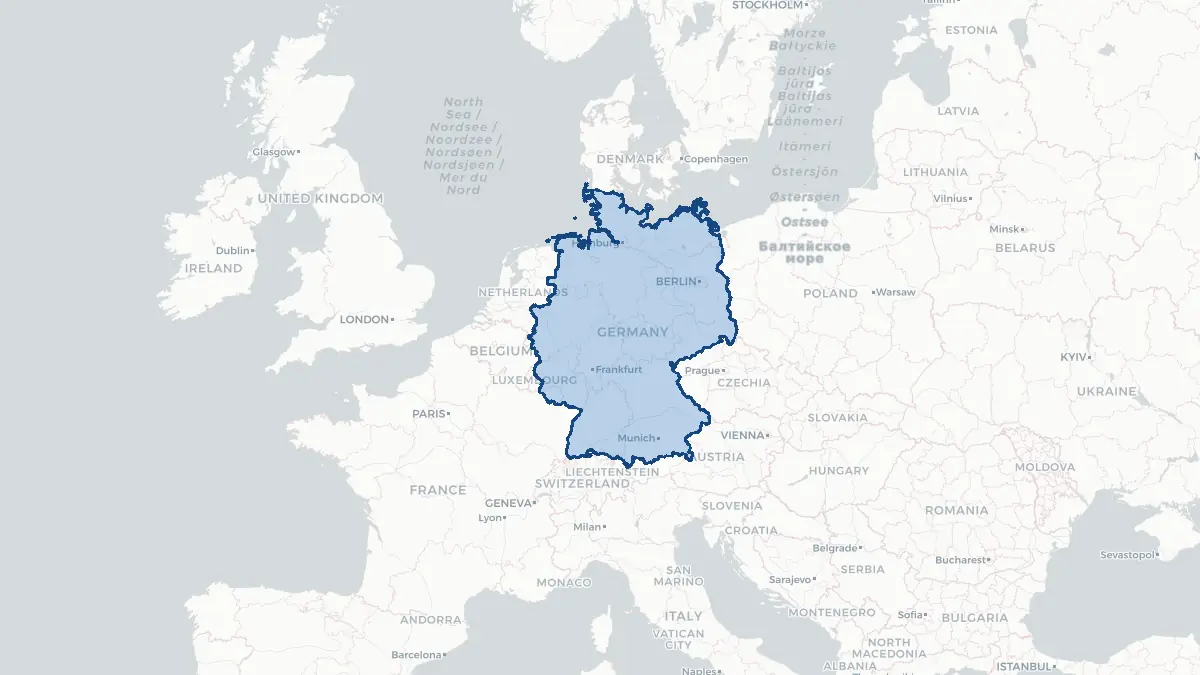
Here you find a map of Germany, capital Berlin, currency Euro and quick links to more facts about the country in Europe.
About the country
Germany on the map
Germany is the most populous country in the European Union and one of the world's leading industrial and economic powers. Its capital is Berlin, and the country covers about 358,000 square kilometres with a population of roughly 84 million. Germany uses the euro as its currency.
About Germany
Germany is a federal republic made up of sixteen states, each with significant autonomy. It sits at the heart of Europe and is a central member of the European Union and NATO. The country is known for engineering, manufacturing and a strong tradition of science and philosophy. Its federal structure gives regional cities such as Munich, Hamburg and Frankfurt distinct identities.
Geography and landscape
Germany lies in Central Europe and borders nine countries: Denmark, Poland, the Czech Republic, Austria, Switzerland, France, Luxembourg, Belgium and the Netherlands. The landscape rises from the North Sea and Baltic coasts and the northern lowlands to central uplands and the Bavarian Alps in the south, where the Zugspitze reaches 2,962 metres. The Rhine, Elbe and Danube are among its major rivers. The climate is temperate, with cool, wet winters and mild to warm summers. Forests such as the Black Forest cover large parts of the country.
History
The region was home to Germanic tribes who resisted Roman expansion, and later formed the core of the Holy Roman Empire. For centuries Germany was a patchwork of states, until Prussia led unification into a single empire in 1871. Defeat in the First World War and the rise of the Nazi regime led to the Second World War and the Holocaust, among the darkest chapters in human history. After 1945 the country was divided into East and West Germany during the Cold War. The Berlin Wall fell in 1989 and Germany was reunified in 1990. It has since become the economic and political anchor of the European Union.
Economy and currency
Germany has the largest economy in Europe, built on manufacturing, automotive production, machinery, chemicals and exports. It is home to global brands and a strong network of specialised medium-sized companies. The currency is the euro, which replaced the German mark in 2002. Frankfurt hosts the European Central Bank.
Culture and language
The official language is German, one of the most widely spoken native languages in Europe. Germany has a rich heritage in classical music, literature and philosophy, from Bach and Beethoven to Goethe and Kant. The country is known for its festivals, including Oktoberfest, and its tradition of Christmas markets. Regional customs, cuisine and dialects vary widely across the federal states.
Frequently asked questions
What is the capital of Germany? The capital of Germany is Berlin, which is also the country's largest city. It became the capital of reunified Germany in 1990.
What currency is used in Germany? Germany uses the euro. It replaced the German mark in 2002, when euro notes and coins entered circulation.
How many countries border Germany? Germany borders nine countries, more than almost any other nation in Europe. They are Denmark, Poland, the Czech Republic, Austria, Switzerland, France, Luxembourg, Belgium and the Netherlands.
Geo Quiz
Think you know your capitals, flags, and continents? Take the quiz!
Neighbouring countries
Continue to nearby countries
More countries in the same part of the world
Europe index
Open the continent hub for Europe to see the full country list, capitals and frequently asked questions on one page.
Interactive map
Zoomable map of Germany
Country index
All countries by continent
Jump directly to the right section or keep scrolling.
Africa
58 countries- Algeria
- Angola
- Benin
- Botswana
- Burkina Faso
- Burundi
- Central African Republic
- Djibouti
- Democratic Republic of the Congo
- Egypt
- Equatorial Guinea
- Ivory Coast
- Eritrea
- Ethiopia
- Gabon
- Gambia
- Ghana
- Guinea
- Guinea-Bissau
- Cameroon
- Cape Verde
- Kenya
- Comoros
- Republic of the Congo
- Lesotho
- Liberia
- Libya
- Madagascar
- Malawi
- Mali
- Morocco
- Mauritania
- Mauritius
- Mayotte
- Mozambique
- Namibia
- Niger
- Nigeria
- Reunion
- Rwanda
- Saint Helena
- Sao Tome and Principe
- Senegal
- Seychelles
- Sierra Leone
- Somalia
- Sudan
- Swaziland
- South Africa
- South Sudan
- Tanzania
- Chad
- Togo
- Tunisia
- Uganda
- Western Sahara
- Zambia
- Zimbabwe
Asia
52 countries- Afghanistan
- Armenia
- Azerbaijan
- Bahrain
- Bangladesh
- Bhutan
- British Indian Ocean Territory
- Brunei
- Myanmar
- Philippines
- United Arab Emirates
- Georgia
- Hong Kong
- India
- Indonesia
- Iraq
- Iran
- Israel
- Japan
- Yemen
- Jordan
- Christmas Island
- Cambodia
- Kazakhstan
- China
- Kyrgyzstan
- Cocos Islands
- Kuwait
- Laos
- Lebanon
- Macau
- Malaysia
- Maldives
- Mongolia
- Nepal
- North Korea
- Oman
- Pakistan
- Palestinian Territory
- Qatar
- Saudi Arabia
- Singapore
- Sri Lanka
- South Korea
- Syria
- Tajikistan
- Taiwan
- Thailand
- Turkey
- Turkmenistan
- Uzbekistan
- Vietnam
Europe
53 countries- Albania
- Andorra
- Belgium
- Bosnia and Herzegovina
- Bulgaria
- Cyprus
- Denmark
- Estonia
- Finland
- France
- Faroe Islands
- Gibraltar
- Greece
- Guernsey
- Ireland
- Iceland
- Isle of Man
- Italy
- Jersey
- Kosovo
- Croatia
- Latvia
- Liechtenstein
- Lithuania
- Luxembourg
- Macedonia
- Malta
- Moldova
- Monaco
- Montenegro
- Netherlands
- Norway
- Poland
- Portugal
- Romania
- Russia
- San Marino
- Switzerland
- Serbia
- Slovakia
- Slovenia
- Spain
- United Kingdom
- Svalbard and Jan Mayen
- Sweden
- Czech Republic
- Germany
- Ukraine
- Hungary
- Vatican
- Belarus
- Aland Islands
- Austria
North America
42 countries- U.S. Virgin Islands
- Anguilla
- Antigua and Barbuda
- Aruba
- Bahamas
- Barbados
- Belize
- Bermuda
- Bonaire, Saint Eustatius and Saba
- British Virgin Islands
- Cayman Islands
- Costa Rica
- Curacao
- Dominica
- Dominican Republic
- El Salvador
- Grenada
- Greenland
- Guadeloupe
- Guatemala
- Haiti
- Honduras
- Jamaica
- Canada
- Cuba
- Martinique
- Mexico
- Montserrat
- Netherlands Antilles
- Nicaragua
- Panama
- Puerto Rico
- Saint Barthelemy
- Saint Kitts and Nevis
- Saint Lucia
- Saint Martin
- Saint Vincent and the Grenadines
- Saint Pierre and Miquelon
- Sint Maarten
- Trinidad and Tobago
- Turks and Caicos Islands
- United States
South America
14 countriesOceania
27 countries- American Samoa
- Australia
- Cook Islands
- Fiji
- French Polynesia
- United States Minor Outlying Islands
- Guam
- Kiribati
- Marshall Islands
- Micronesia
- Nauru
- Niue
- Northern Mariana Islands
- Norfolk Island
- New Caledonia
- New Zealand
- Palau
- Papua New Guinea
- Pitcairn
- Solomon Islands
- Samoa
- Tokelau
- Tonga
- Tuvalu
- Vanuatu
- Wallis and Futuna
- East Timor