
Europe
Denmark — map and facts
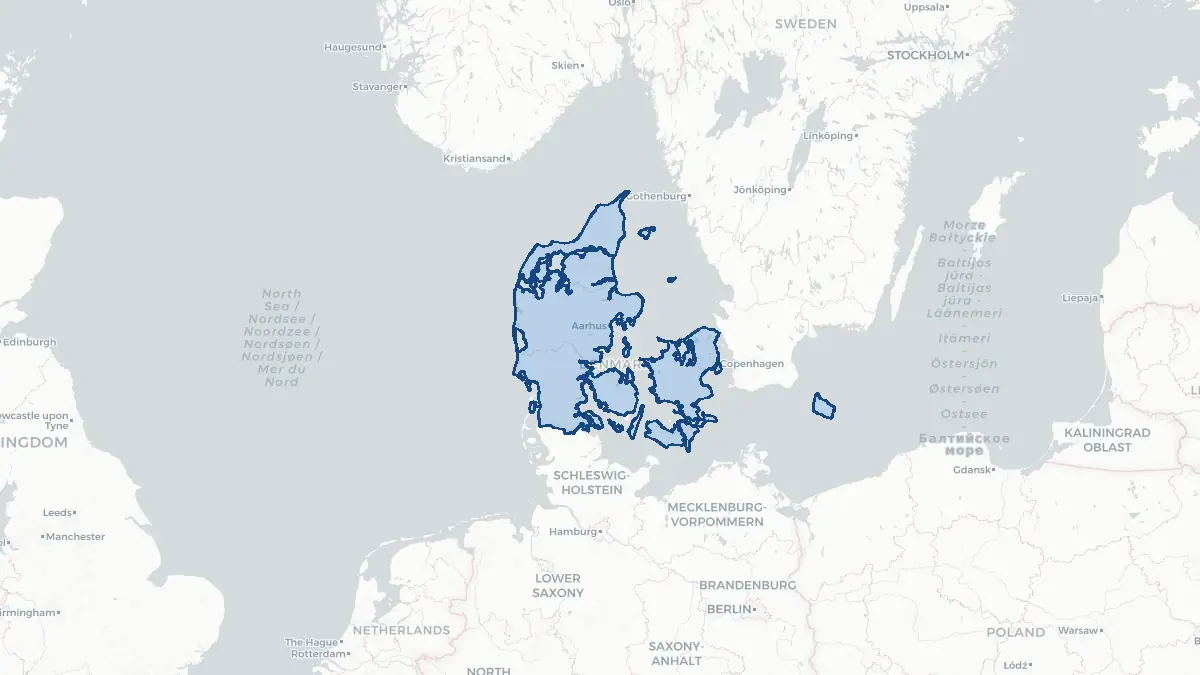
Here you find a map of Denmark, capital Copenhagen, currency Danska kronor and quick links to more facts about the country in Europe.
About the country
Denmark on the map
Denmark is the southernmost Nordic country, made up of the Jutland peninsula and hundreds of islands. Its capital is Copenhagen, and the country covers about 43,000 square kilometres with a population of roughly 5.9 million. Denmark uses the Danish krone as its currency.
About Denmark
Denmark is a constitutional monarchy with one of the oldest continuous monarchies in the world. It is known for its high quality of life, strong welfare state and design tradition. The Kingdom of Denmark also includes the self-governing territories of Greenland and the Faroe Islands. Danish society is often associated with the concept of hygge, a sense of cosiness and contentment.
Geography and landscape
Denmark's only land border is with Germany to the south, while the rest of the country is surrounded by the North Sea and the Baltic. It consists of the Jutland peninsula and more than four hundred islands, the largest being Zealand and Funen. The landscape is low-lying and gently rolling, with the highest natural point reaching only about 170 metres. The climate is temperate, with mild summers, cool winters and frequent wind. Bridges and tunnels, including the Öresund link to Sweden, connect many of the islands.
History
Denmark was a powerful Viking kingdom whose seafarers raided and settled across Europe. In the Middle Ages it dominated the Nordic region, at times ruling Norway and Sweden under the Kalmar Union. Over the following centuries Denmark lost territory through a series of wars, including the cession of Norway in 1814. The country was occupied by Germany during the Second World War before being liberated in 1945. After the war Denmark developed a comprehensive welfare state and a stable parliamentary democracy. It joined the European Economic Community in 1973.
Economy and currency
Denmark has a high-income, mixed economy with strengths in shipping, pharmaceuticals, renewable energy and agriculture. It is a world leader in wind power and design. The currency is the Danish krone, which is pegged to the euro rather than replaced by it. Copenhagen is the country's main economic and cultural centre.
Culture and language
The official language is Danish, a North Germanic language closely related to Norwegian and Swedish. Denmark has a strong design and architectural tradition, along with a celebrated literary heritage that includes Hans Christian Andersen. Cycling is a central part of daily life, particularly in Copenhagen. The Danish concept of hygge, emphasising warmth and togetherness, has become known around the world.
Frequently asked questions
What is the capital of Denmark? The capital of Denmark is Copenhagen, located on the island of Zealand. It is the largest city and the political, economic and cultural centre of Denmark.
What currency is used in Denmark? Denmark uses the Danish krone. Although Denmark is a member of the European Union, it has kept its own currency, which is pegged to the euro.
Does Denmark include Greenland? Yes, Greenland is a self-governing territory within the Kingdom of Denmark, as are the Faroe Islands. Both have extensive autonomy over their own internal affairs.
Geo Quiz
Think you know your capitals, flags, and continents? Take the quiz!
Neighbouring countries
Continue to nearby countries
More countries in the same part of the world
Europe index
Open the continent hub for Europe to see the full country list, capitals and frequently asked questions on one page.
Interactive map
Zoomable map of Denmark
Country index
All countries by continent
Jump directly to the right section or keep scrolling.
Africa
58 countries- Algeria
- Angola
- Benin
- Botswana
- Burkina Faso
- Burundi
- Central African Republic
- Djibouti
- Democratic Republic of the Congo
- Egypt
- Equatorial Guinea
- Ivory Coast
- Eritrea
- Ethiopia
- Gabon
- Gambia
- Ghana
- Guinea
- Guinea-Bissau
- Cameroon
- Cape Verde
- Kenya
- Comoros
- Republic of the Congo
- Lesotho
- Liberia
- Libya
- Madagascar
- Malawi
- Mali
- Morocco
- Mauritania
- Mauritius
- Mayotte
- Mozambique
- Namibia
- Niger
- Nigeria
- Reunion
- Rwanda
- Saint Helena
- Sao Tome and Principe
- Senegal
- Seychelles
- Sierra Leone
- Somalia
- Sudan
- Swaziland
- South Africa
- South Sudan
- Tanzania
- Chad
- Togo
- Tunisia
- Uganda
- Western Sahara
- Zambia
- Zimbabwe
Asia
52 countries- Afghanistan
- Armenia
- Azerbaijan
- Bahrain
- Bangladesh
- Bhutan
- British Indian Ocean Territory
- Brunei
- Myanmar
- Philippines
- United Arab Emirates
- Georgia
- Hong Kong
- India
- Indonesia
- Iraq
- Iran
- Israel
- Japan
- Yemen
- Jordan
- Christmas Island
- Cambodia
- Kazakhstan
- China
- Kyrgyzstan
- Cocos Islands
- Kuwait
- Laos
- Lebanon
- Macau
- Malaysia
- Maldives
- Mongolia
- Nepal
- North Korea
- Oman
- Pakistan
- Palestinian Territory
- Qatar
- Saudi Arabia
- Singapore
- Sri Lanka
- South Korea
- Syria
- Tajikistan
- Taiwan
- Thailand
- Turkey
- Turkmenistan
- Uzbekistan
- Vietnam
Europe
53 countries- Albania
- Andorra
- Belgium
- Bosnia and Herzegovina
- Bulgaria
- Cyprus
- Denmark
- Estonia
- Finland
- France
- Faroe Islands
- Gibraltar
- Greece
- Guernsey
- Ireland
- Iceland
- Isle of Man
- Italy
- Jersey
- Kosovo
- Croatia
- Latvia
- Liechtenstein
- Lithuania
- Luxembourg
- Macedonia
- Malta
- Moldova
- Monaco
- Montenegro
- Netherlands
- Norway
- Poland
- Portugal
- Romania
- Russia
- San Marino
- Switzerland
- Serbia
- Slovakia
- Slovenia
- Spain
- United Kingdom
- Svalbard and Jan Mayen
- Sweden
- Czech Republic
- Germany
- Ukraine
- Hungary
- Vatican
- Belarus
- Aland Islands
- Austria
North America
42 countries- U.S. Virgin Islands
- Anguilla
- Antigua and Barbuda
- Aruba
- Bahamas
- Barbados
- Belize
- Bermuda
- Bonaire, Saint Eustatius and Saba
- British Virgin Islands
- Cayman Islands
- Costa Rica
- Curacao
- Dominica
- Dominican Republic
- El Salvador
- Grenada
- Greenland
- Guadeloupe
- Guatemala
- Haiti
- Honduras
- Jamaica
- Canada
- Cuba
- Martinique
- Mexico
- Montserrat
- Netherlands Antilles
- Nicaragua
- Panama
- Puerto Rico
- Saint Barthelemy
- Saint Kitts and Nevis
- Saint Lucia
- Saint Martin
- Saint Vincent and the Grenadines
- Saint Pierre and Miquelon
- Sint Maarten
- Trinidad and Tobago
- Turks and Caicos Islands
- United States
South America
14 countriesOceania
27 countries- American Samoa
- Australia
- Cook Islands
- Fiji
- French Polynesia
- United States Minor Outlying Islands
- Guam
- Kiribati
- Marshall Islands
- Micronesia
- Nauru
- Niue
- Northern Mariana Islands
- Norfolk Island
- New Caledonia
- New Zealand
- Palau
- Papua New Guinea
- Pitcairn
- Solomon Islands
- Samoa
- Tokelau
- Tonga
- Tuvalu
- Vanuatu
- Wallis and Futuna
- East Timor