
Africa
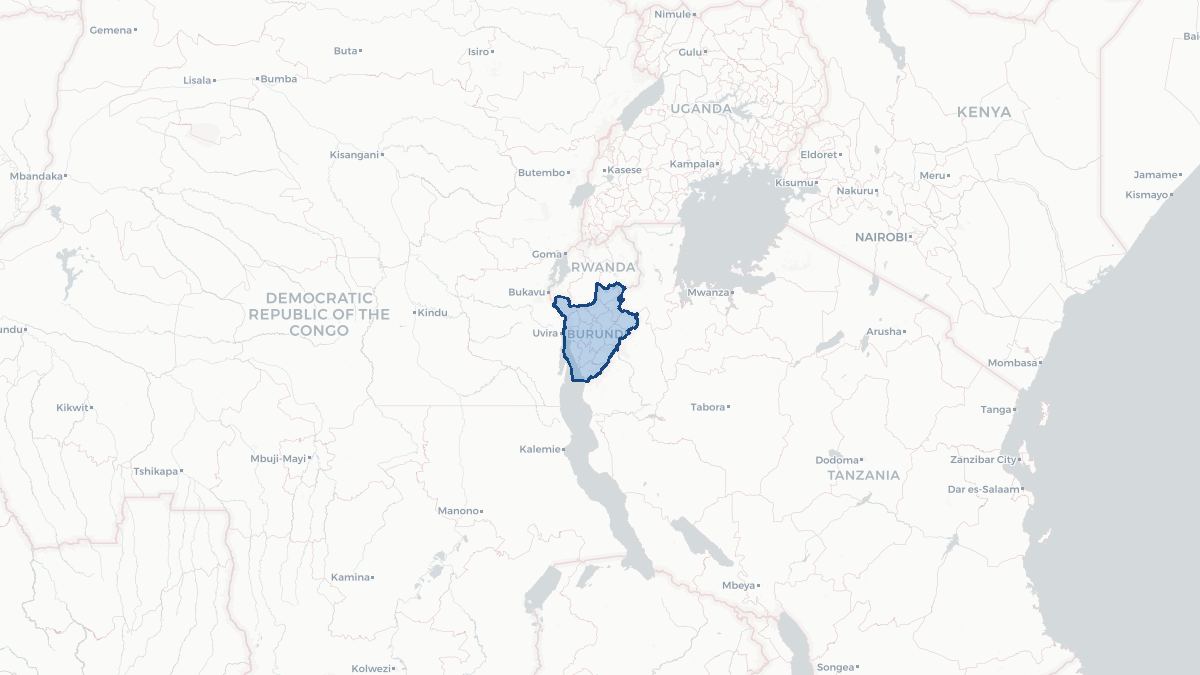
Burundi — map and facts
Here you find a map of Burundi, capital Bujumbura, currency Franc and quick links to more facts about the country in Africa.
Mini-quiz
Test yourself: 3 questions about Burundi
About the country
Burundi on the map
About Burundi
Burundi is a small, densely populated landlocked country in the Great Lakes region of Central Africa, with a population of approximately 13 million people. Its capital is Gitega, designated as the political capital in 2019, while Bujumbura remains the economic capital and largest city, situated on the northeastern shore of Lake Tanganyika. Burundi is one of the world's poorest and most food-insecure nations, consistently ranked near the bottom of global human development indices. It is a presidential republic governed by President Évariste Ndayishimiye, who came to power in 2020 following the death of long-ruling President Pierre Nkurunziza. Kirundi and French are the official languages, with Swahili also widely spoken. The economy is overwhelmingly agrarian, with the majority of the population engaged in subsistence farming; coffee and tea are the primary export earners. Political tension between the Hutu majority and Tutsi minority — exacerbated by colonial-era policies — has driven cycles of violence and instability throughout Burundi's post-independence history.
Geography and Landscape
Burundi covers approximately 27,830 square kilometres, making it one of the smallest countries in Africa. Despite its small size, the terrain is highly varied. The country sits on the western edge of the East African Rift system, and its landscape is characterised by steep hills, deep valleys, and high plateaus — a topography that has earned the region the informal description of "the land of a thousand hills." The Congo-Nile divide ridge runs north-south through the country, separating rivers that flow west into the Congo basin from those that drain east and north into the Nile system. The highest point is Mount Heha at 2,684 metres. Lake Tanganyika forms the entire western border; at around 1,470 metres deep it is the world's second-deepest lake and harbours remarkable endemic biodiversity. The Ruvubu River in the northeast is one of the most remote headwater tributaries of the Nile. The climate is tropical highland, tempered by elevation, with two wet seasons. Deforestation and soil erosion are serious environmental problems linked to extreme population pressure.
History
The territory of present-day Burundi was organised as the Kingdom of Burundi by at least the seventeenth century, a Tutsi-ruled monarchy with a complex hierarchical social structure involving both Hutu and Tutsi populations. Germany incorporated the kingdom into German East Africa in the 1890s. After Germany's defeat in World War One, Belgium administered the territory first as part of the League of Nations mandate Ruanda-Urundi, and then as a United Nations trust territory. Belgian rule entrenched ethnic divisions by issuing identity cards classifying people as Hutu, Tutsi, or Twa, and by concentrating power among the Tutsi. Burundi gained independence on 1 July 1962. The post-independence period was marked by cycles of ethnically driven violence; a 1972 massacre in which the Tutsi-dominated army killed an estimated 100,000 to 300,000 Hutus constitutes one of the clearest cases of genocide in African history. A civil war beginning in 1993 following the assassination of elected President Melchior Ndadaye killed over 300,000 people. The Arusha Peace and Reconciliation Agreement of 2000 established power-sharing arrangements that brought a degree of stability, though political repression under Nkurunziza and his successor has continued to limit democratic freedoms.
Questions about Burundi
What is the capital of Burundi?
Bujumbura is the capital of Burundi.
What currency is used in Burundi?
Franc (BIF) is the currency of Burundi.
What languages are spoken in Burundi?
Languages spoken in Burundi: fr-BI,rn.
Which countries border Burundi?
Burundi borders Tanzania, Democratic Republic of the Congo, Rwanda.
In which continent is Burundi?
Burundi is located in Africa.
Neighbouring countries
Continue to nearby countries
More countries in the same part of the world
Africa index
Open the continent hub for Africa to see the full country list, capitals and frequently asked questions on one page.
Interactive map
Zoomable map of Burundi
Country index
All countries by continent
Jump directly to the right section or keep scrolling.
Africa
58 countries- Algeria
- Angola
- Benin
- Botswana
- Burkina Faso
- Burundi
- Central African Republic
- Djibouti
- Democratic Republic of the Congo
- Egypt
- Equatorial Guinea
- Ivory Coast
- Eritrea
- Eswatini
- Ethiopia
- Gabon
- Gambia
- Ghana
- Guinea
- Guinea-Bissau
- Cameroon
- Cape Verde
- Kenya
- Comoros
- Republic of the Congo
- Lesotho
- Liberia
- Libya
- Madagascar
- Malawi
- Mali
- Morocco
- Mauritania
- Mauritius
- Mayotte
- Mozambique
- Namibia
- Niger
- Nigeria
- Reunion
- Rwanda
- Saint Helena
- Sao Tome and Principe
- Senegal
- Seychelles
- Sierra Leone
- Somalia
- Sudan
- South Africa
- South Sudan
- Tanzania
- Chad
- Togo
- Tunisia
- Uganda
- Western Sahara
- Zambia
- Zimbabwe
Asia
52 countries- Afghanistan
- Armenia
- Azerbaijan
- Bahrain
- Bangladesh
- Bhutan
- British Indian Ocean Territory
- Brunei
- Philippines
- United Arab Emirates
- Georgia
- Hong Kong
- India
- Indonesia
- Iraq
- Iran
- Israel
- Japan
- Yemen
- Jordan
- Christmas Island
- Cambodia
- Kazakhstan
- China
- Kyrgyzstan
- Cocos Islands
- Kuwait
- Laos
- Lebanon
- Macau
- Malaysia
- Maldives
- Mongolia
- Myanmar
- Nepal
- North Korea
- Oman
- Pakistan
- Palestinian Territory
- Qatar
- Saudi Arabia
- Singapore
- Sri Lanka
- South Korea
- Syria
- Tajikistan
- Taiwan
- Thailand
- Turkey
- Turkmenistan
- Uzbekistan
- Vietnam
Europe
53 countries- Albania
- Andorra
- Belarus
- Belgium
- Bosnia and Herzegovina
- Bulgaria
- Cyprus
- Denmark
- Estonia
- Finland
- France
- Faroe Islands
- Gibraltar
- Greece
- Guernsey
- Ireland
- Iceland
- Isle of Man
- Italy
- Jersey
- Kosovo
- Croatia
- Latvia
- Liechtenstein
- Lithuania
- Luxembourg
- Malta
- Moldova
- Monaco
- Montenegro
- Netherlands
- North Macedonia
- Norway
- Poland
- Portugal
- Romania
- Russia
- San Marino
- Switzerland
- Serbia
- Slovakia
- Slovenia
- Spain
- United Kingdom
- Svalbard and Jan Mayen
- Sweden
- Czech Republic
- Germany
- Ukraine
- Hungary
- Vatican
- Aland Islands
- Austria
North America
42 countries- U.S. Virgin Islands
- Anguilla
- Antigua and Barbuda
- Aruba
- Bahamas
- Barbados
- Belize
- Bermuda
- Bonaire, Saint Eustatius and Saba
- British Virgin Islands
- Cayman Islands
- Costa Rica
- Curacao
- Dominica
- Dominican Republic
- El Salvador
- Grenada
- Greenland
- Guadeloupe
- Guatemala
- Haiti
- Honduras
- Jamaica
- Canada
- Cuba
- Martinique
- Mexico
- Montserrat
- Netherlands Antilles
- Nicaragua
- Panama
- Puerto Rico
- Saint Barthelemy
- Saint Kitts and Nevis
- Saint Lucia
- Saint Martin
- Saint Vincent and the Grenadines
- Saint Pierre and Miquelon
- Sint Maarten
- Trinidad and Tobago
- Turks and Caicos Islands
- United States
South America
14 countriesOceania
27 countries- American Samoa
- Australia
- Cook Islands
- Fiji
- French Polynesia
- United States Minor Outlying Islands
- Guam
- Kiribati
- Marshall Islands
- Micronesia
- Nauru
- Niue
- Northern Mariana Islands
- Norfolk Island
- New Caledonia
- New Zealand
- Palau
- Papua New Guinea
- Pitcairn
- Solomon Islands
- Samoa
- Tokelau
- Tonga
- Tuvalu
- Vanuatu
- Wallis and Futuna
- East Timor