
Africa
Ethiopia — map and facts
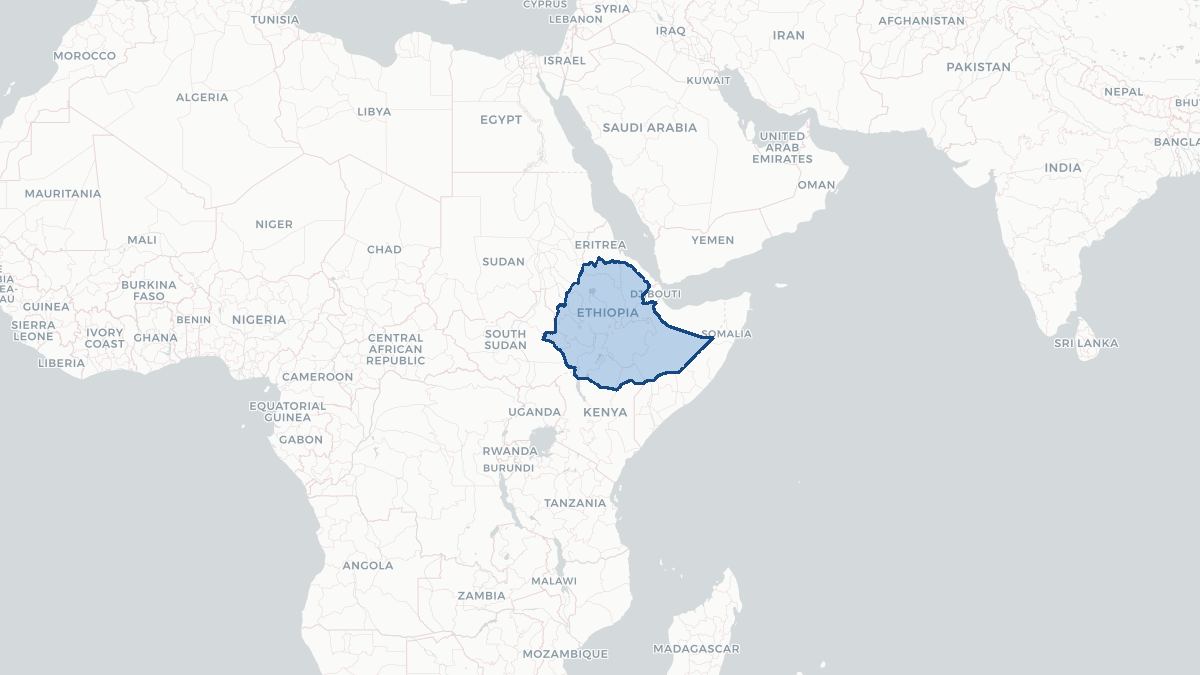
Here you find a map of Ethiopia, capital Addis Ababa, currency Birr and quick links to more facts about the country in Africa.
Mini-quiz
Test yourself: 3 questions about Ethiopia
About the country
Ethiopia on the map
About Ethiopia
Ethiopia is the most populous landlocked country in the world, with an estimated population of over 125 million people, and is the second most populous nation in Africa. The capital and largest city is Addis Ababa, which also serves as the headquarters of the African Union. The government is a federal parliamentary republic; Prime Minister Abiy Ahmed has led the country since 2018 and was awarded the Nobel Peace Prize in 2019 for initiating a peace process with Eritrea. Ethiopia is one of the world's oldest nations and one of only two African countries — alongside Liberia — never to have been colonised, having famously defeated Italian forces at the Battle of Adwa in 1896. It is a country of extraordinary ethnic and linguistic diversity, with over 80 recognised languages; the largest ethnic groups are the Oromo, Amhara, Somali, and Tigrinya. Amharic is the official working language of the federal government. Ethiopia is predominantly Christian, with the Ethiopian Orthodox Tewahedo Church being one of the world's oldest Christian institutions, alongside a large Muslim population and a small Jewish community.
Geography and Landscape
Ethiopia covers approximately 1.1 million square kilometres in the Horn of Africa, bordered by Eritrea and Djibouti to the northeast, Somalia to the east, Kenya to the south, South Sudan and Sudan to the west. The country is dominated by the Ethiopian Highlands, one of the largest continuous highland masses in Africa, divided by the Great Rift Valley running diagonally from northeast to southwest. Ras Dashen in the Simien Mountains of the north is the highest peak, reaching 4,550 metres, and is surrounded by one of Africa's most dramatic highland landscapes, protected as a UNESCO World Heritage Site. The Blue Nile, known locally as the Abbay, rises from Lake Tana in the northwest, the largest lake in Ethiopia, and flows west into Sudan. The Awash River drains the Rift Valley northward and terminates in the Afar depression without reaching the sea. The Afar Triangle in the northeast is one of the hottest and most geologically active places on Earth, featuring the Danakil Depression, which sits at 116 metres below sea level. The western lowlands receive higher rainfall and support dense forest, while the east and southeast are arid.
History
Ethiopia is among the world's oldest continuously inhabited regions; fossil evidence of early human ancestors, including the famous "Lucy" (Australopithecus afarensis), was discovered in the Afar region in 1974, dating back approximately 3.2 million years. The Kingdom of D'mt flourished from around 980 to 400 BCE, followed by the Aksumite Empire, which rose to prominence in the first century CE and became one of the four great powers of the ancient world alongside Rome, Persia, and China. Aksum adopted Christianity in the fourth century CE under King Ezana, making Ethiopia one of the earliest Christian states. The medieval Zagwe dynasty, centred at Lalibela, constructed the extraordinary rock-hewn churches in the twelfth and thirteenth centuries. The Solomonic dynasty was restored in 1270 and lasted, with interruptions, until 1974. Emperor Menelik II decisively defeated Italy at the Battle of Adwa on 1 March 1896, preserving Ethiopian sovereignty. Emperor Haile Selassie ruled from 1930 until he was deposed by a Marxist military junta, the Derg, in 1974. The Derg ruled through the Red Terror, a period of mass killings, until it was overthrown in 1991 by rebel forces led by the Ethiopian People's Revolutionary Democratic Front. A federal democratic republic was established in 1994. A devastating civil war in the Tigray region broke out in 2020.
Questions about Ethiopia
What is the capital of Ethiopia?
Addis Ababa is the capital of Ethiopia.
What currency is used in Ethiopia?
Birr (ETB) is the currency of Ethiopia.
What languages are spoken in Ethiopia?
Languages spoken in Ethiopia: am,en-ET,om-ET,ti-ET,so-ET,sid.
Which countries border Ethiopia?
Ethiopia borders Eritrea, Kenya, Sudan, South Sudan, Somalia, Djibouti.
In which continent is Ethiopia?
Ethiopia is located in Africa.
Neighbouring countries
Continue to nearby countries
More countries in the same part of the world
Africa index
Open the continent hub for Africa to see the full country list, capitals and frequently asked questions on one page.
Interactive map
Zoomable map of Ethiopia
Country index
All countries by continent
Jump directly to the right section or keep scrolling.
Africa
58 countries- Algeria
- Angola
- Benin
- Botswana
- Burkina Faso
- Burundi
- Central African Republic
- Djibouti
- Democratic Republic of the Congo
- Egypt
- Equatorial Guinea
- Ivory Coast
- Eritrea
- Eswatini
- Ethiopia
- Gabon
- Gambia
- Ghana
- Guinea
- Guinea-Bissau
- Cameroon
- Cape Verde
- Kenya
- Comoros
- Republic of the Congo
- Lesotho
- Liberia
- Libya
- Madagascar
- Malawi
- Mali
- Morocco
- Mauritania
- Mauritius
- Mayotte
- Mozambique
- Namibia
- Niger
- Nigeria
- Reunion
- Rwanda
- Saint Helena
- Sao Tome and Principe
- Senegal
- Seychelles
- Sierra Leone
- Somalia
- Sudan
- South Africa
- South Sudan
- Tanzania
- Chad
- Togo
- Tunisia
- Uganda
- Western Sahara
- Zambia
- Zimbabwe
Asia
52 countries- Afghanistan
- Armenia
- Azerbaijan
- Bahrain
- Bangladesh
- Bhutan
- British Indian Ocean Territory
- Brunei
- Philippines
- United Arab Emirates
- Georgia
- Hong Kong
- India
- Indonesia
- Iraq
- Iran
- Israel
- Japan
- Yemen
- Jordan
- Christmas Island
- Cambodia
- Kazakhstan
- China
- Kyrgyzstan
- Cocos Islands
- Kuwait
- Laos
- Lebanon
- Macau
- Malaysia
- Maldives
- Mongolia
- Myanmar
- Nepal
- North Korea
- Oman
- Pakistan
- Palestinian Territory
- Qatar
- Saudi Arabia
- Singapore
- Sri Lanka
- South Korea
- Syria
- Tajikistan
- Taiwan
- Thailand
- Turkey
- Turkmenistan
- Uzbekistan
- Vietnam
Europe
53 countries- Albania
- Andorra
- Belarus
- Belgium
- Bosnia and Herzegovina
- Bulgaria
- Cyprus
- Denmark
- Estonia
- Finland
- France
- Faroe Islands
- Gibraltar
- Greece
- Guernsey
- Ireland
- Iceland
- Isle of Man
- Italy
- Jersey
- Kosovo
- Croatia
- Latvia
- Liechtenstein
- Lithuania
- Luxembourg
- Malta
- Moldova
- Monaco
- Montenegro
- Netherlands
- North Macedonia
- Norway
- Poland
- Portugal
- Romania
- Russia
- San Marino
- Switzerland
- Serbia
- Slovakia
- Slovenia
- Spain
- United Kingdom
- Svalbard and Jan Mayen
- Sweden
- Czech Republic
- Germany
- Ukraine
- Hungary
- Vatican
- Aland Islands
- Austria
North America
42 countries- U.S. Virgin Islands
- Anguilla
- Antigua and Barbuda
- Aruba
- Bahamas
- Barbados
- Belize
- Bermuda
- Bonaire, Saint Eustatius and Saba
- British Virgin Islands
- Cayman Islands
- Costa Rica
- Curacao
- Dominica
- Dominican Republic
- El Salvador
- Grenada
- Greenland
- Guadeloupe
- Guatemala
- Haiti
- Honduras
- Jamaica
- Canada
- Cuba
- Martinique
- Mexico
- Montserrat
- Netherlands Antilles
- Nicaragua
- Panama
- Puerto Rico
- Saint Barthelemy
- Saint Kitts and Nevis
- Saint Lucia
- Saint Martin
- Saint Vincent and the Grenadines
- Saint Pierre and Miquelon
- Sint Maarten
- Trinidad and Tobago
- Turks and Caicos Islands
- United States
South America
14 countriesOceania
27 countries- American Samoa
- Australia
- Cook Islands
- Fiji
- French Polynesia
- United States Minor Outlying Islands
- Guam
- Kiribati
- Marshall Islands
- Micronesia
- Nauru
- Niue
- Northern Mariana Islands
- Norfolk Island
- New Caledonia
- New Zealand
- Palau
- Papua New Guinea
- Pitcairn
- Solomon Islands
- Samoa
- Tokelau
- Tonga
- Tuvalu
- Vanuatu
- Wallis and Futuna
- East Timor