
Africa
Mauritius — map and facts
Here you find a map of Mauritius, capital Port Louis, currency Rupie and quick links to more facts about the country in Africa.
About the country
Mauritius on the map
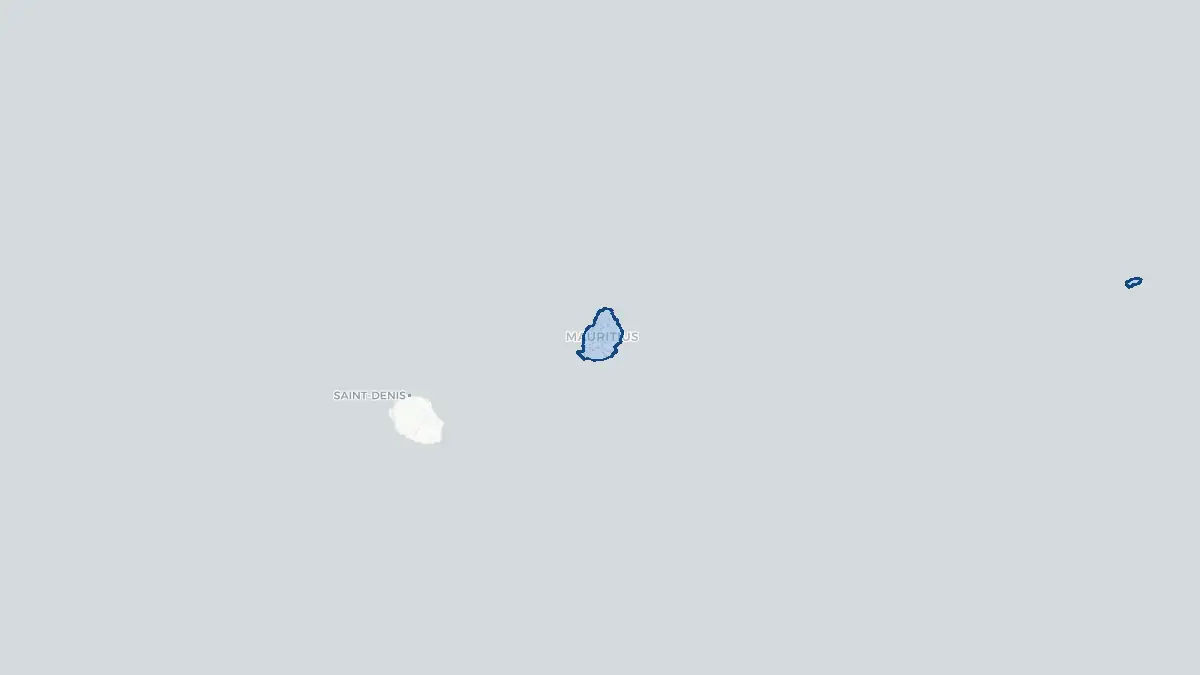
Mauritius is an island nation in the southwestern Indian Ocean, located approximately 2,000 kilometres off the southeastern coast of Africa and 900 kilometres east of Madagascar. With a population of around 1.3 million, it is one of the most densely populated countries in Africa. The capital, Port Louis, serves as the financial, commercial, and cultural hub of the nation. Mauritius is widely regarded as one of Africa's most stable and prosperous democracies, consistently ranking highly on indices of governance, press freedom, and economic competitiveness. The country's economy is remarkably diversified for a small island state, encompassing financial services, tourism, textile manufacturing, information technology, and seafood processing. Mauritius is a founding member of the African Union and maintains strong ties with both the European Union and Commonwealth nations. The society is richly multicultural, comprising communities of Indian, Creole, Chinese, and European heritage who live in relative harmony. English and French are official languages alongside Mauritian Creole, and the country retains a distinctly Franco-British colonial cultural character.
The main island of Mauritius covers approximately 1,865 square kilometres and is of volcanic origin. The landscape is characterised by a central plateau surrounded by coastal lowlands, with the highest point, Piton de la Petite Rivière Noire, reaching 828 metres. The island's interior is dominated by sugarcane plantations, which still cover a substantial portion of the agricultural land despite the sector's declining economic share. The coastline is fringed by coral reefs forming a lagoon that provides sheltered waters popular for water sports and diving. The offshore islets of Rodrigues, Agaléga, and the Cargados Carajos Shoals are also part of Mauritian territory. Rodrigues, the most significant outer island, lies 560 kilometres to the east and functions as an autonomous region with its own regional assembly. The climate is tropical and subtropical, with a warm, humid summer from November to April and a cooler, drier winter season. Cyclones occasionally affect the island between January and March.
Mauritius was uninhabited when Arab sailors first noted its existence in the 10th century, and Portuguese navigators visited in the early 16th century, naming it Ilha do Cirne. The Dutch established the first permanent settlement in 1638, naming the island after Prince Maurice of Nassau, and introduced sugarcane cultivation and the exploitation of ebony forests. They also inadvertently contributed to the extinction of the dodo, the island's iconic flightless bird, which disappeared by around 1693. The Dutch abandoned Mauritius in 1710, and the French East India Company claimed it in 1715, renaming it Île de France. Under French rule, particularly during the governorship of Mahé de Labourdonnais, Port Louis developed into a significant port. France introduced enslaved African and Malagasy workers to develop sugar plantations. Britain seized the island in 1810 during the Napoleonic Wars. Following the abolition of slavery in 1835, over 450,000 indentured labourers arrived from India, dramatically reshaping the island's population. Mauritius achieved independence on 12 March 1968 and became a republic in 1992.
Geo Quiz
Think you know your capitals, flags, and continents? Take the quiz!
Neighbouring countries
Continue to nearby countries
There are no registered neighbouring countries for Mauritius in the current database.
More countries in the same part of the world
Africa index
Open the continent hub for Africa to see the full country list, capitals and frequently asked questions on one page.
Interactive map
Zoomable map of Mauritius
Country index
All countries by continent
Jump directly to the right section or keep scrolling.
Africa
58 countries- Algeria
- Angola
- Benin
- Botswana
- Burkina Faso
- Burundi
- Central African Republic
- Djibouti
- Democratic Republic of the Congo
- Egypt
- Equatorial Guinea
- Ivory Coast
- Eritrea
- Ethiopia
- Gabon
- Gambia
- Ghana
- Guinea
- Guinea-Bissau
- Cameroon
- Cape Verde
- Kenya
- Comoros
- Republic of the Congo
- Lesotho
- Liberia
- Libya
- Madagascar
- Malawi
- Mali
- Morocco
- Mauritania
- Mauritius
- Mayotte
- Mozambique
- Namibia
- Niger
- Nigeria
- Reunion
- Rwanda
- Saint Helena
- Sao Tome and Principe
- Senegal
- Seychelles
- Sierra Leone
- Somalia
- Sudan
- Swaziland
- South Africa
- South Sudan
- Tanzania
- Chad
- Togo
- Tunisia
- Uganda
- Western Sahara
- Zambia
- Zimbabwe
Asia
52 countries- Afghanistan
- Armenia
- Azerbaijan
- Bahrain
- Bangladesh
- Bhutan
- British Indian Ocean Territory
- Brunei
- Myanmar
- Philippines
- United Arab Emirates
- Georgia
- Hong Kong
- India
- Indonesia
- Iraq
- Iran
- Israel
- Japan
- Yemen
- Jordan
- Christmas Island
- Cambodia
- Kazakhstan
- China
- Kyrgyzstan
- Cocos Islands
- Kuwait
- Laos
- Lebanon
- Macau
- Malaysia
- Maldives
- Mongolia
- Nepal
- North Korea
- Oman
- Pakistan
- Palestinian Territory
- Qatar
- Saudi Arabia
- Singapore
- Sri Lanka
- South Korea
- Syria
- Tajikistan
- Taiwan
- Thailand
- Turkey
- Turkmenistan
- Uzbekistan
- Vietnam
Europe
53 countries- Albania
- Andorra
- Belgium
- Bosnia and Herzegovina
- Bulgaria
- Cyprus
- Denmark
- Estonia
- Finland
- France
- Faroe Islands
- Gibraltar
- Greece
- Guernsey
- Ireland
- Iceland
- Isle of Man
- Italy
- Jersey
- Kosovo
- Croatia
- Latvia
- Liechtenstein
- Lithuania
- Luxembourg
- Macedonia
- Malta
- Moldova
- Monaco
- Montenegro
- Netherlands
- Norway
- Poland
- Portugal
- Romania
- Russia
- San Marino
- Switzerland
- Serbia
- Slovakia
- Slovenia
- Spain
- United Kingdom
- Svalbard and Jan Mayen
- Sweden
- Czech Republic
- Germany
- Ukraine
- Hungary
- Vatican
- Belarus
- Aland Islands
- Austria
North America
42 countries- U.S. Virgin Islands
- Anguilla
- Antigua and Barbuda
- Aruba
- Bahamas
- Barbados
- Belize
- Bermuda
- Bonaire, Saint Eustatius and Saba
- British Virgin Islands
- Cayman Islands
- Costa Rica
- Curacao
- Dominica
- Dominican Republic
- El Salvador
- Grenada
- Greenland
- Guadeloupe
- Guatemala
- Haiti
- Honduras
- Jamaica
- Canada
- Cuba
- Martinique
- Mexico
- Montserrat
- Netherlands Antilles
- Nicaragua
- Panama
- Puerto Rico
- Saint Barthelemy
- Saint Kitts and Nevis
- Saint Lucia
- Saint Martin
- Saint Vincent and the Grenadines
- Saint Pierre and Miquelon
- Sint Maarten
- Trinidad and Tobago
- Turks and Caicos Islands
- United States
South America
14 countriesOceania
27 countries- American Samoa
- Australia
- Cook Islands
- Fiji
- French Polynesia
- United States Minor Outlying Islands
- Guam
- Kiribati
- Marshall Islands
- Micronesia
- Nauru
- Niue
- Northern Mariana Islands
- Norfolk Island
- New Caledonia
- New Zealand
- Palau
- Papua New Guinea
- Pitcairn
- Solomon Islands
- Samoa
- Tokelau
- Tonga
- Tuvalu
- Vanuatu
- Wallis and Futuna
- East Timor