
Asia
Bhutan — map and facts
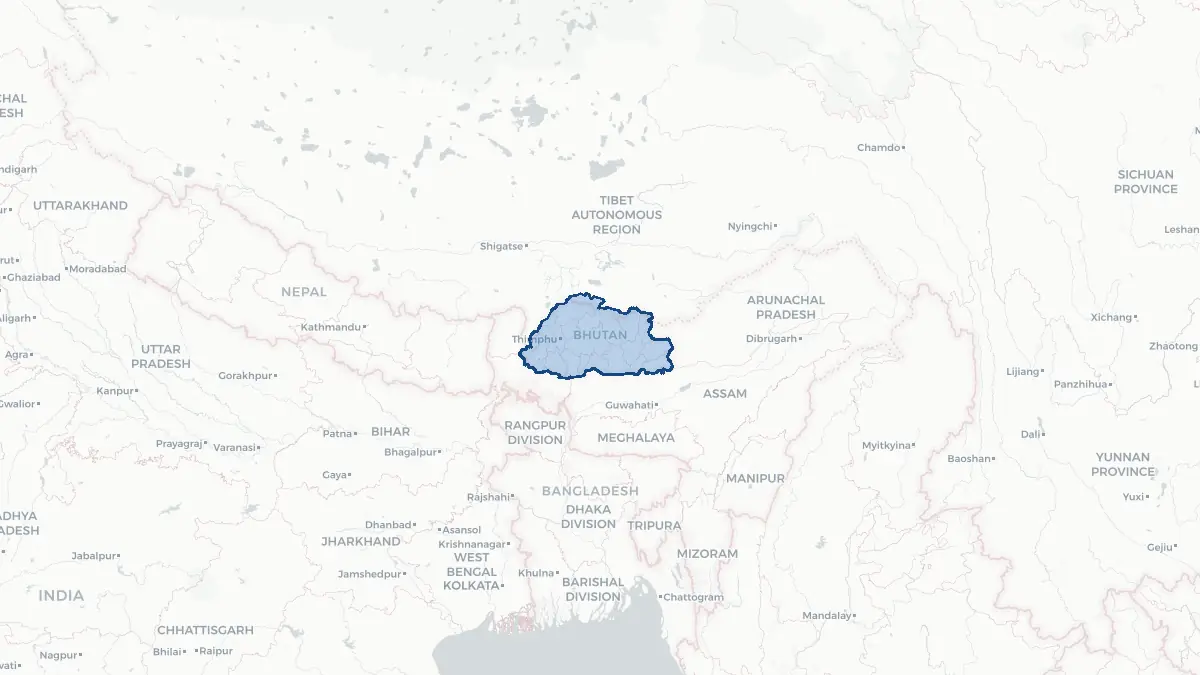
Here you find a map of Bhutan, capital Thimphu, currency Ngultrum Rupie and quick links to more facts about the country in Asia.
About the country
Bhutan on the map
Bhutan is a small Buddhist kingdom nestled in the eastern Himalayas, bordered by India to the south and China to the north. With a population of approximately 750,000, it remains one of the world's most isolated and culturally preserved nations. The capital, Thimphu, serves as the political and cultural heart of the country. Bhutan transitioned from an absolute monarchy to a constitutional monarchy in 2008, holding its first democratic elections that year. The kingdom is internationally renowned for its philosophy of Gross National Happiness, a development framework that prioritises the spiritual and psychological wellbeing of its citizens alongside economic growth. Traditional dress, the Dzongkha language, and Vajrayana Buddhism are central to national identity, reinforced through strict cultural preservation policies. Tourism is carefully managed through a high-value, low-impact model, requiring visitors to pay a daily fee. Bhutan also holds the distinction of being carbon-negative, absorbing more carbon dioxide than it produces.
Bhutan's geography is defined almost entirely by the Himalayas, making it one of the most mountainous countries on Earth. The landscape rises dramatically from the subtropical plains of the south to soaring peaks in the north, where Gangkhar Puensum — believed to be the world's highest unclimbed mountain at 7,570 metres — stands permanently off-limits out of respect for local spiritual beliefs. The country is divided broadly into three zones: the southern foothills covered in dense tropical forest, the central valleys where most of the population and agriculture are concentrated, and the northern alpine highlands. Major rivers including the Paro Chhu and Wang Chhu carve through deep valleys, feeding into the Brahmaputra system. Bhutan is extraordinarily biodiverse, with over 70% of its land under forest cover, and serves as a critical ecological corridor between the Indian subcontinent and the Tibetan Plateau. Snow leopards, Bengal tigers, and red pandas inhabit its protected wilderness areas.
Bhutan's recorded history stretches back to at least the 7th century, when the Tibetan king Songtsen Gampo is said to have built two Buddhist temples on Bhutanese soil. The arrival of the Tibetan saint Guru Rinpoche (Padmasambhava) in the 8th century firmly established Vajrayana Buddhism as the spiritual foundation of the land. For centuries, Bhutan was a collection of competing fiefdoms until Zhabdrung Ngawang Namgyal, a Tibetan lama, unified the country in the early 17th century and established a dual system of civil and religious governance. The hereditary Wangchuck dynasty came to power in 1907, with Ugyen Wangchuck becoming the first king. Bhutan avoided formal colonisation, maintaining its sovereignty through careful diplomacy, particularly in relation to British India. In 2008, the fourth king, Jigme Singye Wangchuck, handed power to an elected parliament, completing the nation's peaceful transition to constitutional democracy under the fifth king, Jigme Khesar Namgyel Wangchuck.
Geo Quiz
Think you know your capitals, flags, and continents? Take the quiz!
Neighbouring countries
Continue to nearby countries
More countries in the same part of the world
Asia index
Open the continent hub for Asia to see the full country list, capitals and frequently asked questions on one page.
Interactive map
Zoomable map of Bhutan
Country index
All countries by continent
Jump directly to the right section or keep scrolling.
Africa
58 countries- Algeria
- Angola
- Benin
- Botswana
- Burkina Faso
- Burundi
- Central African Republic
- Djibouti
- Democratic Republic of the Congo
- Egypt
- Equatorial Guinea
- Ivory Coast
- Eritrea
- Ethiopia
- Gabon
- Gambia
- Ghana
- Guinea
- Guinea-Bissau
- Cameroon
- Cape Verde
- Kenya
- Comoros
- Republic of the Congo
- Lesotho
- Liberia
- Libya
- Madagascar
- Malawi
- Mali
- Morocco
- Mauritania
- Mauritius
- Mayotte
- Mozambique
- Namibia
- Niger
- Nigeria
- Reunion
- Rwanda
- Saint Helena
- Sao Tome and Principe
- Senegal
- Seychelles
- Sierra Leone
- Somalia
- Sudan
- Swaziland
- South Africa
- South Sudan
- Tanzania
- Chad
- Togo
- Tunisia
- Uganda
- Western Sahara
- Zambia
- Zimbabwe
Asia
52 countries- Afghanistan
- Armenia
- Azerbaijan
- Bahrain
- Bangladesh
- Bhutan
- British Indian Ocean Territory
- Brunei
- Myanmar
- Philippines
- United Arab Emirates
- Georgia
- Hong Kong
- India
- Indonesia
- Iraq
- Iran
- Israel
- Japan
- Yemen
- Jordan
- Christmas Island
- Cambodia
- Kazakhstan
- China
- Kyrgyzstan
- Cocos Islands
- Kuwait
- Laos
- Lebanon
- Macau
- Malaysia
- Maldives
- Mongolia
- Nepal
- North Korea
- Oman
- Pakistan
- Palestinian Territory
- Qatar
- Saudi Arabia
- Singapore
- Sri Lanka
- South Korea
- Syria
- Tajikistan
- Taiwan
- Thailand
- Turkey
- Turkmenistan
- Uzbekistan
- Vietnam
Europe
53 countries- Albania
- Andorra
- Belgium
- Bosnia and Herzegovina
- Bulgaria
- Cyprus
- Denmark
- Estonia
- Finland
- France
- Faroe Islands
- Gibraltar
- Greece
- Guernsey
- Ireland
- Iceland
- Isle of Man
- Italy
- Jersey
- Kosovo
- Croatia
- Latvia
- Liechtenstein
- Lithuania
- Luxembourg
- Macedonia
- Malta
- Moldova
- Monaco
- Montenegro
- Netherlands
- Norway
- Poland
- Portugal
- Romania
- Russia
- San Marino
- Switzerland
- Serbia
- Slovakia
- Slovenia
- Spain
- United Kingdom
- Svalbard and Jan Mayen
- Sweden
- Czech Republic
- Germany
- Ukraine
- Hungary
- Vatican
- Belarus
- Aland Islands
- Austria
North America
42 countries- U.S. Virgin Islands
- Anguilla
- Antigua and Barbuda
- Aruba
- Bahamas
- Barbados
- Belize
- Bermuda
- Bonaire, Saint Eustatius and Saba
- British Virgin Islands
- Cayman Islands
- Costa Rica
- Curacao
- Dominica
- Dominican Republic
- El Salvador
- Grenada
- Greenland
- Guadeloupe
- Guatemala
- Haiti
- Honduras
- Jamaica
- Canada
- Cuba
- Martinique
- Mexico
- Montserrat
- Netherlands Antilles
- Nicaragua
- Panama
- Puerto Rico
- Saint Barthelemy
- Saint Kitts and Nevis
- Saint Lucia
- Saint Martin
- Saint Vincent and the Grenadines
- Saint Pierre and Miquelon
- Sint Maarten
- Trinidad and Tobago
- Turks and Caicos Islands
- United States
South America
14 countriesOceania
27 countries- American Samoa
- Australia
- Cook Islands
- Fiji
- French Polynesia
- United States Minor Outlying Islands
- Guam
- Kiribati
- Marshall Islands
- Micronesia
- Nauru
- Niue
- Northern Mariana Islands
- Norfolk Island
- New Caledonia
- New Zealand
- Palau
- Papua New Guinea
- Pitcairn
- Solomon Islands
- Samoa
- Tokelau
- Tonga
- Tuvalu
- Vanuatu
- Wallis and Futuna
- East Timor