
Africa
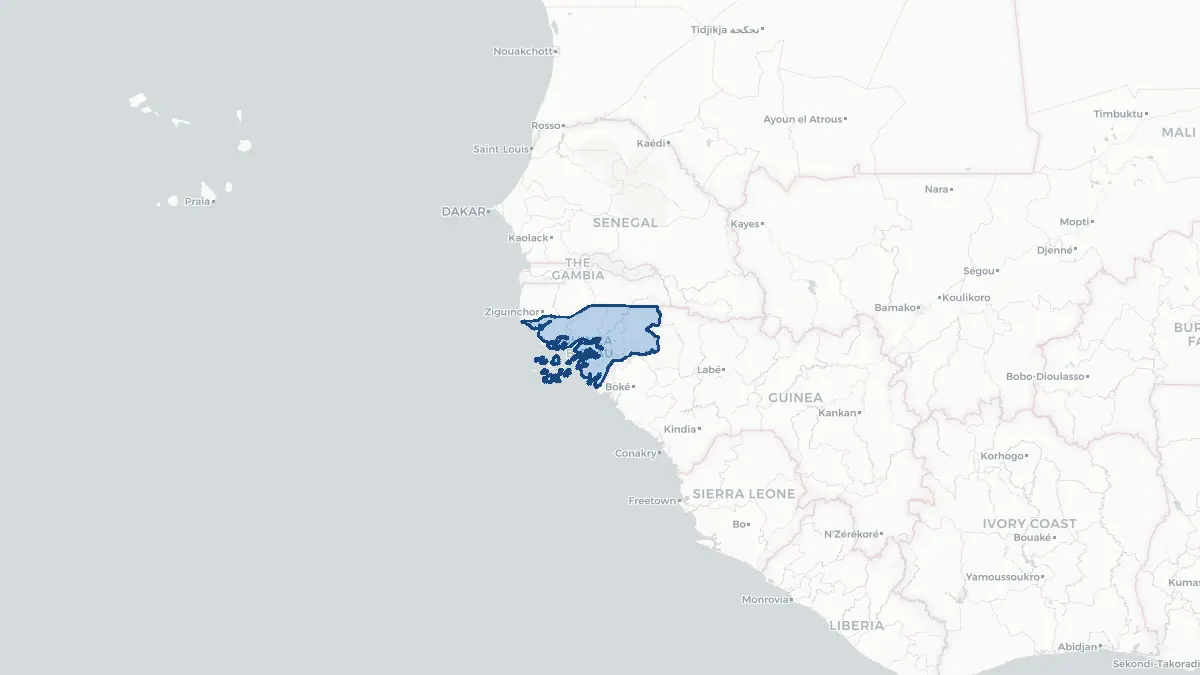
Guinea-Bissau — map and facts
Here you find a map of Guinea-Bissau, capital Bissau, currency Franc and quick links to more facts about the country in Africa.
About the country
Guinea-Bissau on the map
About Guinea-Bissau
Guinea-Bissau is a small West African nation bordered by Senegal to the north and Guinea to the south and east, with an Atlantic coastline to the west. Its capital is Bissau, the country's largest city, and the total population is approximately 2.1 million. Guinea-Bissau is one of the world's poorest countries, consistently ranking near the bottom of the Human Development Index. The economy depends heavily on cashew nut exports, which account for the vast majority of export earnings, as well as subsistence agriculture and fishing. The country is ethnically diverse, with the Balanta, Fula, Mandinka, Manjaco, and Papel among the main groups. Portuguese is the official language, though Guinea-Bissau Creole is the most widely spoken lingua franca. Since independence from Portugal on 24 September 1974, the country has experienced chronic political instability, with multiple coups and assassinations of heads of state. The narcotics trade has also been a destabilising factor, with the country characterised by international observers as a narco-state given its role as a transit point for South American cocaine bound for Europe.
Geography and Landscape
Guinea-Bissau covers approximately 36,000 square kilometres of low-lying coastal West Africa. The mainland terrain is predominantly flat, rarely exceeding 60 metres in elevation, and is characterised by extensive tidal rivers, estuaries, and mangrove forests that penetrate deep inland along the Geba, Cacheu, and Corubal rivers. The Corubal, the country's largest river, originates in the Fouta Djallon highlands of Guinea. The coastline is exceptionally indented and fragmented. Offshore lies the Bijagós Archipelago, a UNESCO Biosphere Reserve consisting of approximately 88 islands and islets, of which around 20 are permanently inhabited. The archipelago is one of the most ecologically intact coastal wetland systems in West Africa, hosting large populations of saltwater hippos, nesting sea turtles, manatees, and an extraordinary diversity of migratory birds. The highest point in Guinea-Bissau is in the southeast near the Guinean border, reaching only around 300 metres. The climate is tropical, with a wet season from June to November and a dry season influenced by the Harmattan.
History
The territory of Guinea-Bissau was part of the Gabu Kingdom, a Mandinka state that formed as a tributary of the Mali Empire and persisted as an independent entity until the nineteenth century. Portuguese explorers reached the coast in the mid-fifteenth century, establishing trading posts that became significant nodes in the slave trade. The port of Cacheu became an early centre of Portuguese activity. Portugal's colonisation of the interior was largely resisted, and effective administrative control was only established in the early twentieth century. The territory was designated Portuguese Guinea in 1879. In 1956, Amílcar Cabral co-founded the African Party for the Independence of Guinea and Cape Verde (PAIGC), which launched an armed guerrilla struggle in 1963. By the early 1970s, the PAIGC controlled much of the country. Guinea-Bissau declared independence unilaterally in 1973, recognised by Portugal after the Carnation Revolution in Lisbon in 1974. Cabral was assassinated in 1973 before independence. The years since have seen repeated coups — in 1980, 2003, 2009, and 2012 — reflecting deep structural fragility.
Geo Quiz
Think you know your capitals, flags, and continents? Take the quiz!
Neighbouring countries
Continue to nearby countries
More countries in the same part of the world
Africa index
Open the continent hub for Africa to see the full country list, capitals and frequently asked questions on one page.
Interactive map
Zoomable map of Guinea-Bissau
Country index
All countries by continent
Jump directly to the right section or keep scrolling.
Africa
58 countries- Algeria
- Angola
- Benin
- Botswana
- Burkina Faso
- Burundi
- Central African Republic
- Djibouti
- Democratic Republic of the Congo
- Egypt
- Equatorial Guinea
- Ivory Coast
- Eritrea
- Ethiopia
- Gabon
- Gambia
- Ghana
- Guinea
- Guinea-Bissau
- Cameroon
- Cape Verde
- Kenya
- Comoros
- Republic of the Congo
- Lesotho
- Liberia
- Libya
- Madagascar
- Malawi
- Mali
- Morocco
- Mauritania
- Mauritius
- Mayotte
- Mozambique
- Namibia
- Niger
- Nigeria
- Reunion
- Rwanda
- Saint Helena
- Sao Tome and Principe
- Senegal
- Seychelles
- Sierra Leone
- Somalia
- Sudan
- Swaziland
- South Africa
- South Sudan
- Tanzania
- Chad
- Togo
- Tunisia
- Uganda
- Western Sahara
- Zambia
- Zimbabwe
Asia
52 countries- Afghanistan
- Armenia
- Azerbaijan
- Bahrain
- Bangladesh
- Bhutan
- British Indian Ocean Territory
- Brunei
- Myanmar
- Philippines
- United Arab Emirates
- Georgia
- Hong Kong
- India
- Indonesia
- Iraq
- Iran
- Israel
- Japan
- Yemen
- Jordan
- Christmas Island
- Cambodia
- Kazakhstan
- China
- Kyrgyzstan
- Cocos Islands
- Kuwait
- Laos
- Lebanon
- Macau
- Malaysia
- Maldives
- Mongolia
- Nepal
- North Korea
- Oman
- Pakistan
- Palestinian Territory
- Qatar
- Saudi Arabia
- Singapore
- Sri Lanka
- South Korea
- Syria
- Tajikistan
- Taiwan
- Thailand
- Turkey
- Turkmenistan
- Uzbekistan
- Vietnam
Europe
53 countries- Albania
- Andorra
- Belgium
- Bosnia and Herzegovina
- Bulgaria
- Cyprus
- Denmark
- Estonia
- Finland
- France
- Faroe Islands
- Gibraltar
- Greece
- Guernsey
- Ireland
- Iceland
- Isle of Man
- Italy
- Jersey
- Kosovo
- Croatia
- Latvia
- Liechtenstein
- Lithuania
- Luxembourg
- Macedonia
- Malta
- Moldova
- Monaco
- Montenegro
- Netherlands
- Norway
- Poland
- Portugal
- Romania
- Russia
- San Marino
- Switzerland
- Serbia
- Slovakia
- Slovenia
- Spain
- United Kingdom
- Svalbard and Jan Mayen
- Sweden
- Czech Republic
- Germany
- Ukraine
- Hungary
- Vatican
- Belarus
- Aland Islands
- Austria
North America
42 countries- U.S. Virgin Islands
- Anguilla
- Antigua and Barbuda
- Aruba
- Bahamas
- Barbados
- Belize
- Bermuda
- Bonaire, Saint Eustatius and Saba
- British Virgin Islands
- Cayman Islands
- Costa Rica
- Curacao
- Dominica
- Dominican Republic
- El Salvador
- Grenada
- Greenland
- Guadeloupe
- Guatemala
- Haiti
- Honduras
- Jamaica
- Canada
- Cuba
- Martinique
- Mexico
- Montserrat
- Netherlands Antilles
- Nicaragua
- Panama
- Puerto Rico
- Saint Barthelemy
- Saint Kitts and Nevis
- Saint Lucia
- Saint Martin
- Saint Vincent and the Grenadines
- Saint Pierre and Miquelon
- Sint Maarten
- Trinidad and Tobago
- Turks and Caicos Islands
- United States
South America
14 countriesOceania
27 countries- American Samoa
- Australia
- Cook Islands
- Fiji
- French Polynesia
- United States Minor Outlying Islands
- Guam
- Kiribati
- Marshall Islands
- Micronesia
- Nauru
- Niue
- Northern Mariana Islands
- Norfolk Island
- New Caledonia
- New Zealand
- Palau
- Papua New Guinea
- Pitcairn
- Solomon Islands
- Samoa
- Tokelau
- Tonga
- Tuvalu
- Vanuatu
- Wallis and Futuna
- East Timor