
North America
Saint Lucia — map and facts
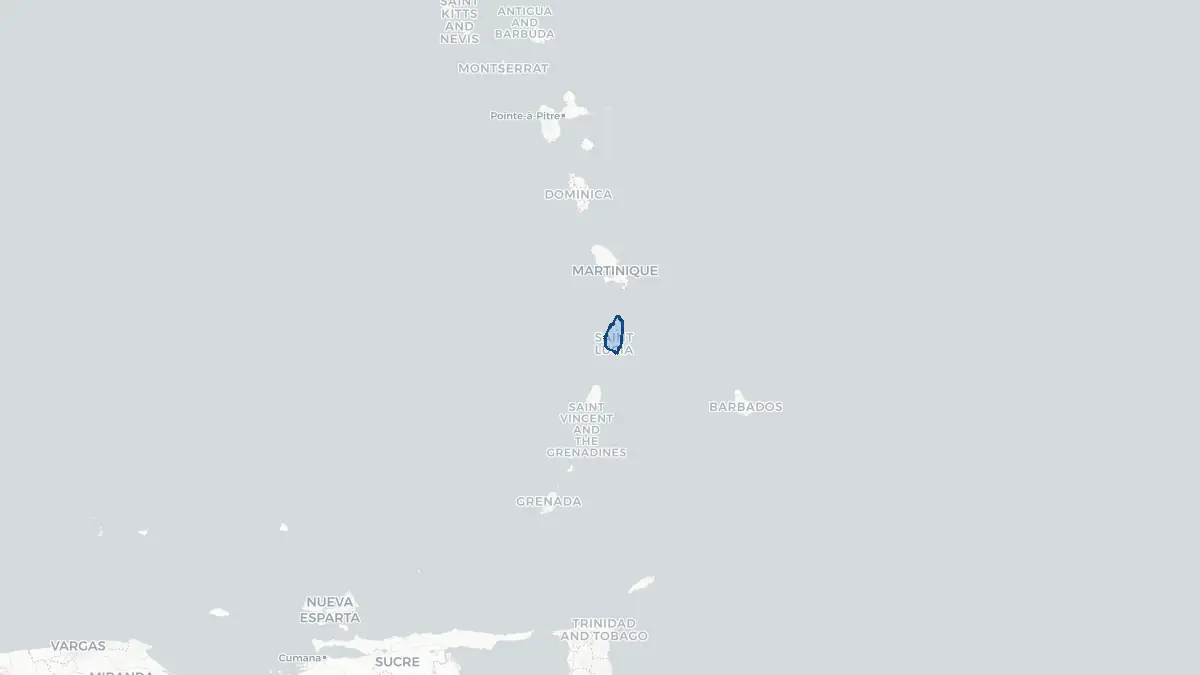
Here you find a map of Saint Lucia, capital Castries, currency Östkaribisk dollar and quick links to more facts about the country in North America.
About the country
Saint Lucia on the map
About Saint Lucia
Saint Lucia is a small island nation in the eastern Caribbean Sea, part of the Lesser Antilles and specifically the Windward Islands. It lies between Martinique to the north and Saint Vincent to the south. The capital is Castries, which is also the country's main port and commercial centre, home to roughly 70,000 people. The island's total population is approximately 185,000. Saint Lucia is an independent constitutional monarchy, with the British monarch as head of state represented by a governor-general, and a parliamentary system of government. The country became independent on 22 February 1979 and is a member of CARICOM and the Commonwealth. The economy is heavily dependent on tourism, which centres on the island's dramatic scenery, particularly the Piton mountains and the volcanic hot springs near Soufrière. Banana cultivation was historically important but declined sharply after the loss of preferential trade arrangements with the European Union. Saint Lucia has produced two Nobel laureates — economist Arthur Lewis and poet Derek Walcott — a remarkable distinction for a country of its size.
Geography and Landscape
Saint Lucia covers approximately 616 square kilometres, making it one of the larger Windward Islands. The island is of volcanic origin and has a mountainous, forested interior. The two Piton mountains on the southwestern coast — Gros Piton at 771 metres and Petit Piton at 743 metres — are the island's most iconic landmarks and together constitute a UNESCO World Heritage Site. The Qualibou volcanic complex in the south contains a drive-in volcano, sulphur springs, and boiling mud pools near the town of Soufrière. The Barre de l'Isle ridge runs north to south through the centre of the island, dividing it into windward and leeward coasts. The Atlantic coast to the east is rugged and wave-battered, while the Caribbean coast to the west is calmer, with sheltered bays and beaches. The Cul de Sac and Roseau valleys in the interior were historically important for banana and sugar cultivation. Rainforest covers much of the highlands, and the island receives significant rainfall, especially on the windward side.
History
Saint Lucia was originally inhabited by the Arawak people, who were later displaced by the Caribs. European settlement proved difficult in early years: English and French settlers alternated control of the island throughout the seventeenth and eighteenth centuries, earning it the nickname "Helen of the West Indies." The French established the first permanent European colony around 1660, and under French rule the plantation economy was developed using enslaved African labour, producing sugar, tobacco, and cotton. The island changed hands fourteen times between France and Britain before finally becoming a British possession under the Treaty of Paris in 1814. Enslaved people were emancipated in 1834. Saint Lucia was administered as part of the British Windward Islands colony. The island became an Associated State of the United Kingdom in 1967, gaining full control over internal affairs, and achieved full independence on 22 February 1979. The country's political life has been shaped by the alternating governments of the Saint Lucia Labour Party and the United Workers Party, both founded by prominent national figures of the mid-twentieth century.
Geo Quiz
Think you know your capitals, flags, and continents? Take the quiz!
Neighbouring countries
Continue to nearby countries
There are no registered neighbouring countries for Saint Lucia in the current database.
More countries in the same part of the world
North America index
Open the continent hub for North America to see the full country list, capitals and frequently asked questions on one page.
Interactive map
Zoomable map of Saint Lucia
Country index
All countries by continent
Jump directly to the right section or keep scrolling.
Africa
58 countries- Algeria
- Angola
- Benin
- Botswana
- Burkina Faso
- Burundi
- Central African Republic
- Djibouti
- Democratic Republic of the Congo
- Egypt
- Equatorial Guinea
- Ivory Coast
- Eritrea
- Ethiopia
- Gabon
- Gambia
- Ghana
- Guinea
- Guinea-Bissau
- Cameroon
- Cape Verde
- Kenya
- Comoros
- Republic of the Congo
- Lesotho
- Liberia
- Libya
- Madagascar
- Malawi
- Mali
- Morocco
- Mauritania
- Mauritius
- Mayotte
- Mozambique
- Namibia
- Niger
- Nigeria
- Reunion
- Rwanda
- Saint Helena
- Sao Tome and Principe
- Senegal
- Seychelles
- Sierra Leone
- Somalia
- Sudan
- Swaziland
- South Africa
- South Sudan
- Tanzania
- Chad
- Togo
- Tunisia
- Uganda
- Western Sahara
- Zambia
- Zimbabwe
Asia
52 countries- Afghanistan
- Armenia
- Azerbaijan
- Bahrain
- Bangladesh
- Bhutan
- British Indian Ocean Territory
- Brunei
- Myanmar
- Philippines
- United Arab Emirates
- Georgia
- Hong Kong
- India
- Indonesia
- Iraq
- Iran
- Israel
- Japan
- Yemen
- Jordan
- Christmas Island
- Cambodia
- Kazakhstan
- China
- Kyrgyzstan
- Cocos Islands
- Kuwait
- Laos
- Lebanon
- Macau
- Malaysia
- Maldives
- Mongolia
- Nepal
- North Korea
- Oman
- Pakistan
- Palestinian Territory
- Qatar
- Saudi Arabia
- Singapore
- Sri Lanka
- South Korea
- Syria
- Tajikistan
- Taiwan
- Thailand
- Turkey
- Turkmenistan
- Uzbekistan
- Vietnam
Europe
53 countries- Albania
- Andorra
- Belgium
- Bosnia and Herzegovina
- Bulgaria
- Cyprus
- Denmark
- Estonia
- Finland
- France
- Faroe Islands
- Gibraltar
- Greece
- Guernsey
- Ireland
- Iceland
- Isle of Man
- Italy
- Jersey
- Kosovo
- Croatia
- Latvia
- Liechtenstein
- Lithuania
- Luxembourg
- Macedonia
- Malta
- Moldova
- Monaco
- Montenegro
- Netherlands
- Norway
- Poland
- Portugal
- Romania
- Russia
- San Marino
- Switzerland
- Serbia
- Slovakia
- Slovenia
- Spain
- United Kingdom
- Svalbard and Jan Mayen
- Sweden
- Czech Republic
- Germany
- Ukraine
- Hungary
- Vatican
- Belarus
- Aland Islands
- Austria
North America
42 countries- U.S. Virgin Islands
- Anguilla
- Antigua and Barbuda
- Aruba
- Bahamas
- Barbados
- Belize
- Bermuda
- Bonaire, Saint Eustatius and Saba
- British Virgin Islands
- Cayman Islands
- Costa Rica
- Curacao
- Dominica
- Dominican Republic
- El Salvador
- Grenada
- Greenland
- Guadeloupe
- Guatemala
- Haiti
- Honduras
- Jamaica
- Canada
- Cuba
- Martinique
- Mexico
- Montserrat
- Netherlands Antilles
- Nicaragua
- Panama
- Puerto Rico
- Saint Barthelemy
- Saint Kitts and Nevis
- Saint Lucia
- Saint Martin
- Saint Vincent and the Grenadines
- Saint Pierre and Miquelon
- Sint Maarten
- Trinidad and Tobago
- Turks and Caicos Islands
- United States
South America
14 countriesOceania
27 countries- American Samoa
- Australia
- Cook Islands
- Fiji
- French Polynesia
- United States Minor Outlying Islands
- Guam
- Kiribati
- Marshall Islands
- Micronesia
- Nauru
- Niue
- Northern Mariana Islands
- Norfolk Island
- New Caledonia
- New Zealand
- Palau
- Papua New Guinea
- Pitcairn
- Solomon Islands
- Samoa
- Tokelau
- Tonga
- Tuvalu
- Vanuatu
- Wallis and Futuna
- East Timor