
South America
Colombia — map and facts
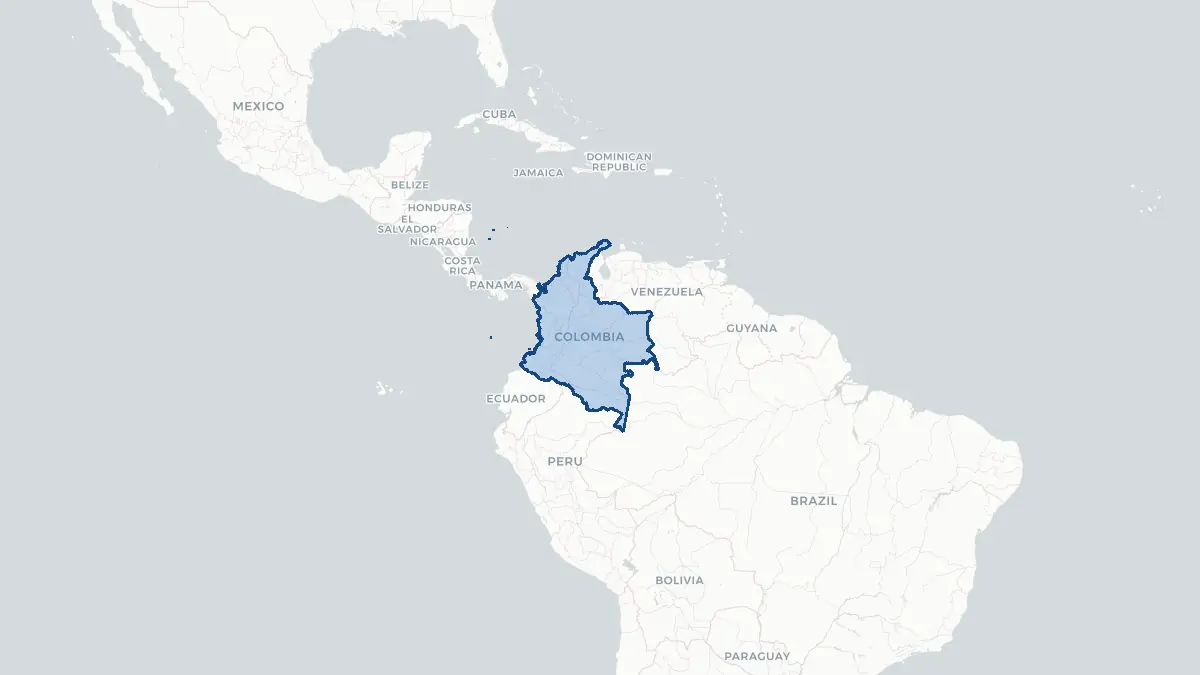
Here you find a map of Colombia, capital Bogota, currency Peso and quick links to more facts about the country in South America.
About the country
Colombia on the map
About Colombia
Colombia is a country of approximately 51 million people located in the northwestern corner of South America, bordering Panama, Venezuela, Brazil, Ecuador, and Peru, as well as the Caribbean Sea and the Pacific Ocean. It is a unitary republic with a presidential system and has Bogotá as its sprawling highland capital. Spanish is the official language, and the population is a rich mestizo mix of indigenous, European, and African heritage. Colombia is famed for its biodiversity—it is one of the world's most megadiverse nations—as well as its music, particularly cumbia and vallenato, its literature through Nobel laureate Gabriel García Márquez, and its world-renowned coffee. It is also one of the largest exporters of cut flowers globally. Despite decades marred by armed conflict between the government, guerrilla groups, and drug cartels, Colombia has undergone remarkable transformation since the 2000s, with falling violence rates, growing tourism, and a dynamic economy driven by oil, mining, and services.
Geography and Landscape
Colombia's geography is among the most varied in the world. The western third of the country is dominated by three parallel ranges of the Andes mountains—the Western, Central, and Eastern Cordilleras—which contain the country's most densely populated valleys and cities. East of the Andes lie the vast Llanos, tropical grassland plains that stretch into Venezuela, and further east the dense Amazon rainforest covers about a third of the national territory. Colombia's two coastlines—Caribbean in the north and Pacific in the west—offer contrasting environments: the Caribbean coast features white-sand beaches and the Sierra Nevada de Santa Marta, the world's highest coastal mountain range, while the Pacific coast is one of the rainiest places on earth. Major rivers include the Magdalena and Cauca, which flow northward through the Andean heartland. Colombia's extraordinary altitude range, from sea level to 5,775 m at Nevado del Huila, creates dozens of distinct ecological zones.
History
Before European arrival, the territory was home to the Muisca, Tairona, and Sinú civilisations, among others. Spanish conquistadors entered the region in the 1500s, and in 1538 Bogotá was founded. Colombia was the heart of the Viceroyalty of New Granada. Independence was achieved in 1819 under Simón Bolívar following the Battle of Boyacá, and Colombia formed part of Gran Colombia until that union dissolved in 1830. The nineteenth and early twentieth centuries were marked by civil wars between Liberal and Conservative factions, most devastatingly in the Thousand Days War (1899–1902). The mid-twentieth century saw La Violencia, a brutal civil conflict that claimed over 200,000 lives. From the 1960s, Marxist guerrilla groups such as the FARC and ELN emerged, and the 1980s–1990s brought the height of drug cartel violence under Pablo Escobar. A peace accord with the FARC was signed in 2016, representing a turning point. Colombia continues to address inequality and implement post-conflict reconstruction.
Geo Quiz
Think you know your capitals, flags, and continents? Take the quiz!
Neighbouring countries
Continue to nearby countries
More countries in the same part of the world
South America index
Open the continent hub for South America to see the full country list, capitals and frequently asked questions on one page.
Interactive map
Zoomable map of Colombia
Country index
All countries by continent
Jump directly to the right section or keep scrolling.
Africa
58 countries- Algeria
- Angola
- Benin
- Botswana
- Burkina Faso
- Burundi
- Central African Republic
- Djibouti
- Democratic Republic of the Congo
- Egypt
- Equatorial Guinea
- Ivory Coast
- Eritrea
- Ethiopia
- Gabon
- Gambia
- Ghana
- Guinea
- Guinea-Bissau
- Cameroon
- Cape Verde
- Kenya
- Comoros
- Republic of the Congo
- Lesotho
- Liberia
- Libya
- Madagascar
- Malawi
- Mali
- Morocco
- Mauritania
- Mauritius
- Mayotte
- Mozambique
- Namibia
- Niger
- Nigeria
- Reunion
- Rwanda
- Saint Helena
- Sao Tome and Principe
- Senegal
- Seychelles
- Sierra Leone
- Somalia
- Sudan
- Swaziland
- South Africa
- South Sudan
- Tanzania
- Chad
- Togo
- Tunisia
- Uganda
- Western Sahara
- Zambia
- Zimbabwe
Asia
52 countries- Afghanistan
- Armenia
- Azerbaijan
- Bahrain
- Bangladesh
- Bhutan
- British Indian Ocean Territory
- Brunei
- Myanmar
- Philippines
- United Arab Emirates
- Georgia
- Hong Kong
- India
- Indonesia
- Iraq
- Iran
- Israel
- Japan
- Yemen
- Jordan
- Christmas Island
- Cambodia
- Kazakhstan
- China
- Kyrgyzstan
- Cocos Islands
- Kuwait
- Laos
- Lebanon
- Macau
- Malaysia
- Maldives
- Mongolia
- Nepal
- North Korea
- Oman
- Pakistan
- Palestinian Territory
- Qatar
- Saudi Arabia
- Singapore
- Sri Lanka
- South Korea
- Syria
- Tajikistan
- Taiwan
- Thailand
- Turkey
- Turkmenistan
- Uzbekistan
- Vietnam
Europe
53 countries- Albania
- Andorra
- Belgium
- Bosnia and Herzegovina
- Bulgaria
- Cyprus
- Denmark
- Estonia
- Finland
- France
- Faroe Islands
- Gibraltar
- Greece
- Guernsey
- Ireland
- Iceland
- Isle of Man
- Italy
- Jersey
- Kosovo
- Croatia
- Latvia
- Liechtenstein
- Lithuania
- Luxembourg
- Macedonia
- Malta
- Moldova
- Monaco
- Montenegro
- Netherlands
- Norway
- Poland
- Portugal
- Romania
- Russia
- San Marino
- Switzerland
- Serbia
- Slovakia
- Slovenia
- Spain
- United Kingdom
- Svalbard and Jan Mayen
- Sweden
- Czech Republic
- Germany
- Ukraine
- Hungary
- Vatican
- Belarus
- Aland Islands
- Austria
North America
42 countries- U.S. Virgin Islands
- Anguilla
- Antigua and Barbuda
- Aruba
- Bahamas
- Barbados
- Belize
- Bermuda
- Bonaire, Saint Eustatius and Saba
- British Virgin Islands
- Cayman Islands
- Costa Rica
- Curacao
- Dominica
- Dominican Republic
- El Salvador
- Grenada
- Greenland
- Guadeloupe
- Guatemala
- Haiti
- Honduras
- Jamaica
- Canada
- Cuba
- Martinique
- Mexico
- Montserrat
- Netherlands Antilles
- Nicaragua
- Panama
- Puerto Rico
- Saint Barthelemy
- Saint Kitts and Nevis
- Saint Lucia
- Saint Martin
- Saint Vincent and the Grenadines
- Saint Pierre and Miquelon
- Sint Maarten
- Trinidad and Tobago
- Turks and Caicos Islands
- United States
South America
14 countriesOceania
27 countries- American Samoa
- Australia
- Cook Islands
- Fiji
- French Polynesia
- United States Minor Outlying Islands
- Guam
- Kiribati
- Marshall Islands
- Micronesia
- Nauru
- Niue
- Northern Mariana Islands
- Norfolk Island
- New Caledonia
- New Zealand
- Palau
- Papua New Guinea
- Pitcairn
- Solomon Islands
- Samoa
- Tokelau
- Tonga
- Tuvalu
- Vanuatu
- Wallis and Futuna
- East Timor