
Oceania
Tuvalu — map and facts
Here you find a map of Tuvalu, capital Funafuti, currency Australien dollar and quick links to more facts about the country in Oceania.
Mini-quiz
Test yourself: 3 questions about Tuvalu
About the country
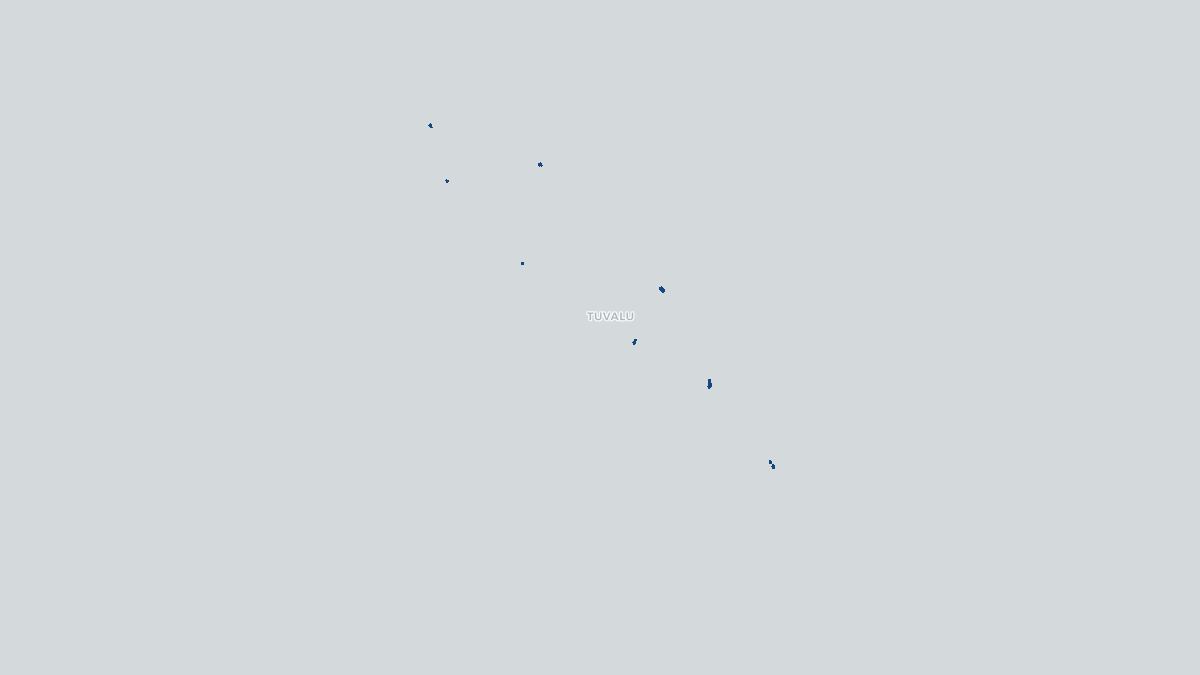
Tuvalu on the map
About Tuvalu
Tuvalu is one of the world's smallest and most remote nations, located in the central Pacific Ocean roughly midway between Hawaii and Australia. It consists of nine low-lying atolls and reef islands, of which eight are inhabited. The capital is Funafuti, the most populous atoll. The total population is approximately 11,000 people, making Tuvalu the fourth smallest country in the world by population. Tuvalu gained independence from Britain on 1 October 1978 and is a constitutional monarchy with the British monarch as head of state. The country entered a Compact of Free Association with Australia in 2023, granting Tuvaluans a pathway to Australian residency in exchange for Australian rights regarding defence and foreign affairs. Tuvalu faces an existential threat from rising sea levels, as no point in the country rises more than five metres above sea level. The economy depends on fishing licences, remittances, postage stamps, and the sale of its internet domain, .tv.
Geography and Landscape
Tuvalu's nine islands stretch across approximately 500 kilometres of ocean in a rough north-south alignment, though the total land area is only about 26 square kilometres, making it the fourth smallest country in the world by area. The islands are all atolls or reef islands, characterised by flat, sandy terrain rarely more than a few metres above sea level. Funafuti, the capital atoll, is the largest and contains the main airstrip and government buildings. The other islands are Nanumea, Nanumanga, Niutao, Nui, Vaitupu, Nukufetau, Nukulaelae, and Niulakita. The islands are surrounded by lagoons and coral reefs of high ecological value. Freshwater is scarce and collected through rainwater. The climate is tropical, warm and humid, with rainfall generally sufficient but vulnerable to droughts during La Niña years. Tuvalu is highly vulnerable to storm surges, king tides, and the effects of climate change.
History
Tuvalu has been inhabited for approximately 3,000 years, settled by Polynesian peoples most likely originating from Samoa and Tonga. The islands were largely unknown to Europeans until the eighteenth and nineteenth centuries. British captain Arent Schuyler de Peyster is generally credited with charting the islands in the 1820s, and the group was sometimes known as the Ellice Islands, named after English politician Edward Ellice. Christian missionaries from the London Missionary Society arrived in the 1860s and converted the population relatively rapidly. The islands became a British protectorate in 1892, grouped with the Gilbert Islands. They were administered jointly as the Gilbert and Ellice Islands Colony from 1916. In 1974, the Ellice Islands voted in a referendum to separate from the Gilbert Islands, leading to separate administration, and in 1978 they became independent as Tuvalu, while the Gilbert Islands became Kiribati. In 2023 Tuvalu signed the Falepili Union agreement with Australia, securing climate and security cooperation.
Questions about Tuvalu
What is the capital of Tuvalu?
Funafuti is the capital of Tuvalu.
What currency is used in Tuvalu?
Dollar (AUD) is the currency of Tuvalu.
What languages are spoken in Tuvalu?
Languages spoken in Tuvalu: tvl,en,sm,gil.
In which continent is Tuvalu?
Tuvalu is located in Oceania.
Neighbouring countries
Continue to nearby countries
There are no registered neighbouring countries for Tuvalu in the current database.
More countries in the same part of the world
Oceania index
Open the continent hub for Oceania to see the full country list, capitals and frequently asked questions on one page.
Interactive map
Zoomable map of Tuvalu
Country index
All countries by continent
Jump directly to the right section or keep scrolling.
Africa
58 countries- Algeria
- Angola
- Benin
- Botswana
- Burkina Faso
- Burundi
- Central African Republic
- Djibouti
- Democratic Republic of the Congo
- Egypt
- Equatorial Guinea
- Ivory Coast
- Eritrea
- Eswatini
- Ethiopia
- Gabon
- Gambia
- Ghana
- Guinea
- Guinea-Bissau
- Cameroon
- Cape Verde
- Kenya
- Comoros
- Republic of the Congo
- Lesotho
- Liberia
- Libya
- Madagascar
- Malawi
- Mali
- Morocco
- Mauritania
- Mauritius
- Mayotte
- Mozambique
- Namibia
- Niger
- Nigeria
- Reunion
- Rwanda
- Saint Helena
- Sao Tome and Principe
- Senegal
- Seychelles
- Sierra Leone
- Somalia
- Sudan
- South Africa
- South Sudan
- Tanzania
- Chad
- Togo
- Tunisia
- Uganda
- Western Sahara
- Zambia
- Zimbabwe
Asia
52 countries- Afghanistan
- Armenia
- Azerbaijan
- Bahrain
- Bangladesh
- Bhutan
- British Indian Ocean Territory
- Brunei
- Philippines
- United Arab Emirates
- Georgia
- Hong Kong
- India
- Indonesia
- Iraq
- Iran
- Israel
- Japan
- Yemen
- Jordan
- Christmas Island
- Cambodia
- Kazakhstan
- China
- Kyrgyzstan
- Cocos Islands
- Kuwait
- Laos
- Lebanon
- Macau
- Malaysia
- Maldives
- Mongolia
- Myanmar
- Nepal
- North Korea
- Oman
- Pakistan
- Palestinian Territory
- Qatar
- Saudi Arabia
- Singapore
- Sri Lanka
- South Korea
- Syria
- Tajikistan
- Taiwan
- Thailand
- Turkey
- Turkmenistan
- Uzbekistan
- Vietnam
Europe
53 countries- Albania
- Andorra
- Belarus
- Belgium
- Bosnia and Herzegovina
- Bulgaria
- Cyprus
- Denmark
- Estonia
- Finland
- France
- Faroe Islands
- Gibraltar
- Greece
- Guernsey
- Ireland
- Iceland
- Isle of Man
- Italy
- Jersey
- Kosovo
- Croatia
- Latvia
- Liechtenstein
- Lithuania
- Luxembourg
- Malta
- Moldova
- Monaco
- Montenegro
- Netherlands
- North Macedonia
- Norway
- Poland
- Portugal
- Romania
- Russia
- San Marino
- Switzerland
- Serbia
- Slovakia
- Slovenia
- Spain
- United Kingdom
- Svalbard and Jan Mayen
- Sweden
- Czech Republic
- Germany
- Ukraine
- Hungary
- Vatican
- Aland Islands
- Austria
North America
42 countries- U.S. Virgin Islands
- Anguilla
- Antigua and Barbuda
- Aruba
- Bahamas
- Barbados
- Belize
- Bermuda
- Bonaire, Saint Eustatius and Saba
- British Virgin Islands
- Cayman Islands
- Costa Rica
- Curacao
- Dominica
- Dominican Republic
- El Salvador
- Grenada
- Greenland
- Guadeloupe
- Guatemala
- Haiti
- Honduras
- Jamaica
- Canada
- Cuba
- Martinique
- Mexico
- Montserrat
- Netherlands Antilles
- Nicaragua
- Panama
- Puerto Rico
- Saint Barthelemy
- Saint Kitts and Nevis
- Saint Lucia
- Saint Martin
- Saint Vincent and the Grenadines
- Saint Pierre and Miquelon
- Sint Maarten
- Trinidad and Tobago
- Turks and Caicos Islands
- United States
South America
14 countriesOceania
27 countries- American Samoa
- Australia
- Cook Islands
- Fiji
- French Polynesia
- United States Minor Outlying Islands
- Guam
- Kiribati
- Marshall Islands
- Micronesia
- Nauru
- Niue
- Northern Mariana Islands
- Norfolk Island
- New Caledonia
- New Zealand
- Palau
- Papua New Guinea
- Pitcairn
- Solomon Islands
- Samoa
- Tokelau
- Tonga
- Tuvalu
- Vanuatu
- Wallis and Futuna
- East Timor