
Europe
Switzerland — map and facts
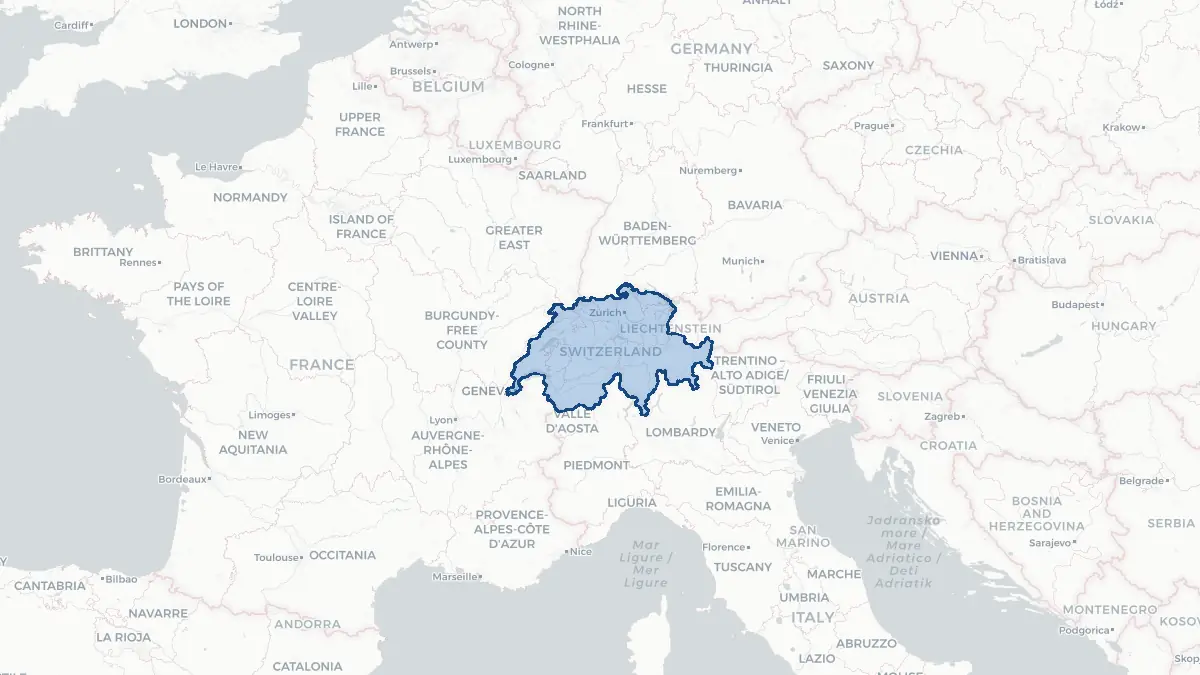
Here you find a map of Switzerland, capital Berne, currency Schweiziska franc and quick links to more facts about the country in Europe.
About the country
Switzerland on the map
Switzerland is a small, landlocked country in the heart of Western Europe, known for its Alpine scenery, political neutrality and high standard of living. Its capital is Bern, though Zurich is the largest city, and the country covers about 41,000 square kilometres with a population of around 8.7 million. Switzerland uses the Swiss franc as its currency.
About Switzerland
Switzerland is a federal state with four official languages — German, French, Italian and Romansh — and is not a member of the European Union, though it has a broad network of bilateral agreements with it. It is renowned for its political stability, direct democracy and neutrality, which it has maintained since 1815. The country hosts numerous international organisations, including the Red Cross headquarters and many UN agencies in Geneva.
Geography and landscape
Switzerland borders Germany to the north, Austria and Liechtenstein to the east, Italy to the south, and France to the west. The country is divided into three main zones: the Jura mountains in the north-west, the Swiss Plateau in the centre where most of the population lives, and the Alps in the south, covering roughly two-thirds of the country. The Alps include iconic peaks such as the Matterhorn (4,478 m) and Monte Rosa (4,634 m). The Rhine, Rhône, Inn and Ticino rivers all rise in Switzerland. Lake Geneva and Lake Constance are among the prominent lakes.
History
The Swiss Confederation traces its origins to alliances among Alpine cantons in 1291. It expanded through the late medieval period and successfully resisted Burgundian and Habsburg power. The Reformation, associated with Ulrich Zwingli in Zurich and John Calvin in Geneva, had a lasting impact on European religious life. Napoleonic forces occupied Switzerland at the end of the eighteenth century, but the Congress of Vienna in 1815 recognised its perpetual neutrality. Switzerland avoided involvement in both World Wars. Women gained the right to vote in federal elections in 1971. The country joined the United Nations only in 2002.
Economy and currency
Switzerland has one of the highest per capita incomes in the world. Its economy is built on banking and finance, pharmaceuticals, precision engineering, watches and tourism. Zurich and Geneva are leading global financial centres. The currency is the Swiss franc (CHF), one of the world's most stable currencies and a traditional safe-haven asset.
Culture and language
Switzerland's four official languages reflect its cultural diversity: German in the east and centre, French in the west (Romandy), Italian in Ticino, and Romansh in parts of Graubünden. The country is known for its watchmaking tradition, Alpine folk culture and a strong system of direct democracy in which citizens vote on legislation and constitutional amendments. The Swiss flag — a white cross on a red square — is one of the most recognised national symbols in the world.
Frequently asked questions
What is the capital of Switzerland? The capital of Switzerland is Bern, which serves as the seat of the federal government. Zurich is the largest city and the main financial centre.
What currency is used in Switzerland? Switzerland uses the Swiss franc (CHF). Switzerland is not a member of the EU and has not adopted the euro.
How many official languages does Switzerland have? Switzerland has four official languages: German, French, Italian and Romansh.
Geo Quiz
Think you know your capitals, flags, and continents? Take the quiz!
Neighbouring countries
Continue to nearby countries
More countries in the same part of the world
Europe index
Open the continent hub for Europe to see the full country list, capitals and frequently asked questions on one page.
Interactive map
Zoomable map of Switzerland
Country index
All countries by continent
Jump directly to the right section or keep scrolling.
Africa
58 countries- Algeria
- Angola
- Benin
- Botswana
- Burkina Faso
- Burundi
- Central African Republic
- Djibouti
- Democratic Republic of the Congo
- Egypt
- Equatorial Guinea
- Ivory Coast
- Eritrea
- Ethiopia
- Gabon
- Gambia
- Ghana
- Guinea
- Guinea-Bissau
- Cameroon
- Cape Verde
- Kenya
- Comoros
- Republic of the Congo
- Lesotho
- Liberia
- Libya
- Madagascar
- Malawi
- Mali
- Morocco
- Mauritania
- Mauritius
- Mayotte
- Mozambique
- Namibia
- Niger
- Nigeria
- Reunion
- Rwanda
- Saint Helena
- Sao Tome and Principe
- Senegal
- Seychelles
- Sierra Leone
- Somalia
- Sudan
- Swaziland
- South Africa
- South Sudan
- Tanzania
- Chad
- Togo
- Tunisia
- Uganda
- Western Sahara
- Zambia
- Zimbabwe
Asia
52 countries- Afghanistan
- Armenia
- Azerbaijan
- Bahrain
- Bangladesh
- Bhutan
- British Indian Ocean Territory
- Brunei
- Myanmar
- Philippines
- United Arab Emirates
- Georgia
- Hong Kong
- India
- Indonesia
- Iraq
- Iran
- Israel
- Japan
- Yemen
- Jordan
- Christmas Island
- Cambodia
- Kazakhstan
- China
- Kyrgyzstan
- Cocos Islands
- Kuwait
- Laos
- Lebanon
- Macau
- Malaysia
- Maldives
- Mongolia
- Nepal
- North Korea
- Oman
- Pakistan
- Palestinian Territory
- Qatar
- Saudi Arabia
- Singapore
- Sri Lanka
- South Korea
- Syria
- Tajikistan
- Taiwan
- Thailand
- Turkey
- Turkmenistan
- Uzbekistan
- Vietnam
Europe
53 countries- Albania
- Andorra
- Belgium
- Bosnia and Herzegovina
- Bulgaria
- Cyprus
- Denmark
- Estonia
- Finland
- France
- Faroe Islands
- Gibraltar
- Greece
- Guernsey
- Ireland
- Iceland
- Isle of Man
- Italy
- Jersey
- Kosovo
- Croatia
- Latvia
- Liechtenstein
- Lithuania
- Luxembourg
- Macedonia
- Malta
- Moldova
- Monaco
- Montenegro
- Netherlands
- Norway
- Poland
- Portugal
- Romania
- Russia
- San Marino
- Switzerland
- Serbia
- Slovakia
- Slovenia
- Spain
- United Kingdom
- Svalbard and Jan Mayen
- Sweden
- Czech Republic
- Germany
- Ukraine
- Hungary
- Vatican
- Belarus
- Aland Islands
- Austria
North America
42 countries- U.S. Virgin Islands
- Anguilla
- Antigua and Barbuda
- Aruba
- Bahamas
- Barbados
- Belize
- Bermuda
- Bonaire, Saint Eustatius and Saba
- British Virgin Islands
- Cayman Islands
- Costa Rica
- Curacao
- Dominica
- Dominican Republic
- El Salvador
- Grenada
- Greenland
- Guadeloupe
- Guatemala
- Haiti
- Honduras
- Jamaica
- Canada
- Cuba
- Martinique
- Mexico
- Montserrat
- Netherlands Antilles
- Nicaragua
- Panama
- Puerto Rico
- Saint Barthelemy
- Saint Kitts and Nevis
- Saint Lucia
- Saint Martin
- Saint Vincent and the Grenadines
- Saint Pierre and Miquelon
- Sint Maarten
- Trinidad and Tobago
- Turks and Caicos Islands
- United States
South America
14 countriesOceania
27 countries- American Samoa
- Australia
- Cook Islands
- Fiji
- French Polynesia
- United States Minor Outlying Islands
- Guam
- Kiribati
- Marshall Islands
- Micronesia
- Nauru
- Niue
- Northern Mariana Islands
- Norfolk Island
- New Caledonia
- New Zealand
- Palau
- Papua New Guinea
- Pitcairn
- Solomon Islands
- Samoa
- Tokelau
- Tonga
- Tuvalu
- Vanuatu
- Wallis and Futuna
- East Timor