
Europe
Slovenia — map and facts
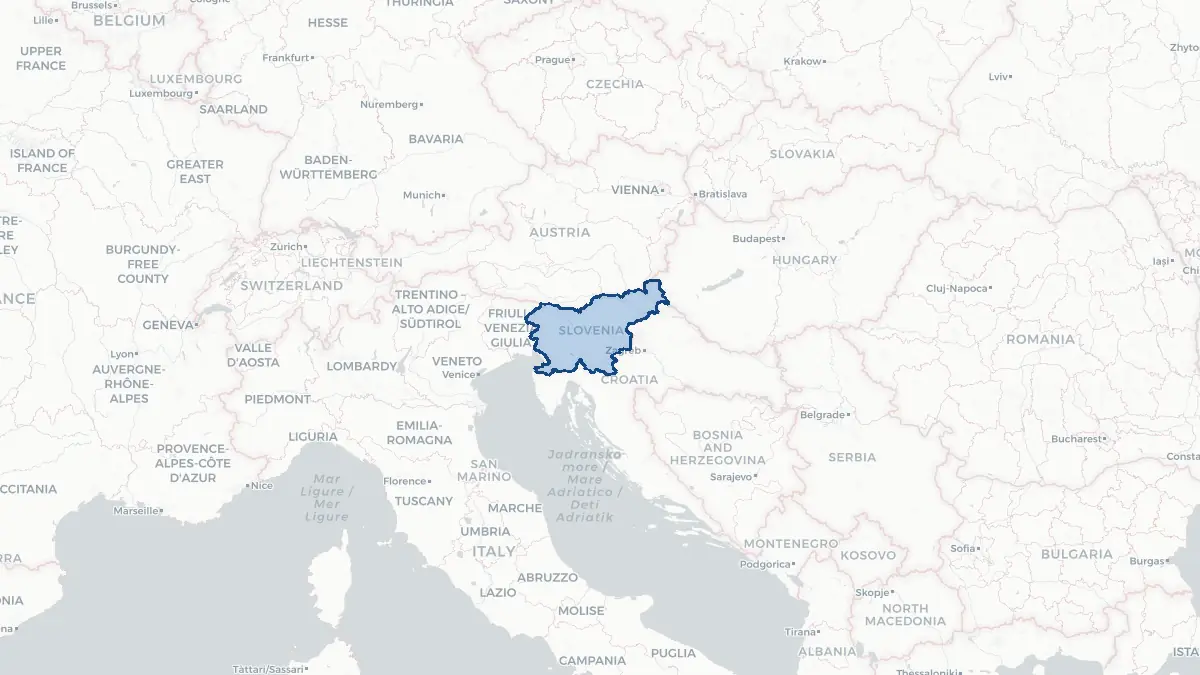
Here you find a map of Slovenia, capital Ljubljana, currency Euro and quick links to more facts about the country in Europe.
About the country
Slovenia on the map
About Slovenia
Slovenia is a small Central European nation of approximately 2.1 million people, bordered by Austria, Hungary, Croatia, and Italy, with a short coastline on the Adriatic Sea. Its capital is Ljubljana, known for its charming baroque old town and car-free city centre. Slovenia was the first Yugoslav republic to declare independence, doing so in June 1991, and joined both NATO and the EU in 2004, adopting the euro in 2007. It has consistently been the most economically successful of the former Yugoslav states. The official language is Slovenian, a South Slavic language. Slovenia has a high Human Development Index, strong manufacturing and tourism sectors, and a quality of life among the highest in Central and Eastern Europe.
Geography and Landscape
Slovenia's compact territory encompasses extraordinary geographic diversity. The Julian Alps in the northwest, including Triglav (2,864 m) — the national symbol — form some of the most spectacular alpine scenery in Europe. The So?a (Isonzo) river valley, renowned for its emerald waters, runs through this region. The Karst plateau in the southwest gives its name to karst topography worldwide and contains Postojna Cave and Škocjan Caves (UNESCO). The Pannonian lowlands in the northeast support agriculture. The short Adriatic coast around Koper features Mediterranean flora and a mild climate. The Sava and Drava rivers drain the country northward. Triglav National Park protects the alpine core. Slovenia has one of the highest forest-cover ratios in Europe at nearly 60 per cent.
History
Slavic tribes settled the eastern Alps in the sixth and seventh centuries. The region became part of the Frankish Empire and later the Habsburg domains, where it remained for several centuries under Austrian and later Austro-Hungarian rule. Slovenian national consciousness grew through the nineteenth century, especially through the poet France Prešeren and the Romantic national awakening. After the First World War, Slovenia became part of the Kingdom of Serbs, Croats, and Slovenes (later Yugoslavia). During the Second World War, Slovenia was divided among Nazi Germany, Fascist Italy, and Hungary. After 1945 it was the most northwesterly and economically advanced republic of socialist Yugoslavia. Slovenia declared independence on 25 June 1991; the Ten-Day War with Yugoslavia followed but ended quickly. It joined NATO and the EU in 2004.
Geo Quiz
Think you know your capitals, flags, and continents? Take the quiz!
Neighbouring countries
Continue to nearby countries
More countries in the same part of the world
Europe index
Open the continent hub for Europe to see the full country list, capitals and frequently asked questions on one page.
Interactive map
Zoomable map of Slovenia
Country index
All countries by continent
Jump directly to the right section or keep scrolling.
Africa
58 countries- Algeria
- Angola
- Benin
- Botswana
- Burkina Faso
- Burundi
- Central African Republic
- Djibouti
- Democratic Republic of the Congo
- Egypt
- Equatorial Guinea
- Ivory Coast
- Eritrea
- Ethiopia
- Gabon
- Gambia
- Ghana
- Guinea
- Guinea-Bissau
- Cameroon
- Cape Verde
- Kenya
- Comoros
- Republic of the Congo
- Lesotho
- Liberia
- Libya
- Madagascar
- Malawi
- Mali
- Morocco
- Mauritania
- Mauritius
- Mayotte
- Mozambique
- Namibia
- Niger
- Nigeria
- Reunion
- Rwanda
- Saint Helena
- Sao Tome and Principe
- Senegal
- Seychelles
- Sierra Leone
- Somalia
- Sudan
- Swaziland
- South Africa
- South Sudan
- Tanzania
- Chad
- Togo
- Tunisia
- Uganda
- Western Sahara
- Zambia
- Zimbabwe
Asia
52 countries- Afghanistan
- Armenia
- Azerbaijan
- Bahrain
- Bangladesh
- Bhutan
- British Indian Ocean Territory
- Brunei
- Myanmar
- Philippines
- United Arab Emirates
- Georgia
- Hong Kong
- India
- Indonesia
- Iraq
- Iran
- Israel
- Japan
- Yemen
- Jordan
- Christmas Island
- Cambodia
- Kazakhstan
- China
- Kyrgyzstan
- Cocos Islands
- Kuwait
- Laos
- Lebanon
- Macau
- Malaysia
- Maldives
- Mongolia
- Nepal
- North Korea
- Oman
- Pakistan
- Palestinian Territory
- Qatar
- Saudi Arabia
- Singapore
- Sri Lanka
- South Korea
- Syria
- Tajikistan
- Taiwan
- Thailand
- Turkey
- Turkmenistan
- Uzbekistan
- Vietnam
Europe
53 countries- Albania
- Andorra
- Belgium
- Bosnia and Herzegovina
- Bulgaria
- Cyprus
- Denmark
- Estonia
- Finland
- France
- Faroe Islands
- Gibraltar
- Greece
- Guernsey
- Ireland
- Iceland
- Isle of Man
- Italy
- Jersey
- Kosovo
- Croatia
- Latvia
- Liechtenstein
- Lithuania
- Luxembourg
- Macedonia
- Malta
- Moldova
- Monaco
- Montenegro
- Netherlands
- Norway
- Poland
- Portugal
- Romania
- Russia
- San Marino
- Switzerland
- Serbia
- Slovakia
- Slovenia
- Spain
- United Kingdom
- Svalbard and Jan Mayen
- Sweden
- Czech Republic
- Germany
- Ukraine
- Hungary
- Vatican
- Belarus
- Aland Islands
- Austria
North America
42 countries- U.S. Virgin Islands
- Anguilla
- Antigua and Barbuda
- Aruba
- Bahamas
- Barbados
- Belize
- Bermuda
- Bonaire, Saint Eustatius and Saba
- British Virgin Islands
- Cayman Islands
- Costa Rica
- Curacao
- Dominica
- Dominican Republic
- El Salvador
- Grenada
- Greenland
- Guadeloupe
- Guatemala
- Haiti
- Honduras
- Jamaica
- Canada
- Cuba
- Martinique
- Mexico
- Montserrat
- Netherlands Antilles
- Nicaragua
- Panama
- Puerto Rico
- Saint Barthelemy
- Saint Kitts and Nevis
- Saint Lucia
- Saint Martin
- Saint Vincent and the Grenadines
- Saint Pierre and Miquelon
- Sint Maarten
- Trinidad and Tobago
- Turks and Caicos Islands
- United States
South America
14 countriesOceania
27 countries- American Samoa
- Australia
- Cook Islands
- Fiji
- French Polynesia
- United States Minor Outlying Islands
- Guam
- Kiribati
- Marshall Islands
- Micronesia
- Nauru
- Niue
- Northern Mariana Islands
- Norfolk Island
- New Caledonia
- New Zealand
- Palau
- Papua New Guinea
- Pitcairn
- Solomon Islands
- Samoa
- Tokelau
- Tonga
- Tuvalu
- Vanuatu
- Wallis and Futuna
- East Timor