
Europe
Croatia — map and facts
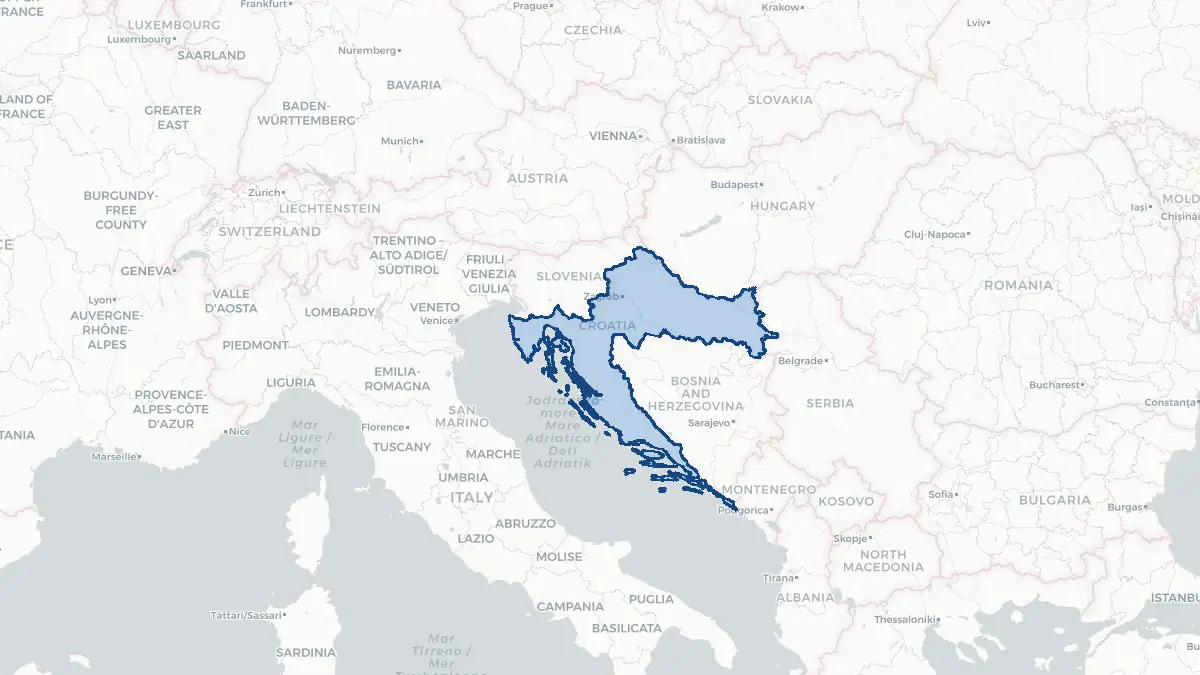
Here you find a map of Croatia, capital Zagreb, currency Euro and quick links to more facts about the country in Europe.
About the country
Croatia on the map
Croatia is a crescent-shaped country on the eastern shore of the Adriatic Sea in South-East Europe. Its capital is Zagreb, and the country covers about 56,600 square kilometres with a population of roughly 3.9 million. Croatia has used the euro as its currency since January 2023.
About Croatia
Croatia is a democratic republic and has been a member of the European Union since 2013 and of NATO since 2009. It joined the Schengen Area and the eurozone simultaneously at the start of 2023. The country is a popular tourist destination owing to its long Adriatic coastline, historic walled cities and Mediterranean climate.
Geography and landscape
Croatia borders Slovenia and Hungary to the north, Serbia to the north-east, Bosnia and Herzegovina to the east and south-east, and Montenegro to the far south. Geographically it divides into three regions: the Pannonian lowlands in the east (Slavonia), the mountainous Dinaric hinterland, and the long Adriatic coastal strip comprising Dalmatia and Istria. The Dalmatian coast features limestone cliffs, peninsulas and over a thousand islands. The Plitvice Lakes, a UNESCO World Heritage Site, are among the country's best-known natural features.
History
Croats settled the region in the seventh century and established a medieval kingdom that reached its height in the early eleventh century. Croatia entered a personal union with Hungary in 1102 and was later contested between the Ottoman Empire and the Habsburgs. After the First World War it joined the Kingdom of Serbs, Croats and Slovenes, which became Yugoslavia. Croatia declared independence from Yugoslavia in 1991, leading to the Croatian War of Independence, which ended in 1995. The country then pursued EU and NATO integration before joining both organisations.
Economy and currency
Tourism is a major pillar of Croatia's economy, bringing in significant foreign currency earnings through the Adriatic coast. Other sectors include manufacturing, shipbuilding, chemicals and agriculture. Croatia replaced the Croatian kuna with the euro in January 2023 when it joined the eurozone.
Culture and language
The official language is Croatian, a South Slavic language. Croatia has a rich cultural heritage that spans Roman, Venetian, Habsburg and Yugoslav influences, visible particularly in coastal cities such as Dubrovnik, Split and Zadar. Traditional music, folk dance and a culinary culture centred on seafood and Mediterranean produce are important features of local life.
Frequently asked questions
What is the capital of Croatia? The capital of Croatia is Zagreb, located in the north of the country. It is also Croatia's largest city and its political and cultural centre.
What currency is used in Croatia? Croatia has used the euro since January 2023, when it replaced the Croatian kuna upon joining the eurozone.
Is Croatia in the Schengen Area? Yes. Croatia joined the Schengen Area on 1 January 2023, the same date it adopted the euro.
Geo Quiz
Think you know your capitals, flags, and continents? Take the quiz!
Neighbouring countries
Continue to nearby countries
More countries in the same part of the world
Europe index
Open the continent hub for Europe to see the full country list, capitals and frequently asked questions on one page.
Interactive map
Zoomable map of Croatia
Country index
All countries by continent
Jump directly to the right section or keep scrolling.
Africa
58 countries- Algeria
- Angola
- Benin
- Botswana
- Burkina Faso
- Burundi
- Central African Republic
- Djibouti
- Democratic Republic of the Congo
- Egypt
- Equatorial Guinea
- Ivory Coast
- Eritrea
- Ethiopia
- Gabon
- Gambia
- Ghana
- Guinea
- Guinea-Bissau
- Cameroon
- Cape Verde
- Kenya
- Comoros
- Republic of the Congo
- Lesotho
- Liberia
- Libya
- Madagascar
- Malawi
- Mali
- Morocco
- Mauritania
- Mauritius
- Mayotte
- Mozambique
- Namibia
- Niger
- Nigeria
- Reunion
- Rwanda
- Saint Helena
- Sao Tome and Principe
- Senegal
- Seychelles
- Sierra Leone
- Somalia
- Sudan
- Swaziland
- South Africa
- South Sudan
- Tanzania
- Chad
- Togo
- Tunisia
- Uganda
- Western Sahara
- Zambia
- Zimbabwe
Asia
52 countries- Afghanistan
- Armenia
- Azerbaijan
- Bahrain
- Bangladesh
- Bhutan
- British Indian Ocean Territory
- Brunei
- Myanmar
- Philippines
- United Arab Emirates
- Georgia
- Hong Kong
- India
- Indonesia
- Iraq
- Iran
- Israel
- Japan
- Yemen
- Jordan
- Christmas Island
- Cambodia
- Kazakhstan
- China
- Kyrgyzstan
- Cocos Islands
- Kuwait
- Laos
- Lebanon
- Macau
- Malaysia
- Maldives
- Mongolia
- Nepal
- North Korea
- Oman
- Pakistan
- Palestinian Territory
- Qatar
- Saudi Arabia
- Singapore
- Sri Lanka
- South Korea
- Syria
- Tajikistan
- Taiwan
- Thailand
- Turkey
- Turkmenistan
- Uzbekistan
- Vietnam
Europe
53 countries- Albania
- Andorra
- Belgium
- Bosnia and Herzegovina
- Bulgaria
- Cyprus
- Denmark
- Estonia
- Finland
- France
- Faroe Islands
- Gibraltar
- Greece
- Guernsey
- Ireland
- Iceland
- Isle of Man
- Italy
- Jersey
- Kosovo
- Croatia
- Latvia
- Liechtenstein
- Lithuania
- Luxembourg
- Macedonia
- Malta
- Moldova
- Monaco
- Montenegro
- Netherlands
- Norway
- Poland
- Portugal
- Romania
- Russia
- San Marino
- Switzerland
- Serbia
- Slovakia
- Slovenia
- Spain
- United Kingdom
- Svalbard and Jan Mayen
- Sweden
- Czech Republic
- Germany
- Ukraine
- Hungary
- Vatican
- Belarus
- Aland Islands
- Austria
North America
42 countries- U.S. Virgin Islands
- Anguilla
- Antigua and Barbuda
- Aruba
- Bahamas
- Barbados
- Belize
- Bermuda
- Bonaire, Saint Eustatius and Saba
- British Virgin Islands
- Cayman Islands
- Costa Rica
- Curacao
- Dominica
- Dominican Republic
- El Salvador
- Grenada
- Greenland
- Guadeloupe
- Guatemala
- Haiti
- Honduras
- Jamaica
- Canada
- Cuba
- Martinique
- Mexico
- Montserrat
- Netherlands Antilles
- Nicaragua
- Panama
- Puerto Rico
- Saint Barthelemy
- Saint Kitts and Nevis
- Saint Lucia
- Saint Martin
- Saint Vincent and the Grenadines
- Saint Pierre and Miquelon
- Sint Maarten
- Trinidad and Tobago
- Turks and Caicos Islands
- United States
South America
14 countriesOceania
27 countries- American Samoa
- Australia
- Cook Islands
- Fiji
- French Polynesia
- United States Minor Outlying Islands
- Guam
- Kiribati
- Marshall Islands
- Micronesia
- Nauru
- Niue
- Northern Mariana Islands
- Norfolk Island
- New Caledonia
- New Zealand
- Palau
- Papua New Guinea
- Pitcairn
- Solomon Islands
- Samoa
- Tokelau
- Tonga
- Tuvalu
- Vanuatu
- Wallis and Futuna
- East Timor