
Europe
Hungary — map and facts
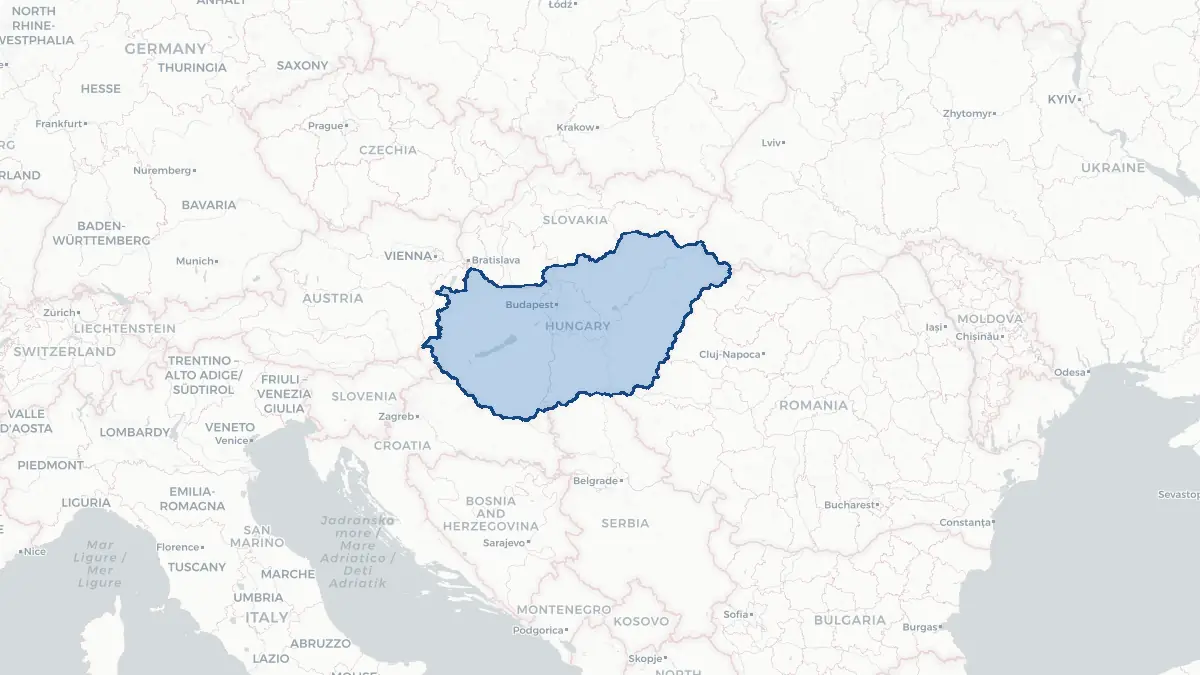
Here you find a map of Hungary, capital Budapest, currency Forint and quick links to more facts about the country in Europe.
About the country
Hungary on the map
Hungary is a landlocked country in Central Europe along the Danube, known for its thermal springs, grand capital and rich cultural traditions. Its capital is Budapest, and the country covers about 93,000 square kilometres with a population of roughly 9.7 million. Hungary uses the Hungarian forint as its currency.
About Hungary
Hungary is a democratic republic and a member of both the European Union and NATO. Its capital, Budapest, was formed from the merger of Buda and Pest in 1873 and is one of Europe's most architecturally striking cities, with impressive historic buildings lining both banks of the Danube. Hungary is known for its thermal spa culture, with dozens of public baths across the country.
Geography and landscape
Hungary borders Austria to the west, Slovakia to the north, Ukraine to the north-east, Romania to the east, Serbia to the south, Croatia to the south-west and Slovenia to the west. The country occupies the Pannonian Basin, a large flat plain surrounded by mountain ranges. The Great Hungarian Plain (Alföld) covers the eastern half of the country. Lake Balaton in the west is the largest lake in Central Europe. The Danube divides the country north to south, while the Tisza is the other major river.
History
The Carpathian Basin was settled by Magyar tribes around 895 CE, and Hungary was founded as a Christian kingdom under Stephen I in 1000 CE. It was a significant Central European power during the medieval period. After the catastrophic defeat at the Battle of Mohács in 1526, much of Hungary fell under Ottoman rule for 150 years. The Habsburgs gradually expelled the Ottomans and incorporated Hungary into their empire. Hungary became a co-equal partner in the Austro-Hungarian Empire in 1867. Under the Treaty of Trianon in 1920, following defeat in the First World War, Hungary lost two-thirds of its territory — an event that remains central to national consciousness. After the Second World War it became a communist state, and the 1956 uprising was crushed by Soviet intervention. Communism ended peacefully in 1989.
Economy and currency
Hungary has a mixed economy with significant foreign investment, particularly in automotive manufacturing, electronics and services. Budapest is an important financial and tourism hub in Central Europe. The currency is the Hungarian forint (HUF). Hungary is an EU member but has not adopted the euro.
Culture and language
Hungarian (Magyar) is the official language and belongs to the Uralic family, making it unrelated to the surrounding Indo-European languages. Hungary has a strong cultural tradition in classical music — Franz Liszt, Béla Bartók and Zoltán Kodály were all Hungarian — as well as in literature and visual arts. The country is celebrated for its cuisine, including goulash and paprika-spiced dishes, and its thermal bath culture is world-renowned.
Frequently asked questions
What is the capital of Hungary? The capital of Hungary is Budapest, formed from the merger of Buda and Pest in 1873. It straddles the Danube and is Hungary's largest city.
What currency is used in Hungary? Hungary uses the Hungarian forint (HUF). It is an EU member but has not adopted the euro.
Is Hungarian related to German or Slavic languages? No. Hungarian belongs to the Uralic language family and is not related to the surrounding German, Slavic or Romance languages.
Geo Quiz
Think you know your capitals, flags, and continents? Take the quiz!
Neighbouring countries
Continue to nearby countries
More countries in the same part of the world
Europe index
Open the continent hub for Europe to see the full country list, capitals and frequently asked questions on one page.
Interactive map
Zoomable map of Hungary
Country index
All countries by continent
Jump directly to the right section or keep scrolling.
Africa
58 countries- Algeria
- Angola
- Benin
- Botswana
- Burkina Faso
- Burundi
- Central African Republic
- Djibouti
- Democratic Republic of the Congo
- Egypt
- Equatorial Guinea
- Ivory Coast
- Eritrea
- Ethiopia
- Gabon
- Gambia
- Ghana
- Guinea
- Guinea-Bissau
- Cameroon
- Cape Verde
- Kenya
- Comoros
- Republic of the Congo
- Lesotho
- Liberia
- Libya
- Madagascar
- Malawi
- Mali
- Morocco
- Mauritania
- Mauritius
- Mayotte
- Mozambique
- Namibia
- Niger
- Nigeria
- Reunion
- Rwanda
- Saint Helena
- Sao Tome and Principe
- Senegal
- Seychelles
- Sierra Leone
- Somalia
- Sudan
- Swaziland
- South Africa
- South Sudan
- Tanzania
- Chad
- Togo
- Tunisia
- Uganda
- Western Sahara
- Zambia
- Zimbabwe
Asia
52 countries- Afghanistan
- Armenia
- Azerbaijan
- Bahrain
- Bangladesh
- Bhutan
- British Indian Ocean Territory
- Brunei
- Myanmar
- Philippines
- United Arab Emirates
- Georgia
- Hong Kong
- India
- Indonesia
- Iraq
- Iran
- Israel
- Japan
- Yemen
- Jordan
- Christmas Island
- Cambodia
- Kazakhstan
- China
- Kyrgyzstan
- Cocos Islands
- Kuwait
- Laos
- Lebanon
- Macau
- Malaysia
- Maldives
- Mongolia
- Nepal
- North Korea
- Oman
- Pakistan
- Palestinian Territory
- Qatar
- Saudi Arabia
- Singapore
- Sri Lanka
- South Korea
- Syria
- Tajikistan
- Taiwan
- Thailand
- Turkey
- Turkmenistan
- Uzbekistan
- Vietnam
Europe
53 countries- Albania
- Andorra
- Belgium
- Bosnia and Herzegovina
- Bulgaria
- Cyprus
- Denmark
- Estonia
- Finland
- France
- Faroe Islands
- Gibraltar
- Greece
- Guernsey
- Ireland
- Iceland
- Isle of Man
- Italy
- Jersey
- Kosovo
- Croatia
- Latvia
- Liechtenstein
- Lithuania
- Luxembourg
- Macedonia
- Malta
- Moldova
- Monaco
- Montenegro
- Netherlands
- Norway
- Poland
- Portugal
- Romania
- Russia
- San Marino
- Switzerland
- Serbia
- Slovakia
- Slovenia
- Spain
- United Kingdom
- Svalbard and Jan Mayen
- Sweden
- Czech Republic
- Germany
- Ukraine
- Hungary
- Vatican
- Belarus
- Aland Islands
- Austria
North America
42 countries- U.S. Virgin Islands
- Anguilla
- Antigua and Barbuda
- Aruba
- Bahamas
- Barbados
- Belize
- Bermuda
- Bonaire, Saint Eustatius and Saba
- British Virgin Islands
- Cayman Islands
- Costa Rica
- Curacao
- Dominica
- Dominican Republic
- El Salvador
- Grenada
- Greenland
- Guadeloupe
- Guatemala
- Haiti
- Honduras
- Jamaica
- Canada
- Cuba
- Martinique
- Mexico
- Montserrat
- Netherlands Antilles
- Nicaragua
- Panama
- Puerto Rico
- Saint Barthelemy
- Saint Kitts and Nevis
- Saint Lucia
- Saint Martin
- Saint Vincent and the Grenadines
- Saint Pierre and Miquelon
- Sint Maarten
- Trinidad and Tobago
- Turks and Caicos Islands
- United States
South America
14 countriesOceania
27 countries- American Samoa
- Australia
- Cook Islands
- Fiji
- French Polynesia
- United States Minor Outlying Islands
- Guam
- Kiribati
- Marshall Islands
- Micronesia
- Nauru
- Niue
- Northern Mariana Islands
- Norfolk Island
- New Caledonia
- New Zealand
- Palau
- Papua New Guinea
- Pitcairn
- Solomon Islands
- Samoa
- Tokelau
- Tonga
- Tuvalu
- Vanuatu
- Wallis and Futuna
- East Timor