
Europe
Iceland — map and facts
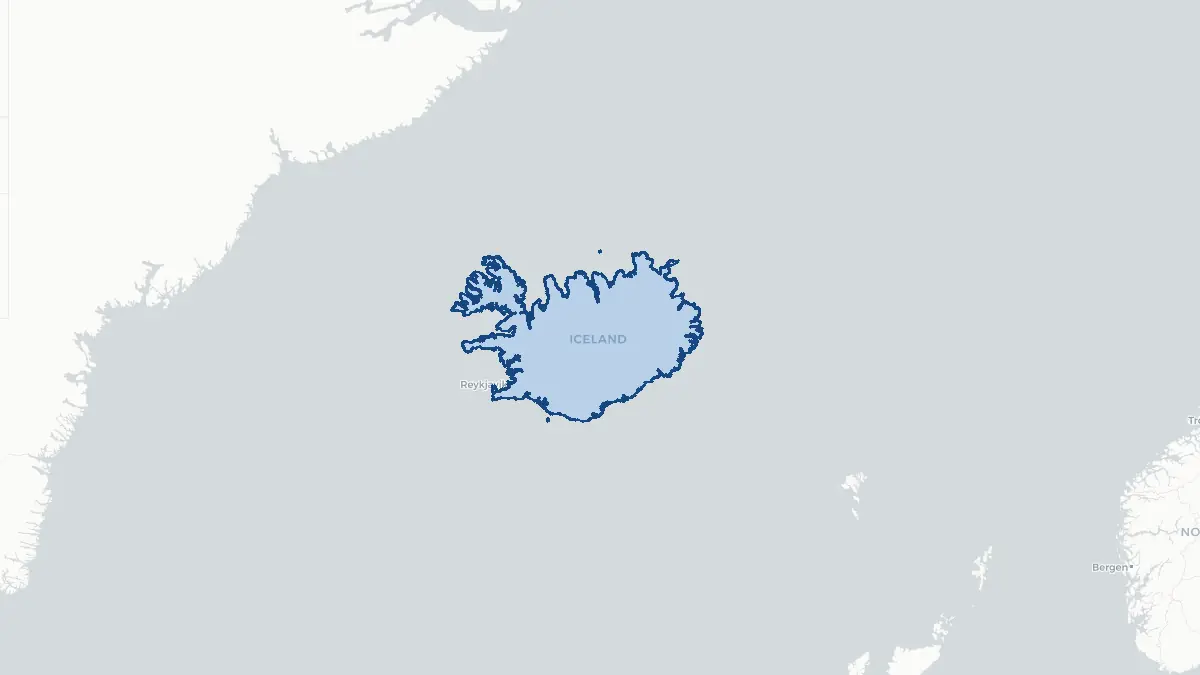
Here you find a map of Iceland, capital Reykjavik, currency Isländsk krona and quick links to more facts about the country in Europe.
About the country
Iceland on the map
About Iceland
Iceland is a Nordic island nation in the North Atlantic Ocean, situated just south of the Arctic Circle. With a population of approximately 370,000 people, it is one of the most sparsely populated countries in Europe, yet boasts one of the highest standards of living in the world. The country is a parliamentary republic, with a president serving as head of state and a prime minister leading the government. Icelandic society is known for its high levels of gender equality, social cohesion, and trust in public institutions. The culture is deeply rooted in Old Norse heritage, with the Icelandic language remaining remarkably close to its medieval form. Literature, particularly the medieval sagas, holds a central place in national identity. Despite its remote location, Iceland has a vibrant creative scene encompassing music, visual arts, and design. The economy is driven by fishing, tourism, aluminium smelting, and geothermal energy, making it one of the world's most renewable energy-dependent nations.
Geography and Landscape
Iceland sits atop the Mid-Atlantic Ridge, making it one of the most geologically active places on Earth. The island spans approximately 103,000 square kilometres and is characterised by a dramatic and varied landscape: glaciers, volcanoes, lava fields, hot springs, geysers, and waterfalls coexist across its surface. Vatnajökull, Europe's largest glacier by volume, covers roughly eight percent of the country. The interior highlands are largely uninhabited, a barren plateau of volcanic desert and ice. Coastal areas offer fertile lowlands where most of the population lives. Iceland's climate is subpolar oceanic, moderated by the Gulf Stream; summers are cool and winters are relatively mild for its latitude, though storms are frequent. The midnight sun occurs in summer, while winter brings long periods of darkness illuminated by the Northern Lights. The country experiences frequent volcanic eruptions and earthquakes, constantly reshaping the land. Notable natural features include Gullfoss waterfall, the Geysir hot spring area, and the volcanic island of Surtsey, formed in the 1960s.
History
Iceland was first settled by Norse Vikings around 874 CE, with Ingólfur Arnarson traditionally cited as the first permanent settler. In 930, the Althing — one of the world's oldest parliaments — was established, making Iceland a pioneering example of representative governance. The island converted to Christianity around the year 1000. Following a period of internal conflict known as the Age of the Sturlungs, Iceland came under Norwegian rule in 1262 and subsequently passed to Danish control in 1380. Under Danish rule, Iceland suffered hardships including volcanic eruptions, plague, and English and later Algerian pirate raids. A nationalist movement emerged in the nineteenth century, leading to home rule in 1904 and sovereignty in 1918, while remaining under the Danish Crown. During the Second World War, Iceland was occupied first by British and then American forces. Full independence was declared on 17 June 1944, founding the Republic of Iceland. The postwar decades brought rapid economic development, and in 1980 Vigdís Finnbogadóttir became the world's first democratically elected female head of state.
Geo Quiz
Think you know your capitals, flags, and continents? Take the quiz!
Neighbouring countries
Continue to nearby countries
There are no registered neighbouring countries for Iceland in the current database.
More countries in the same part of the world
Europe index
Open the continent hub for Europe to see the full country list, capitals and frequently asked questions on one page.
Interactive map
Zoomable map of Iceland
Country index
All countries by continent
Jump directly to the right section or keep scrolling.
Africa
58 countries- Algeria
- Angola
- Benin
- Botswana
- Burkina Faso
- Burundi
- Central African Republic
- Djibouti
- Democratic Republic of the Congo
- Egypt
- Equatorial Guinea
- Ivory Coast
- Eritrea
- Ethiopia
- Gabon
- Gambia
- Ghana
- Guinea
- Guinea-Bissau
- Cameroon
- Cape Verde
- Kenya
- Comoros
- Republic of the Congo
- Lesotho
- Liberia
- Libya
- Madagascar
- Malawi
- Mali
- Morocco
- Mauritania
- Mauritius
- Mayotte
- Mozambique
- Namibia
- Niger
- Nigeria
- Reunion
- Rwanda
- Saint Helena
- Sao Tome and Principe
- Senegal
- Seychelles
- Sierra Leone
- Somalia
- Sudan
- Swaziland
- South Africa
- South Sudan
- Tanzania
- Chad
- Togo
- Tunisia
- Uganda
- Western Sahara
- Zambia
- Zimbabwe
Asia
52 countries- Afghanistan
- Armenia
- Azerbaijan
- Bahrain
- Bangladesh
- Bhutan
- British Indian Ocean Territory
- Brunei
- Myanmar
- Philippines
- United Arab Emirates
- Georgia
- Hong Kong
- India
- Indonesia
- Iraq
- Iran
- Israel
- Japan
- Yemen
- Jordan
- Christmas Island
- Cambodia
- Kazakhstan
- China
- Kyrgyzstan
- Cocos Islands
- Kuwait
- Laos
- Lebanon
- Macau
- Malaysia
- Maldives
- Mongolia
- Nepal
- North Korea
- Oman
- Pakistan
- Palestinian Territory
- Qatar
- Saudi Arabia
- Singapore
- Sri Lanka
- South Korea
- Syria
- Tajikistan
- Taiwan
- Thailand
- Turkey
- Turkmenistan
- Uzbekistan
- Vietnam
Europe
53 countries- Albania
- Andorra
- Belgium
- Bosnia and Herzegovina
- Bulgaria
- Cyprus
- Denmark
- Estonia
- Finland
- France
- Faroe Islands
- Gibraltar
- Greece
- Guernsey
- Ireland
- Iceland
- Isle of Man
- Italy
- Jersey
- Kosovo
- Croatia
- Latvia
- Liechtenstein
- Lithuania
- Luxembourg
- Macedonia
- Malta
- Moldova
- Monaco
- Montenegro
- Netherlands
- Norway
- Poland
- Portugal
- Romania
- Russia
- San Marino
- Switzerland
- Serbia
- Slovakia
- Slovenia
- Spain
- United Kingdom
- Svalbard and Jan Mayen
- Sweden
- Czech Republic
- Germany
- Ukraine
- Hungary
- Vatican
- Belarus
- Aland Islands
- Austria
North America
42 countries- U.S. Virgin Islands
- Anguilla
- Antigua and Barbuda
- Aruba
- Bahamas
- Barbados
- Belize
- Bermuda
- Bonaire, Saint Eustatius and Saba
- British Virgin Islands
- Cayman Islands
- Costa Rica
- Curacao
- Dominica
- Dominican Republic
- El Salvador
- Grenada
- Greenland
- Guadeloupe
- Guatemala
- Haiti
- Honduras
- Jamaica
- Canada
- Cuba
- Martinique
- Mexico
- Montserrat
- Netherlands Antilles
- Nicaragua
- Panama
- Puerto Rico
- Saint Barthelemy
- Saint Kitts and Nevis
- Saint Lucia
- Saint Martin
- Saint Vincent and the Grenadines
- Saint Pierre and Miquelon
- Sint Maarten
- Trinidad and Tobago
- Turks and Caicos Islands
- United States
South America
14 countriesOceania
27 countries- American Samoa
- Australia
- Cook Islands
- Fiji
- French Polynesia
- United States Minor Outlying Islands
- Guam
- Kiribati
- Marshall Islands
- Micronesia
- Nauru
- Niue
- Northern Mariana Islands
- Norfolk Island
- New Caledonia
- New Zealand
- Palau
- Papua New Guinea
- Pitcairn
- Solomon Islands
- Samoa
- Tokelau
- Tonga
- Tuvalu
- Vanuatu
- Wallis and Futuna
- East Timor