
Africa
Equatorial Guinea — map and facts
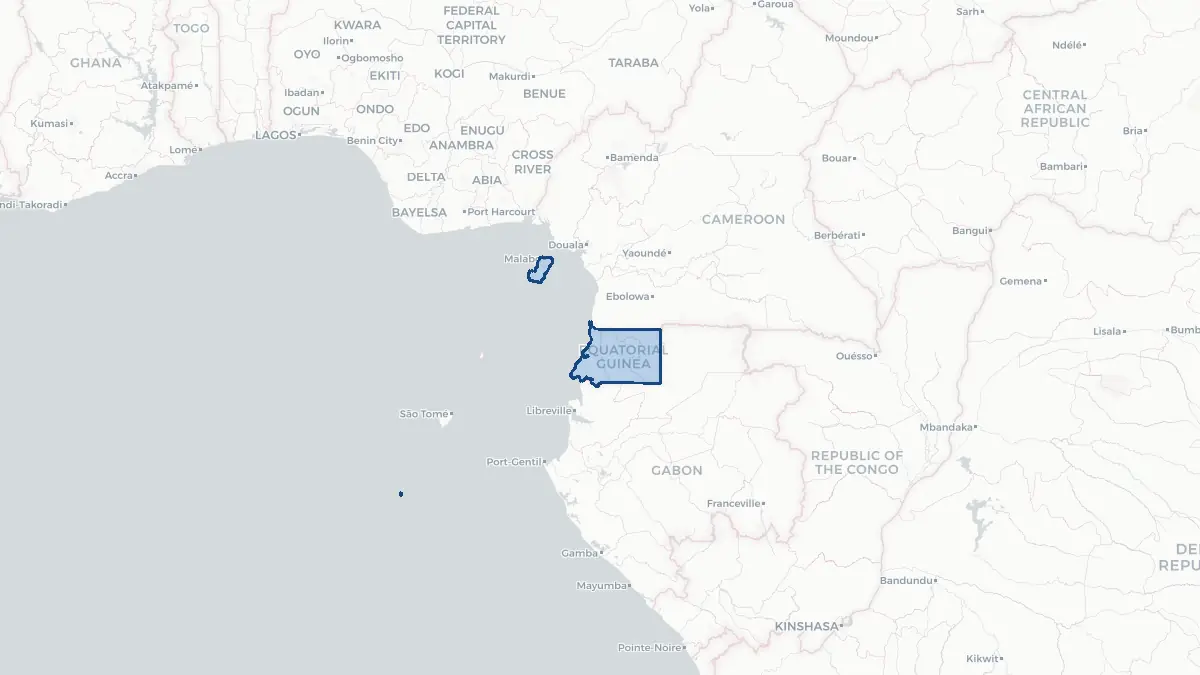
Here you find a map of Equatorial Guinea, capital Malabo, currency Franc and quick links to more facts about the country in Africa.
About the country
Equatorial Guinea on the map
About Equatorial Guinea
Equatorial Guinea is a small Central African nation comprising a mainland territory, Río Muni, bordered by Cameroon to the north and Gabon to the south and east, and several islands in the Gulf of Guinea, the largest of which is Bioko, home to the capital Malabo. A second administrative capital, Oyala (officially Ciudad de la Paz), has been constructed in the mainland interior. The population is approximately 1.5 million. Equatorial Guinea is the only Spanish-speaking country in Africa; Spanish, French, and Portuguese are all official languages. The country experienced a dramatic economic transformation following the discovery of offshore oil in 1995, which propelled it to one of Africa's highest GDP per capita figures. However, wealth has been highly concentrated under the long-ruling Obiang family. Teodoro Obiang Nguema Mbasogo has been president since seizing power in a coup in 1979, making him Africa's longest-serving head of state. Equatorial Guinea is a member of both the African Union and the Community of Portuguese Language Countries.
Geography and Landscape
Equatorial Guinea's mainland region, Río Muni, covers approximately 26,000 square kilometres and is largely blanketed by dense tropical equatorial rainforest. The terrain rises from the coastal plain inland toward a series of hills and plateaus, with the Crystal Mountains in the north and Monte Alén, at around 1,200 metres, in the centre, protected within the Monte Alén National Park. The coastline is indented with mangrove-fringed estuaries. Bioko Island, approximately 2,017 square kilometres in area, lies in the Gulf of Guinea some 32 kilometres from the coast of Cameroon. It is of volcanic origin and geologically active. Pico Basile, Bioko's dominant volcano, reaches 3,011 metres and is the highest point in the country. The island's rugged southern half, less developed, harbours important wildlife including nesting sea turtles and endemic primates. The smaller islands of Annobón, Corisco, and the Elobey islets complete the territory. The climate across all parts of the country is equatorial — hot and very wet throughout the year.
History
Bioko Island, originally inhabited by the Bubi people, was reached by Portuguese navigator Fernão do Pó around 1472, and the island bore his name for centuries. Portugal ceded the island and mainland trading rights to Spain through the Treaty of El Pardo in 1778. Spain's colonial engagement remained limited until the late nineteenth century, when Río Muni was incorporated after the Berlin Conference. The colony, known as Spanish Guinea, was an important source of cocoa and coffee, cultivated largely through forced labour. Independence was achieved on 12 October 1968 under Francisco Macías Nguema, who quickly established one of Africa's most brutal dictatorships, overseeing mass killings and the exile of a third of the population. He was overthrown in 1979 by his nephew, Teodoro Obiang Nguema Mbasogo, who executed him and has governed ever since as an authoritarian ruler. The discovery of oil in 1995 brought sudden wealth, transforming the country's infrastructure while deepening the concentration of power in the ruling family. International criticism of corruption and human rights abuses has been persistent.
Geo Quiz
Think you know your capitals, flags, and continents? Take the quiz!
Neighbouring countries
Continue to nearby countries
More countries in the same part of the world
Africa index
Open the continent hub for Africa to see the full country list, capitals and frequently asked questions on one page.
Interactive map
Zoomable map of Equatorial Guinea
Country index
All countries by continent
Jump directly to the right section or keep scrolling.
Africa
58 countries- Algeria
- Angola
- Benin
- Botswana
- Burkina Faso
- Burundi
- Central African Republic
- Djibouti
- Democratic Republic of the Congo
- Egypt
- Equatorial Guinea
- Ivory Coast
- Eritrea
- Ethiopia
- Gabon
- Gambia
- Ghana
- Guinea
- Guinea-Bissau
- Cameroon
- Cape Verde
- Kenya
- Comoros
- Republic of the Congo
- Lesotho
- Liberia
- Libya
- Madagascar
- Malawi
- Mali
- Morocco
- Mauritania
- Mauritius
- Mayotte
- Mozambique
- Namibia
- Niger
- Nigeria
- Reunion
- Rwanda
- Saint Helena
- Sao Tome and Principe
- Senegal
- Seychelles
- Sierra Leone
- Somalia
- Sudan
- Swaziland
- South Africa
- South Sudan
- Tanzania
- Chad
- Togo
- Tunisia
- Uganda
- Western Sahara
- Zambia
- Zimbabwe
Asia
52 countries- Afghanistan
- Armenia
- Azerbaijan
- Bahrain
- Bangladesh
- Bhutan
- British Indian Ocean Territory
- Brunei
- Myanmar
- Philippines
- United Arab Emirates
- Georgia
- Hong Kong
- India
- Indonesia
- Iraq
- Iran
- Israel
- Japan
- Yemen
- Jordan
- Christmas Island
- Cambodia
- Kazakhstan
- China
- Kyrgyzstan
- Cocos Islands
- Kuwait
- Laos
- Lebanon
- Macau
- Malaysia
- Maldives
- Mongolia
- Nepal
- North Korea
- Oman
- Pakistan
- Palestinian Territory
- Qatar
- Saudi Arabia
- Singapore
- Sri Lanka
- South Korea
- Syria
- Tajikistan
- Taiwan
- Thailand
- Turkey
- Turkmenistan
- Uzbekistan
- Vietnam
Europe
53 countries- Albania
- Andorra
- Belgium
- Bosnia and Herzegovina
- Bulgaria
- Cyprus
- Denmark
- Estonia
- Finland
- France
- Faroe Islands
- Gibraltar
- Greece
- Guernsey
- Ireland
- Iceland
- Isle of Man
- Italy
- Jersey
- Kosovo
- Croatia
- Latvia
- Liechtenstein
- Lithuania
- Luxembourg
- Macedonia
- Malta
- Moldova
- Monaco
- Montenegro
- Netherlands
- Norway
- Poland
- Portugal
- Romania
- Russia
- San Marino
- Switzerland
- Serbia
- Slovakia
- Slovenia
- Spain
- United Kingdom
- Svalbard and Jan Mayen
- Sweden
- Czech Republic
- Germany
- Ukraine
- Hungary
- Vatican
- Belarus
- Aland Islands
- Austria
North America
42 countries- U.S. Virgin Islands
- Anguilla
- Antigua and Barbuda
- Aruba
- Bahamas
- Barbados
- Belize
- Bermuda
- Bonaire, Saint Eustatius and Saba
- British Virgin Islands
- Cayman Islands
- Costa Rica
- Curacao
- Dominica
- Dominican Republic
- El Salvador
- Grenada
- Greenland
- Guadeloupe
- Guatemala
- Haiti
- Honduras
- Jamaica
- Canada
- Cuba
- Martinique
- Mexico
- Montserrat
- Netherlands Antilles
- Nicaragua
- Panama
- Puerto Rico
- Saint Barthelemy
- Saint Kitts and Nevis
- Saint Lucia
- Saint Martin
- Saint Vincent and the Grenadines
- Saint Pierre and Miquelon
- Sint Maarten
- Trinidad and Tobago
- Turks and Caicos Islands
- United States
South America
14 countriesOceania
27 countries- American Samoa
- Australia
- Cook Islands
- Fiji
- French Polynesia
- United States Minor Outlying Islands
- Guam
- Kiribati
- Marshall Islands
- Micronesia
- Nauru
- Niue
- Northern Mariana Islands
- Norfolk Island
- New Caledonia
- New Zealand
- Palau
- Papua New Guinea
- Pitcairn
- Solomon Islands
- Samoa
- Tokelau
- Tonga
- Tuvalu
- Vanuatu
- Wallis and Futuna
- East Timor