
Africa
Republic of the Congo — map and facts
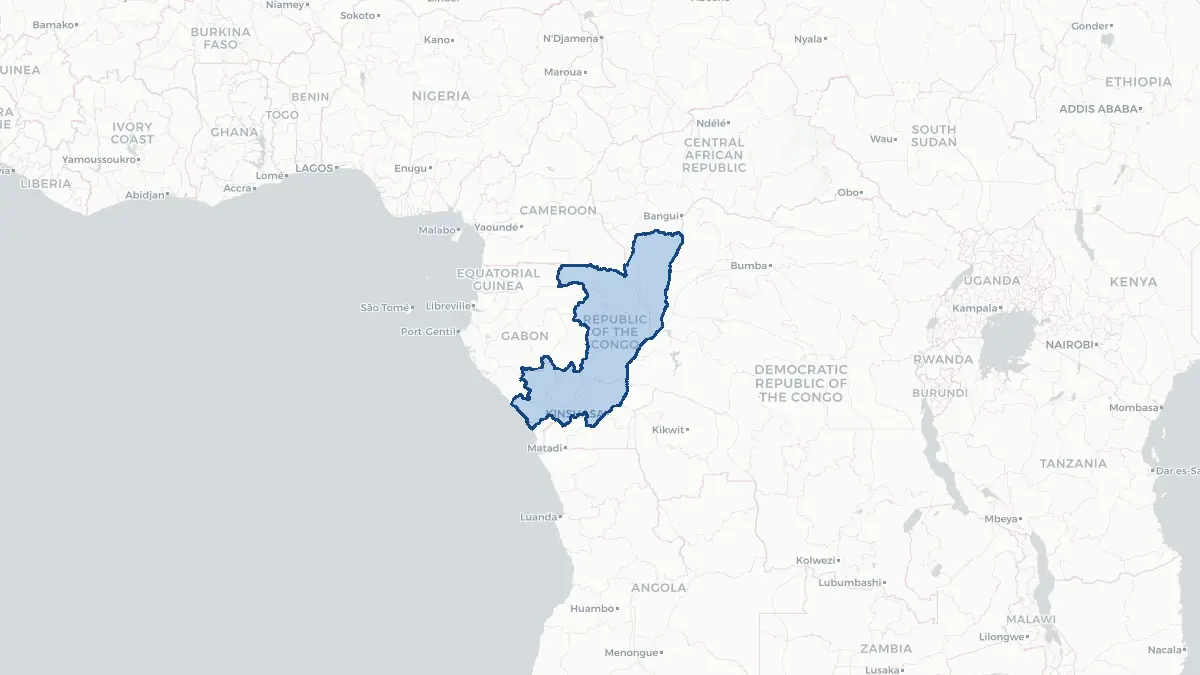
Here you find a map of Republic of the Congo, capital Brazzaville, currency Franc and quick links to more facts about the country in Africa.
About the country
Republic of the Congo on the map
About Republic of the Congo
The Republic of the Congo, sometimes called Congo-Brazzaville to distinguish it from its larger neighbour, is a Central African nation of approximately 5.8 million people. Its capital and largest city is Brazzaville, situated on the northern bank of the Congo River directly across from Kinshasa, forming one of the world's closest pairs of national capitals. The country is a presidential republic; Denis Sassou Nguesso has dominated political life for most of the period since 1979, currently serving as president. The economy depends heavily on petroleum, which accounts for the large majority of export revenues, though falling oil production has created fiscal pressures in recent years. French is the official language, while Lingala and Kikongo serve as widely spoken national languages. The country's population is composed of numerous ethnic groups, with the Kongo, Teke, and Mboshi among the largest. Despite considerable oil wealth, a large proportion of the population lives in poverty. The country also holds significant timber and mineral resources that remain underdeveloped.
Geography and Landscape
The Republic of the Congo covers approximately 342,000 square kilometres in Central Africa, bordered by Gabon to the west, Cameroon and the Central African Republic to the north, the Democratic Republic of the Congo to the east and south, and Cabinda (Angola) to the southwest, with a short Atlantic coastline of about 170 kilometres. The terrain consists largely of a low coastal plain, backed by the Mayombe Escarpment, which rises sharply from the coast. The interior is dominated by the vast Congo Basin, covered in dense tropical rainforest and drained by the Congo River and its major tributaries, including the Sangha and Ubangi rivers. The Batéké Plateau occupies much of the southeastern interior, rising to between 500 and 1,000 metres. The country lies almost entirely within the equatorial climate zone, receiving heavy rainfall throughout much of the year, though the south experiences a drier season. The Odzala-Kokoua National Park in the northwest protects one of the most biodiverse forest ecosystems in Africa.
History
The region was inhabited by Pygmy hunter-gatherers before the arrival of Bantu-speaking agricultural peoples beginning around 1000 BCE. The powerful Kingdom of Kongo, centred further south, influenced the coastal regions, while the Teke kingdom held sway over the interior plateau. Portuguese navigators made contact with the coast in the fifteenth century. French explorer Pierre Savorgnan de Brazza signed a treaty with Teke king Makoko in 1880, establishing a French protectorate; Brazzaville, founded that year, bears his name. The territory became part of French Equatorial Africa in 1910, grouping it with present-day Gabon, the Central African Republic, and Chad. Independence was achieved on 15 August 1960. The post-independence decades were turbulent, marked by coups and ideological shifts between Marxist and pro-Western governments. Denis Sassou Nguesso first came to power in 1979, was ousted in democratic elections in 1992, but returned to power after a brief civil war in 1997. He has governed the country since, with a new constitution in 2015 removing presidential term limits.
Geo Quiz
Think you know your capitals, flags, and continents? Take the quiz!
Neighbouring countries
Continue to nearby countries
More countries in the same part of the world
Africa index
Open the continent hub for Africa to see the full country list, capitals and frequently asked questions on one page.
Interactive map
Zoomable map of Republic of the Congo
Country index
All countries by continent
Jump directly to the right section or keep scrolling.
Africa
58 countries- Algeria
- Angola
- Benin
- Botswana
- Burkina Faso
- Burundi
- Central African Republic
- Djibouti
- Democratic Republic of the Congo
- Egypt
- Equatorial Guinea
- Ivory Coast
- Eritrea
- Ethiopia
- Gabon
- Gambia
- Ghana
- Guinea
- Guinea-Bissau
- Cameroon
- Cape Verde
- Kenya
- Comoros
- Republic of the Congo
- Lesotho
- Liberia
- Libya
- Madagascar
- Malawi
- Mali
- Morocco
- Mauritania
- Mauritius
- Mayotte
- Mozambique
- Namibia
- Niger
- Nigeria
- Reunion
- Rwanda
- Saint Helena
- Sao Tome and Principe
- Senegal
- Seychelles
- Sierra Leone
- Somalia
- Sudan
- Swaziland
- South Africa
- South Sudan
- Tanzania
- Chad
- Togo
- Tunisia
- Uganda
- Western Sahara
- Zambia
- Zimbabwe
Asia
52 countries- Afghanistan
- Armenia
- Azerbaijan
- Bahrain
- Bangladesh
- Bhutan
- British Indian Ocean Territory
- Brunei
- Myanmar
- Philippines
- United Arab Emirates
- Georgia
- Hong Kong
- India
- Indonesia
- Iraq
- Iran
- Israel
- Japan
- Yemen
- Jordan
- Christmas Island
- Cambodia
- Kazakhstan
- China
- Kyrgyzstan
- Cocos Islands
- Kuwait
- Laos
- Lebanon
- Macau
- Malaysia
- Maldives
- Mongolia
- Nepal
- North Korea
- Oman
- Pakistan
- Palestinian Territory
- Qatar
- Saudi Arabia
- Singapore
- Sri Lanka
- South Korea
- Syria
- Tajikistan
- Taiwan
- Thailand
- Turkey
- Turkmenistan
- Uzbekistan
- Vietnam
Europe
53 countries- Albania
- Andorra
- Belgium
- Bosnia and Herzegovina
- Bulgaria
- Cyprus
- Denmark
- Estonia
- Finland
- France
- Faroe Islands
- Gibraltar
- Greece
- Guernsey
- Ireland
- Iceland
- Isle of Man
- Italy
- Jersey
- Kosovo
- Croatia
- Latvia
- Liechtenstein
- Lithuania
- Luxembourg
- Macedonia
- Malta
- Moldova
- Monaco
- Montenegro
- Netherlands
- Norway
- Poland
- Portugal
- Romania
- Russia
- San Marino
- Switzerland
- Serbia
- Slovakia
- Slovenia
- Spain
- United Kingdom
- Svalbard and Jan Mayen
- Sweden
- Czech Republic
- Germany
- Ukraine
- Hungary
- Vatican
- Belarus
- Aland Islands
- Austria
North America
42 countries- U.S. Virgin Islands
- Anguilla
- Antigua and Barbuda
- Aruba
- Bahamas
- Barbados
- Belize
- Bermuda
- Bonaire, Saint Eustatius and Saba
- British Virgin Islands
- Cayman Islands
- Costa Rica
- Curacao
- Dominica
- Dominican Republic
- El Salvador
- Grenada
- Greenland
- Guadeloupe
- Guatemala
- Haiti
- Honduras
- Jamaica
- Canada
- Cuba
- Martinique
- Mexico
- Montserrat
- Netherlands Antilles
- Nicaragua
- Panama
- Puerto Rico
- Saint Barthelemy
- Saint Kitts and Nevis
- Saint Lucia
- Saint Martin
- Saint Vincent and the Grenadines
- Saint Pierre and Miquelon
- Sint Maarten
- Trinidad and Tobago
- Turks and Caicos Islands
- United States
South America
14 countriesOceania
27 countries- American Samoa
- Australia
- Cook Islands
- Fiji
- French Polynesia
- United States Minor Outlying Islands
- Guam
- Kiribati
- Marshall Islands
- Micronesia
- Nauru
- Niue
- Northern Mariana Islands
- Norfolk Island
- New Caledonia
- New Zealand
- Palau
- Papua New Guinea
- Pitcairn
- Solomon Islands
- Samoa
- Tokelau
- Tonga
- Tuvalu
- Vanuatu
- Wallis and Futuna
- East Timor