
Africa
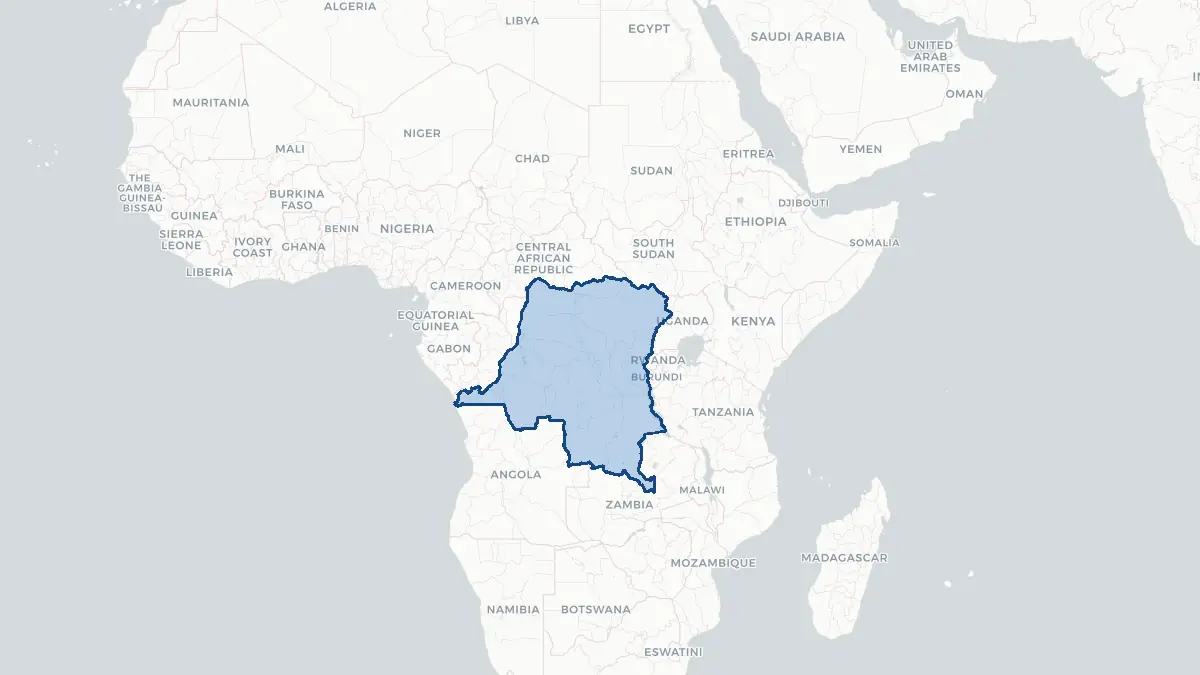
Democratic Republic of the Congo — map and facts
Here you find a map of Democratic Republic of the Congo, capital Kinshasa, currency Franc and quick links to more facts about the country in Africa.
About the country
Democratic Republic of the Congo on the map
About Democratic Republic of the Congo
The Democratic Republic of the Congo is the largest country in sub-Saharan Africa by area and the second-largest on the continent, covering approximately 2.34 million square kilometres. It is home to around 100 million people, making it one of the most populous nations in Africa. The capital is Kinshasa, a sprawling metropolis on the southern bank of the Congo River. The government is a semi-presidential republic; Félix Tshisekedi has served as president since 2019. The country is extraordinarily rich in natural resources, including cobalt, coltan, copper, gold, and diamonds, yet chronic conflict, corruption, and weak governance have prevented these riches from benefiting most of its population. French is the official language, while Lingala, Kikongo, Tshiluba, and Swahili serve as nationally recognised lingua francas. The DRC is home to hundreds of ethnic groups, the largest of which include the Luba, Kongo, and Mongo peoples. The country faces ongoing armed conflict in its eastern provinces, particularly North and South Kivu.
Geography and Landscape
The Democratic Republic of the Congo straddles the equator and is dominated by the Congo Basin, one of the world's largest river basins, covered by the second-largest tropical rainforest on Earth after the Amazon. The Congo River, the world's deepest river and the second-longest in Africa, flows in a great arc through the country before emptying into the Atlantic Ocean. The basin is surrounded by elevated terrain on all sides: the Mitumba Mountains and Albertine Rift in the east, where the Rwenzori Mountains include Margherita Peak at 5,109 metres, the highest point in the country. The eastern border follows the Great Rift Valley and includes a chain of large lakes — Lake Albert, Lake Edward, Lake Kivu, Lake Tanganyika, and Lake Mweru. The north is covered by dense equatorial forest, while the south features the Katanga Plateau and its rich copper and cobalt deposits. The country experiences an equatorial climate in the centre with distinct wet and dry seasons toward the north and south.
History
The region has been inhabited since prehistoric times, and Bantu-speaking peoples migrated into the area beginning around 1000 BCE. The Kingdom of Kongo, one of the most powerful states in central Africa, rose to prominence around the fourteenth century and maintained contact with Portuguese explorers from 1483. The vast interior was explored by European expeditions in the nineteenth century, most famously by Henry Morton Stanley in the 1870s. At the 1884–85 Berlin Conference, the territory was granted to King Léopold II of Belgium as his personal property, becoming the Congo Free State — a regime notorious for extreme brutality and forced labour in rubber extraction, in which millions died. International outcry led to Belgium annexing the territory in 1908 as the Belgian Congo. Independence came on 30 June 1960; the new republic immediately faced a crisis as Katanga province attempted to secede. Patrice Lumumba, the first prime minister, was assassinated in 1961. Mobutu Sese Seko ruled from 1965 to 1997 under a kleptocratic dictatorship. The First and Second Congo Wars (1996–1997, 1998–2003) devastated the country, and conflict in the east has continued ever since.
Geo Quiz
Think you know your capitals, flags, and continents? Take the quiz!
Neighbouring countries
Continue to nearby countries
More countries in the same part of the world
Africa index
Open the continent hub for Africa to see the full country list, capitals and frequently asked questions on one page.
Interactive map
Zoomable map of Democratic Republic of the Congo
Country index
All countries by continent
Jump directly to the right section or keep scrolling.
Africa
58 countries- Algeria
- Angola
- Benin
- Botswana
- Burkina Faso
- Burundi
- Central African Republic
- Djibouti
- Democratic Republic of the Congo
- Egypt
- Equatorial Guinea
- Ivory Coast
- Eritrea
- Ethiopia
- Gabon
- Gambia
- Ghana
- Guinea
- Guinea-Bissau
- Cameroon
- Cape Verde
- Kenya
- Comoros
- Republic of the Congo
- Lesotho
- Liberia
- Libya
- Madagascar
- Malawi
- Mali
- Morocco
- Mauritania
- Mauritius
- Mayotte
- Mozambique
- Namibia
- Niger
- Nigeria
- Reunion
- Rwanda
- Saint Helena
- Sao Tome and Principe
- Senegal
- Seychelles
- Sierra Leone
- Somalia
- Sudan
- Swaziland
- South Africa
- South Sudan
- Tanzania
- Chad
- Togo
- Tunisia
- Uganda
- Western Sahara
- Zambia
- Zimbabwe
Asia
52 countries- Afghanistan
- Armenia
- Azerbaijan
- Bahrain
- Bangladesh
- Bhutan
- British Indian Ocean Territory
- Brunei
- Myanmar
- Philippines
- United Arab Emirates
- Georgia
- Hong Kong
- India
- Indonesia
- Iraq
- Iran
- Israel
- Japan
- Yemen
- Jordan
- Christmas Island
- Cambodia
- Kazakhstan
- China
- Kyrgyzstan
- Cocos Islands
- Kuwait
- Laos
- Lebanon
- Macau
- Malaysia
- Maldives
- Mongolia
- Nepal
- North Korea
- Oman
- Pakistan
- Palestinian Territory
- Qatar
- Saudi Arabia
- Singapore
- Sri Lanka
- South Korea
- Syria
- Tajikistan
- Taiwan
- Thailand
- Turkey
- Turkmenistan
- Uzbekistan
- Vietnam
Europe
53 countries- Albania
- Andorra
- Belgium
- Bosnia and Herzegovina
- Bulgaria
- Cyprus
- Denmark
- Estonia
- Finland
- France
- Faroe Islands
- Gibraltar
- Greece
- Guernsey
- Ireland
- Iceland
- Isle of Man
- Italy
- Jersey
- Kosovo
- Croatia
- Latvia
- Liechtenstein
- Lithuania
- Luxembourg
- Macedonia
- Malta
- Moldova
- Monaco
- Montenegro
- Netherlands
- Norway
- Poland
- Portugal
- Romania
- Russia
- San Marino
- Switzerland
- Serbia
- Slovakia
- Slovenia
- Spain
- United Kingdom
- Svalbard and Jan Mayen
- Sweden
- Czech Republic
- Germany
- Ukraine
- Hungary
- Vatican
- Belarus
- Aland Islands
- Austria
North America
42 countries- U.S. Virgin Islands
- Anguilla
- Antigua and Barbuda
- Aruba
- Bahamas
- Barbados
- Belize
- Bermuda
- Bonaire, Saint Eustatius and Saba
- British Virgin Islands
- Cayman Islands
- Costa Rica
- Curacao
- Dominica
- Dominican Republic
- El Salvador
- Grenada
- Greenland
- Guadeloupe
- Guatemala
- Haiti
- Honduras
- Jamaica
- Canada
- Cuba
- Martinique
- Mexico
- Montserrat
- Netherlands Antilles
- Nicaragua
- Panama
- Puerto Rico
- Saint Barthelemy
- Saint Kitts and Nevis
- Saint Lucia
- Saint Martin
- Saint Vincent and the Grenadines
- Saint Pierre and Miquelon
- Sint Maarten
- Trinidad and Tobago
- Turks and Caicos Islands
- United States
South America
14 countriesOceania
27 countries- American Samoa
- Australia
- Cook Islands
- Fiji
- French Polynesia
- United States Minor Outlying Islands
- Guam
- Kiribati
- Marshall Islands
- Micronesia
- Nauru
- Niue
- Northern Mariana Islands
- Norfolk Island
- New Caledonia
- New Zealand
- Palau
- Papua New Guinea
- Pitcairn
- Solomon Islands
- Samoa
- Tokelau
- Tonga
- Tuvalu
- Vanuatu
- Wallis and Futuna
- East Timor