
Asia
South Korea — map and facts
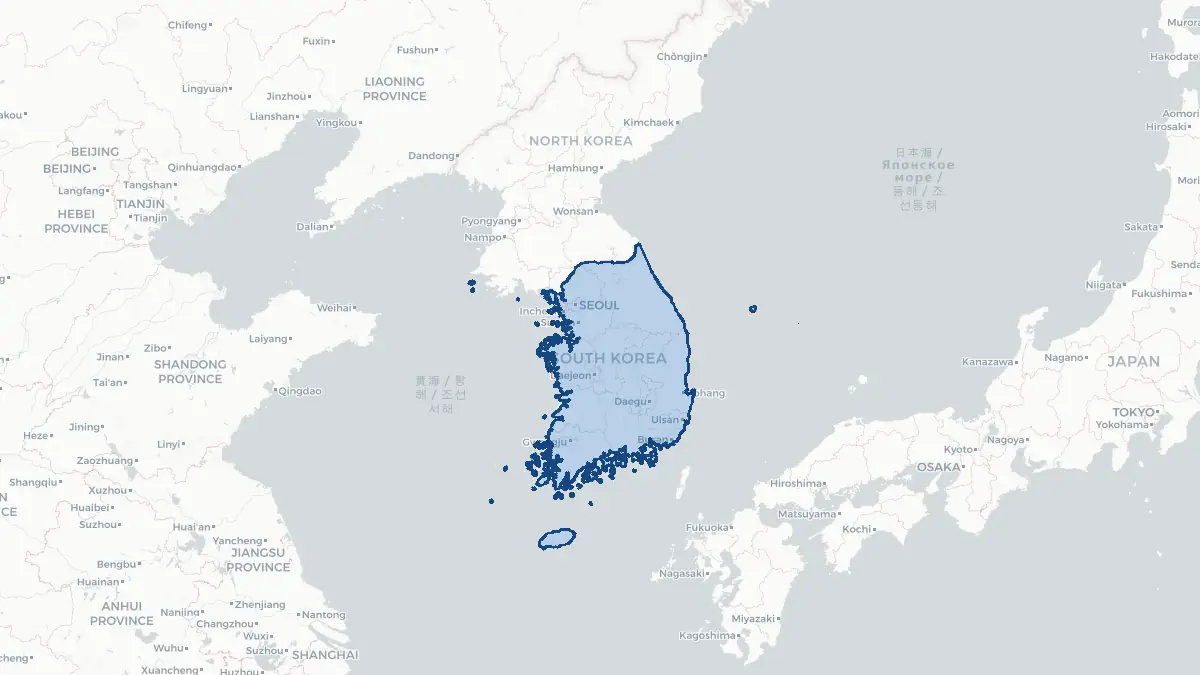
Here you find a map of South Korea, capital Seoul, currency Sydkoreansk won and quick links to more facts about the country in Asia.
About the country
South Korea on the map
About South Korea
South Korea, officially the Republic of Korea, occupies the southern half of the Korean Peninsula in East Asia and has a population of approximately 52 million. It is a vibrant liberal democracy with a unicameral National Assembly, and Seoul—one of the world's great megacities—serves as its capital. Korean is the sole official language. South Korea has achieved one of the most remarkable economic transformations in modern history, rising from post-war devastation to become the world's tenth-largest economy within a generation—a feat known as the "Miracle on the Han River." It is home to global industrial giants such as Samsung, Hyundai, LG, and POSCO. Korean culture has also achieved extraordinary global reach through K-pop music, Korean cinema (including Oscar-winning films), and Korean drama, collectively known as the "Korean Wave" (Hallyu). The country faces persistent geopolitical pressure from North Korea, maintaining one of the world's largest standing militaries and hosting a significant US military presence.
Geography and Landscape
South Korea covers about 100,000 square kilometres on the southern portion of the Korean Peninsula. The terrain is predominantly mountainous, with the Taebaek Range running along the eastern coast and the Sobaek Range cutting through the centre and south. The western and southern coasts are characterised by extensive tidal flats and thousands of offshore islands, making for one of the world's most complex coastlines. The Han River flows through Seoul into the Yellow Sea (West Sea), and the Nakdong River drains the southeast. Mount Hallasan (1,950 m) on Jeju Island is the country's highest peak; Jeju is a volcanic island of outstanding natural beauty. The climate is temperate with four distinct seasons: hot, humid summers; cold, dry winters driven by Siberian winds; and pleasant spring and autumn periods. South Korea experiences monsoon rains (jangma) in summer and occasional typhoons from the Pacific.
History
The Korean Peninsula has been home to advanced civilisations for over two millennia. The Three Kingdoms period (Goguryeo, Baekje, and Silla) shaped early Korean culture and Buddhism took hold from the fourth century. Silla unified much of the peninsula in 668 CE. The Goryeo dynasty (918–1392) gave Korea its English name and produced exquisite celadon ceramics, while the Joseon dynasty (1392–1897) embraced Confucianism and created the Hangul alphabet in 1443. Japan colonised Korea from 1910 to 1945, a period of cultural suppression and forced labour. After liberation, the Korean War (1950–1953) divided the peninsula along the 38th parallel. South Korea thereafter embarked on rapid industrialisation under a series of authoritarian governments in the 1960s–1980s, transitioning to democracy in 1987. The 1988 Seoul Olympics showcased the country's emergence on the world stage. Today South Korea is a mature democracy and a leading global innovator.
Geo Quiz
Think you know your capitals, flags, and continents? Take the quiz!
Neighbouring countries
Continue to nearby countries
More countries in the same part of the world
Asia index
Open the continent hub for Asia to see the full country list, capitals and frequently asked questions on one page.
Interactive map
Zoomable map of South Korea
Country index
All countries by continent
Jump directly to the right section or keep scrolling.
Africa
58 countries- Algeria
- Angola
- Benin
- Botswana
- Burkina Faso
- Burundi
- Central African Republic
- Djibouti
- Democratic Republic of the Congo
- Egypt
- Equatorial Guinea
- Ivory Coast
- Eritrea
- Ethiopia
- Gabon
- Gambia
- Ghana
- Guinea
- Guinea-Bissau
- Cameroon
- Cape Verde
- Kenya
- Comoros
- Republic of the Congo
- Lesotho
- Liberia
- Libya
- Madagascar
- Malawi
- Mali
- Morocco
- Mauritania
- Mauritius
- Mayotte
- Mozambique
- Namibia
- Niger
- Nigeria
- Reunion
- Rwanda
- Saint Helena
- Sao Tome and Principe
- Senegal
- Seychelles
- Sierra Leone
- Somalia
- Sudan
- Swaziland
- South Africa
- South Sudan
- Tanzania
- Chad
- Togo
- Tunisia
- Uganda
- Western Sahara
- Zambia
- Zimbabwe
Asia
52 countries- Afghanistan
- Armenia
- Azerbaijan
- Bahrain
- Bangladesh
- Bhutan
- British Indian Ocean Territory
- Brunei
- Myanmar
- Philippines
- United Arab Emirates
- Georgia
- Hong Kong
- India
- Indonesia
- Iraq
- Iran
- Israel
- Japan
- Yemen
- Jordan
- Christmas Island
- Cambodia
- Kazakhstan
- China
- Kyrgyzstan
- Cocos Islands
- Kuwait
- Laos
- Lebanon
- Macau
- Malaysia
- Maldives
- Mongolia
- Nepal
- North Korea
- Oman
- Pakistan
- Palestinian Territory
- Qatar
- Saudi Arabia
- Singapore
- Sri Lanka
- South Korea
- Syria
- Tajikistan
- Taiwan
- Thailand
- Turkey
- Turkmenistan
- Uzbekistan
- Vietnam
Europe
53 countries- Albania
- Andorra
- Belgium
- Bosnia and Herzegovina
- Bulgaria
- Cyprus
- Denmark
- Estonia
- Finland
- France
- Faroe Islands
- Gibraltar
- Greece
- Guernsey
- Ireland
- Iceland
- Isle of Man
- Italy
- Jersey
- Kosovo
- Croatia
- Latvia
- Liechtenstein
- Lithuania
- Luxembourg
- Macedonia
- Malta
- Moldova
- Monaco
- Montenegro
- Netherlands
- Norway
- Poland
- Portugal
- Romania
- Russia
- San Marino
- Switzerland
- Serbia
- Slovakia
- Slovenia
- Spain
- United Kingdom
- Svalbard and Jan Mayen
- Sweden
- Czech Republic
- Germany
- Ukraine
- Hungary
- Vatican
- Belarus
- Aland Islands
- Austria
North America
42 countries- U.S. Virgin Islands
- Anguilla
- Antigua and Barbuda
- Aruba
- Bahamas
- Barbados
- Belize
- Bermuda
- Bonaire, Saint Eustatius and Saba
- British Virgin Islands
- Cayman Islands
- Costa Rica
- Curacao
- Dominica
- Dominican Republic
- El Salvador
- Grenada
- Greenland
- Guadeloupe
- Guatemala
- Haiti
- Honduras
- Jamaica
- Canada
- Cuba
- Martinique
- Mexico
- Montserrat
- Netherlands Antilles
- Nicaragua
- Panama
- Puerto Rico
- Saint Barthelemy
- Saint Kitts and Nevis
- Saint Lucia
- Saint Martin
- Saint Vincent and the Grenadines
- Saint Pierre and Miquelon
- Sint Maarten
- Trinidad and Tobago
- Turks and Caicos Islands
- United States
South America
14 countriesOceania
27 countries- American Samoa
- Australia
- Cook Islands
- Fiji
- French Polynesia
- United States Minor Outlying Islands
- Guam
- Kiribati
- Marshall Islands
- Micronesia
- Nauru
- Niue
- Northern Mariana Islands
- Norfolk Island
- New Caledonia
- New Zealand
- Palau
- Papua New Guinea
- Pitcairn
- Solomon Islands
- Samoa
- Tokelau
- Tonga
- Tuvalu
- Vanuatu
- Wallis and Futuna
- East Timor