
Asia
Turkey — map and facts
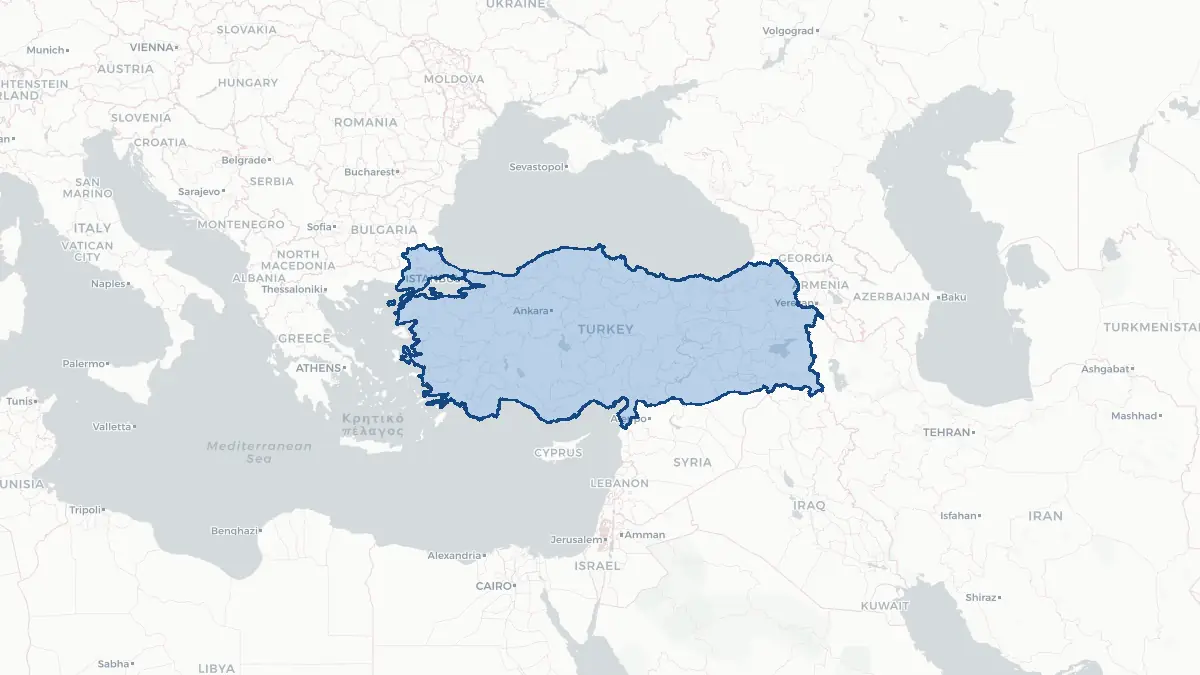
Here you find a map of Turkey, capital Ankara, currency Lira and quick links to more facts about the country in Asia.
About the country
Turkey on the map
Turkey is a transcontinental country straddling south-eastern Europe and south-western Asia, the only nation in the world with territory on both continents. With a population of approximately 85 million and its capital in Ankara, Turkey is one of the most significant countries in the Middle East and Mediterranean region. The currency is the Turkish lira (TRY). Istanbul, Turkey's largest city, is one of the world's most visited cities and former capital of both the Byzantine and Ottoman empires.
About Turkey
Turkey, officially the Republic of Türkiye, is a unitary presidential republic. Most of its territory (Anatolia) lies in south-western Asia; a small portion (Eastern Thrace) lies in Europe, separated by the Bosphorus and Dardanelles straits. Turkey's neighbours include Greece and Bulgaria to the north-west, Georgia and Armenia to the north-east, Iran to the east, and Iraq and Syria to the south. The Bosphorus and Dardanelles, controlled by Turkey, are the only sea routes between the Black Sea and the Mediterranean.
Geography and landscape
Turkey covers approximately 783,562 km². Anatolia is a large plateau surrounded by mountain ranges — the Pontic Mountains in the north and the Taurus Mountains in the south. The highest peak is Mount Ararat (5,137 m) in eastern Turkey. Major rivers include the Euphrates and the Tigris, both rising in eastern Turkey. The Aegean coast in the west is deeply indented with ancient cities and resort towns. The Cappadocia region in central Anatolia is famous for its unique volcanic rock formations and cave dwellings.
History
Anatolia is one of the oldest continuously inhabited regions on Earth. Çatalhöyük, one of the world's first towns, flourished around 7500 BCE. Anatolia was later part of the Persian, Roman, and Byzantine empires, with Constantinople (Istanbul) as the Byzantine capital. The Ottoman Empire, at its height in the 16th–17th centuries, controlled much of South-Eastern Europe, the Middle East, and North Africa. Following the Ottoman defeat in the First World War, Mustafa Kemal Atatürk founded the modern Republic of Turkey in 1923, implementing sweeping reforms including the adoption of the Latin alphabet.
Economy and currency
Turkey has a large and diverse economy. Key sectors include tourism (Turkey consistently ranks among the world's most visited countries), textiles, automotive manufacturing, construction, and food processing. The Turkish lira (TRY) is the national currency. Istanbul is the country's economic and commercial hub. Turkey is a member of the G20 and a candidate for EU membership.
Culture and language
Turkish is the official language, a Turkic language unrelated to Arabic, Persian, or European languages. Turkey's culture is a rich blend of Central Asian Turkic, Islamic, and Western influences. The country is predominantly Muslim (Sunni), though the constitution establishes a secular state. Cultural highlights include Ottoman architecture (the Hagia Sophia, the Blue Mosque), the Sufi whirling dervish tradition, Turkish cuisine (kebab, meze, börek, baklava), and the hammam (Turkish bath). Tea (çay) is central to social life.
Frequently asked questions
What is the capital of Turkey? Ankara is the capital, though Istanbul is the largest city and cultural centre.
What currency does Turkey use? The Turkish lira (TRY).
Is Turkey in Europe or Asia? Turkey is transcontinental: most of the country (Anatolia) is in Asia, while a small portion (Eastern Thrace, including part of Istanbul) is in Europe.
What is the Hagia Sophia? The Hagia Sophia in Istanbul was built as a Christian cathedral in 537 CE by the Byzantine Emperor Justinian, later converted to a mosque under the Ottomans, then a museum, and reconverted to a mosque in 2020. It is one of the world's greatest architectural achievements.
What are the Bosphorus and the Dardanelles? These straits connect the Black Sea to the Mediterranean. Controlled by Turkey, they are of major strategic importance as the only sea route between the two seas.
Geo Quiz
Think you know your capitals, flags, and continents? Take the quiz!
Neighbouring countries
Continue to nearby countries
More countries in the same part of the world
Asia index
Open the continent hub for Asia to see the full country list, capitals and frequently asked questions on one page.
Interactive map
Zoomable map of Turkey
Country index
All countries by continent
Jump directly to the right section or keep scrolling.
Africa
58 countries- Algeria
- Angola
- Benin
- Botswana
- Burkina Faso
- Burundi
- Central African Republic
- Djibouti
- Democratic Republic of the Congo
- Egypt
- Equatorial Guinea
- Ivory Coast
- Eritrea
- Ethiopia
- Gabon
- Gambia
- Ghana
- Guinea
- Guinea-Bissau
- Cameroon
- Cape Verde
- Kenya
- Comoros
- Republic of the Congo
- Lesotho
- Liberia
- Libya
- Madagascar
- Malawi
- Mali
- Morocco
- Mauritania
- Mauritius
- Mayotte
- Mozambique
- Namibia
- Niger
- Nigeria
- Reunion
- Rwanda
- Saint Helena
- Sao Tome and Principe
- Senegal
- Seychelles
- Sierra Leone
- Somalia
- Sudan
- Swaziland
- South Africa
- South Sudan
- Tanzania
- Chad
- Togo
- Tunisia
- Uganda
- Western Sahara
- Zambia
- Zimbabwe
Asia
52 countries- Afghanistan
- Armenia
- Azerbaijan
- Bahrain
- Bangladesh
- Bhutan
- British Indian Ocean Territory
- Brunei
- Myanmar
- Philippines
- United Arab Emirates
- Georgia
- Hong Kong
- India
- Indonesia
- Iraq
- Iran
- Israel
- Japan
- Yemen
- Jordan
- Christmas Island
- Cambodia
- Kazakhstan
- China
- Kyrgyzstan
- Cocos Islands
- Kuwait
- Laos
- Lebanon
- Macau
- Malaysia
- Maldives
- Mongolia
- Nepal
- North Korea
- Oman
- Pakistan
- Palestinian Territory
- Qatar
- Saudi Arabia
- Singapore
- Sri Lanka
- South Korea
- Syria
- Tajikistan
- Taiwan
- Thailand
- Turkey
- Turkmenistan
- Uzbekistan
- Vietnam
Europe
53 countries- Albania
- Andorra
- Belgium
- Bosnia and Herzegovina
- Bulgaria
- Cyprus
- Denmark
- Estonia
- Finland
- France
- Faroe Islands
- Gibraltar
- Greece
- Guernsey
- Ireland
- Iceland
- Isle of Man
- Italy
- Jersey
- Kosovo
- Croatia
- Latvia
- Liechtenstein
- Lithuania
- Luxembourg
- Macedonia
- Malta
- Moldova
- Monaco
- Montenegro
- Netherlands
- Norway
- Poland
- Portugal
- Romania
- Russia
- San Marino
- Switzerland
- Serbia
- Slovakia
- Slovenia
- Spain
- United Kingdom
- Svalbard and Jan Mayen
- Sweden
- Czech Republic
- Germany
- Ukraine
- Hungary
- Vatican
- Belarus
- Aland Islands
- Austria
North America
42 countries- U.S. Virgin Islands
- Anguilla
- Antigua and Barbuda
- Aruba
- Bahamas
- Barbados
- Belize
- Bermuda
- Bonaire, Saint Eustatius and Saba
- British Virgin Islands
- Cayman Islands
- Costa Rica
- Curacao
- Dominica
- Dominican Republic
- El Salvador
- Grenada
- Greenland
- Guadeloupe
- Guatemala
- Haiti
- Honduras
- Jamaica
- Canada
- Cuba
- Martinique
- Mexico
- Montserrat
- Netherlands Antilles
- Nicaragua
- Panama
- Puerto Rico
- Saint Barthelemy
- Saint Kitts and Nevis
- Saint Lucia
- Saint Martin
- Saint Vincent and the Grenadines
- Saint Pierre and Miquelon
- Sint Maarten
- Trinidad and Tobago
- Turks and Caicos Islands
- United States
South America
14 countriesOceania
27 countries- American Samoa
- Australia
- Cook Islands
- Fiji
- French Polynesia
- United States Minor Outlying Islands
- Guam
- Kiribati
- Marshall Islands
- Micronesia
- Nauru
- Niue
- Northern Mariana Islands
- Norfolk Island
- New Caledonia
- New Zealand
- Palau
- Papua New Guinea
- Pitcairn
- Solomon Islands
- Samoa
- Tokelau
- Tonga
- Tuvalu
- Vanuatu
- Wallis and Futuna
- East Timor