
Europe
Greece — map and facts
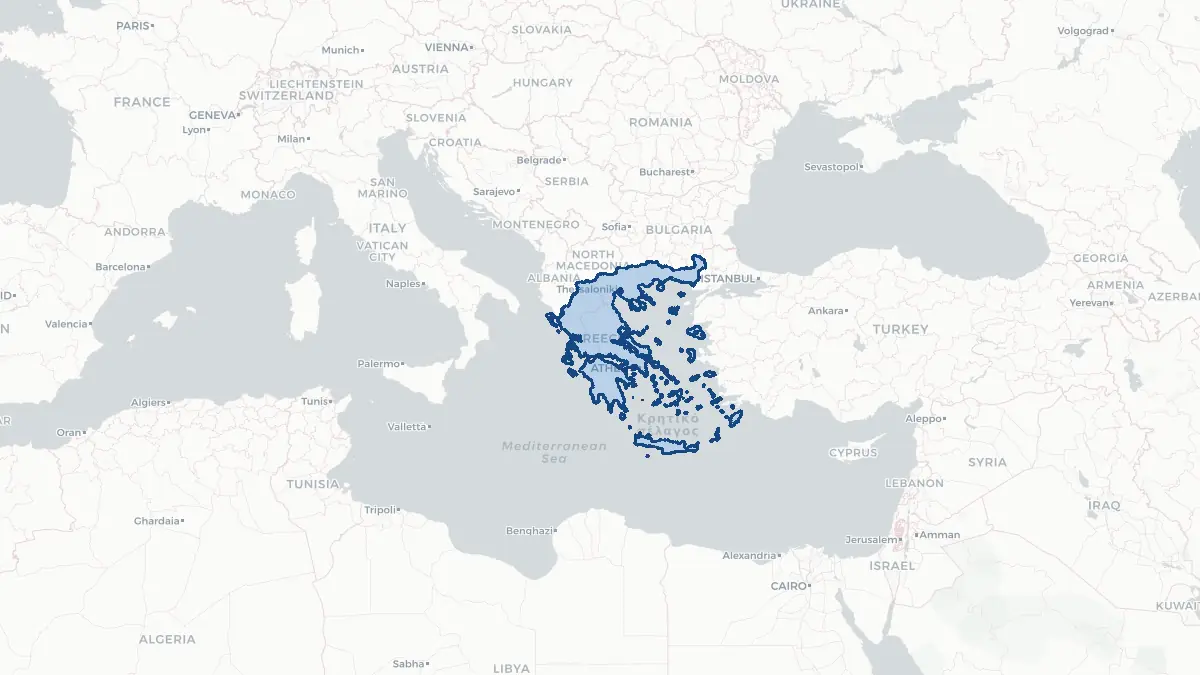
Here you find a map of Greece, capital Athens, currency Euro and quick links to more facts about the country in Europe.
About the country
Greece on the map
Greece is a country in south-eastern Europe, situated at the crossroads of Europe, Asia, and Africa, with coastlines along the Aegean, Ionian, and Mediterranean seas. With a population of approximately 10.7 million and a history that directly shaped Western civilisation, Greece occupies a unique place in world culture. The capital is Athens. The currency is the euro (EUR).
About Greece
Greece, officially the Hellenic Republic, is a parliamentary republic. It comprises a mainland in the southern Balkan Peninsula and an archipelago of approximately 6,000 islands and islets, of which around 220 are inhabited. The most important island groups are the Aegean Islands (including the Cyclades and Dodecanese), the Ionian Islands, and the large island of Crete to the south. Greece borders Albania, North Macedonia, Bulgaria, and Turkey. It has been a member of the European Union since 1981 and uses the euro.
Geography and landscape
Greece covers approximately 131,957 km². Around 80% of the land is mountainous — the Pindus range runs through the mainland, and Mount Olympus (2,918 m) is the country's highest point. Greece has one of the world's longest coastlines relative to land area — approximately 13,700 km — due to its many islands and deeply indented bays. The climate is predominantly Mediterranean: hot, dry summers and mild, wet winters. The Aegean Sea, dotted with islands, is one of the most recognisable maritime landscapes in the world.
History
Greece is considered the cradle of Western civilisation. Ancient Greece produced the world's first known democracy (Athens, 5th century BCE), the Olympic Games, foundational philosophy (Socrates, Plato, Aristotle), drama, and architecture. Alexander the Great's campaigns spread Greek culture from Egypt to India. Greece was later incorporated into the Roman Empire, then the Byzantine Empire, which preserved Greek culture and Orthodox Christianity. Ottoman rule lasted from the 15th century until the Greek War of Independence (1821–1829). Modern Greece emerged as an independent state, later a republic.
Economy and currency
Greece is a developed market economy. Tourism is the largest sector: Greece is one of the world's most visited destinations, with major draws including Athens, the Greek islands (Santorini, Mykonos, Rhodes, Corfu), and ancient archaeological sites. Shipping is another cornerstone — Greek-owned vessels constitute the world's largest fleet. Greece adopted the euro in 2001. Following a severe economic crisis from 2010 to 2018, Greece has returned to growth.
Culture and language
Greek is the official language, one of the world's oldest recorded languages with a continuous written tradition of over 3,400 years. The Greek Orthodox Church is central to culture and identity. Ancient ruins at the Acropolis, Delphi, Olympia, and Knossos attract millions of visitors; the monasteries of Meteora, perched on rock pillars, are a UNESCO World Heritage Site. Greek cuisine — moussaka, souvlaki, spanakopita, fresh seafood, olive oil — is beloved worldwide.
Frequently asked questions
What is the capital of Greece? Athens, one of the world's oldest cities, is the capital and cultural centre.
What currency does Greece use? The euro (EUR), adopted in 2001.
What is the Acropolis? The Acropolis of Athens is a rocky outcrop topped by ancient monuments including the Parthenon, built in the 5th century BCE and dedicated to the goddess Athena. It is a UNESCO World Heritage Site.
How many islands does Greece have? Greece has approximately 6,000 islands and islets, of which around 220 are inhabited. The largest island is Crete.
Is Greece a member of the European Union? Yes. Greece joined the EU in 1981 and adopted the euro in 2001.
Geo Quiz
Think you know your capitals, flags, and continents? Take the quiz!
Neighbouring countries
Continue to nearby countries
More countries in the same part of the world
Europe index
Open the continent hub for Europe to see the full country list, capitals and frequently asked questions on one page.
Interactive map
Zoomable map of Greece
Country index
All countries by continent
Jump directly to the right section or keep scrolling.
Africa
58 countries- Algeria
- Angola
- Benin
- Botswana
- Burkina Faso
- Burundi
- Central African Republic
- Djibouti
- Democratic Republic of the Congo
- Egypt
- Equatorial Guinea
- Ivory Coast
- Eritrea
- Ethiopia
- Gabon
- Gambia
- Ghana
- Guinea
- Guinea-Bissau
- Cameroon
- Cape Verde
- Kenya
- Comoros
- Republic of the Congo
- Lesotho
- Liberia
- Libya
- Madagascar
- Malawi
- Mali
- Morocco
- Mauritania
- Mauritius
- Mayotte
- Mozambique
- Namibia
- Niger
- Nigeria
- Reunion
- Rwanda
- Saint Helena
- Sao Tome and Principe
- Senegal
- Seychelles
- Sierra Leone
- Somalia
- Sudan
- Swaziland
- South Africa
- South Sudan
- Tanzania
- Chad
- Togo
- Tunisia
- Uganda
- Western Sahara
- Zambia
- Zimbabwe
Asia
52 countries- Afghanistan
- Armenia
- Azerbaijan
- Bahrain
- Bangladesh
- Bhutan
- British Indian Ocean Territory
- Brunei
- Myanmar
- Philippines
- United Arab Emirates
- Georgia
- Hong Kong
- India
- Indonesia
- Iraq
- Iran
- Israel
- Japan
- Yemen
- Jordan
- Christmas Island
- Cambodia
- Kazakhstan
- China
- Kyrgyzstan
- Cocos Islands
- Kuwait
- Laos
- Lebanon
- Macau
- Malaysia
- Maldives
- Mongolia
- Nepal
- North Korea
- Oman
- Pakistan
- Palestinian Territory
- Qatar
- Saudi Arabia
- Singapore
- Sri Lanka
- South Korea
- Syria
- Tajikistan
- Taiwan
- Thailand
- Turkey
- Turkmenistan
- Uzbekistan
- Vietnam
Europe
53 countries- Albania
- Andorra
- Belgium
- Bosnia and Herzegovina
- Bulgaria
- Cyprus
- Denmark
- Estonia
- Finland
- France
- Faroe Islands
- Gibraltar
- Greece
- Guernsey
- Ireland
- Iceland
- Isle of Man
- Italy
- Jersey
- Kosovo
- Croatia
- Latvia
- Liechtenstein
- Lithuania
- Luxembourg
- Macedonia
- Malta
- Moldova
- Monaco
- Montenegro
- Netherlands
- Norway
- Poland
- Portugal
- Romania
- Russia
- San Marino
- Switzerland
- Serbia
- Slovakia
- Slovenia
- Spain
- United Kingdom
- Svalbard and Jan Mayen
- Sweden
- Czech Republic
- Germany
- Ukraine
- Hungary
- Vatican
- Belarus
- Aland Islands
- Austria
North America
42 countries- U.S. Virgin Islands
- Anguilla
- Antigua and Barbuda
- Aruba
- Bahamas
- Barbados
- Belize
- Bermuda
- Bonaire, Saint Eustatius and Saba
- British Virgin Islands
- Cayman Islands
- Costa Rica
- Curacao
- Dominica
- Dominican Republic
- El Salvador
- Grenada
- Greenland
- Guadeloupe
- Guatemala
- Haiti
- Honduras
- Jamaica
- Canada
- Cuba
- Martinique
- Mexico
- Montserrat
- Netherlands Antilles
- Nicaragua
- Panama
- Puerto Rico
- Saint Barthelemy
- Saint Kitts and Nevis
- Saint Lucia
- Saint Martin
- Saint Vincent and the Grenadines
- Saint Pierre and Miquelon
- Sint Maarten
- Trinidad and Tobago
- Turks and Caicos Islands
- United States
South America
14 countriesOceania
27 countries- American Samoa
- Australia
- Cook Islands
- Fiji
- French Polynesia
- United States Minor Outlying Islands
- Guam
- Kiribati
- Marshall Islands
- Micronesia
- Nauru
- Niue
- Northern Mariana Islands
- Norfolk Island
- New Caledonia
- New Zealand
- Palau
- Papua New Guinea
- Pitcairn
- Solomon Islands
- Samoa
- Tokelau
- Tonga
- Tuvalu
- Vanuatu
- Wallis and Futuna
- East Timor