
Europe
Albania — map and facts
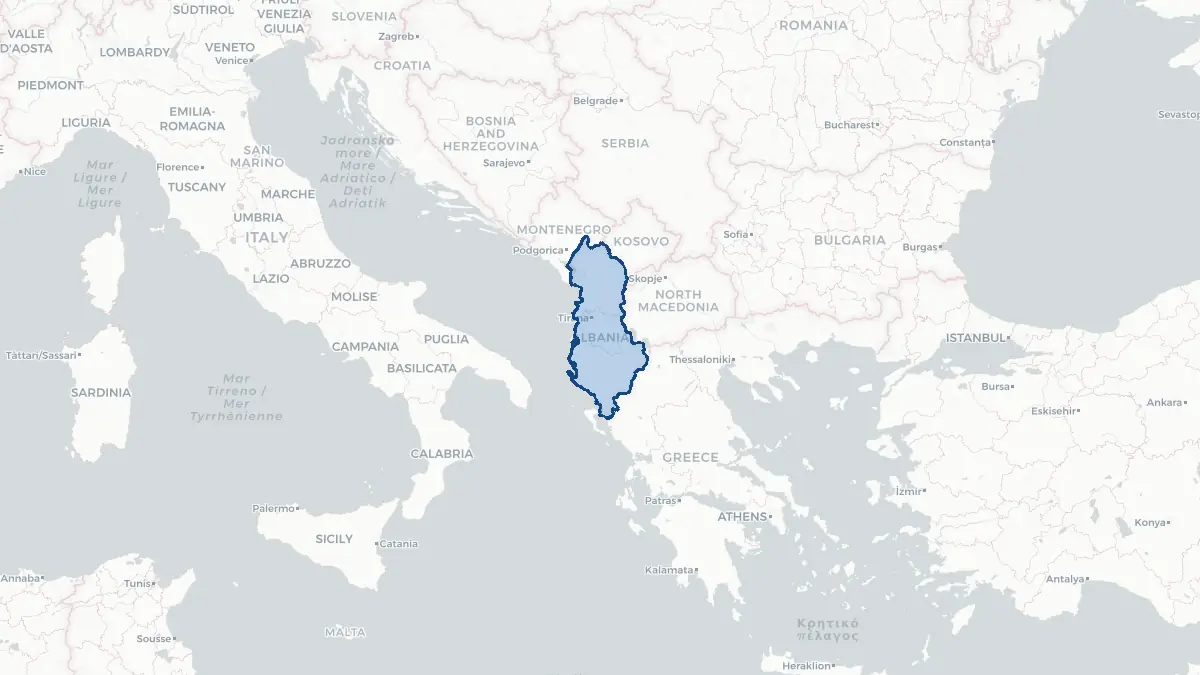
Here you find a map of Albania, capital Tirana, currency Lek and quick links to more facts about the country in Europe.
About the country
Albania on the map
About Albania
Albania is a small southeastern European country on the Adriatic and Ionian Seas, with a population of about 2.8 million. Its capital is Tirana, a city transformed dramatically since the fall of communism in 1991. Albania is a parliamentary republic and has been a NATO member since 2009; EU accession negotiations are ongoing. The country has one of Europe's youngest populations and has seen significant emigration over three decades, with large Albanian communities in Italy, Greece, and North America. The economy has grown steadily, shifting from one of Europe's most isolated and impoverished states toward a more open, service-based economy. Tourism is a major growth sector, with Albania's largely unspoilt Riviera and alpine interior attracting growing numbers of visitors. The official language is Albanian, which forms its own branch of the Indo-European family, spoken in two main dialects — Gheg in the north and Tosk in the south.
Geography and Landscape
About 70 per cent of Albania is covered by hills and mountains. The Albanian Alps rise sharply in the north along the borders with Montenegro and Kosovo, while the interior is criss-crossed by mountain ranges and river valleys. The western lowlands — a narrow coastal strip along the Adriatic and Ionian Seas — contain most agricultural land and urban population. Major rivers include the Drin in the north, the Shkumbin in the centre, and the Vjosa in the south; the Vjosa is now protected as Europe's first wild-river national park. Lake Shkodër, shared with Montenegro, is the largest lake in southern Europe. The southern Riviera offers clear Ionian waters and dramatic cliffs. The coast has a Mediterranean climate; the interior is continental with cold, snowy winters.
History
The Illyrians inhabited the western Balkans long before Greek colonists and Roman conquerors arrived. After Roman and Byzantine rule, Albanian national hero Gjergj Kastrioti Skënderbeu led fierce resistance against Ottoman expansion in the fifteenth century. Albania nonetheless fell under Ottoman rule in 1479 and remained part of the empire for over four centuries. The League of Prizren (1878) launched the modern national movement, and Albania declared independence on 28 November 1912. After the Second World War, Enver Hoxha imposed one of Europe's most repressive communist dictatorships, isolating the country even from the Soviet Union and China. Hoxha died in 1985; communism ended in 1991 after mass protests and emigration. A turbulent transition included an economic crisis in 1997. Albania joined NATO in 2009 and is an active EU candidate.
Geo Quiz
Think you know your capitals, flags, and continents? Take the quiz!
Neighbouring countries
Continue to nearby countries
More countries in the same part of the world
Europe index
Open the continent hub for Europe to see the full country list, capitals and frequently asked questions on one page.
Interactive map
Zoomable map of Albania
Country index
All countries by continent
Jump directly to the right section or keep scrolling.
Africa
58 countries- Algeria
- Angola
- Benin
- Botswana
- Burkina Faso
- Burundi
- Central African Republic
- Djibouti
- Democratic Republic of the Congo
- Egypt
- Equatorial Guinea
- Ivory Coast
- Eritrea
- Ethiopia
- Gabon
- Gambia
- Ghana
- Guinea
- Guinea-Bissau
- Cameroon
- Cape Verde
- Kenya
- Comoros
- Republic of the Congo
- Lesotho
- Liberia
- Libya
- Madagascar
- Malawi
- Mali
- Morocco
- Mauritania
- Mauritius
- Mayotte
- Mozambique
- Namibia
- Niger
- Nigeria
- Reunion
- Rwanda
- Saint Helena
- Sao Tome and Principe
- Senegal
- Seychelles
- Sierra Leone
- Somalia
- Sudan
- Swaziland
- South Africa
- South Sudan
- Tanzania
- Chad
- Togo
- Tunisia
- Uganda
- Western Sahara
- Zambia
- Zimbabwe
Asia
52 countries- Afghanistan
- Armenia
- Azerbaijan
- Bahrain
- Bangladesh
- Bhutan
- British Indian Ocean Territory
- Brunei
- Myanmar
- Philippines
- United Arab Emirates
- Georgia
- Hong Kong
- India
- Indonesia
- Iraq
- Iran
- Israel
- Japan
- Yemen
- Jordan
- Christmas Island
- Cambodia
- Kazakhstan
- China
- Kyrgyzstan
- Cocos Islands
- Kuwait
- Laos
- Lebanon
- Macau
- Malaysia
- Maldives
- Mongolia
- Nepal
- North Korea
- Oman
- Pakistan
- Palestinian Territory
- Qatar
- Saudi Arabia
- Singapore
- Sri Lanka
- South Korea
- Syria
- Tajikistan
- Taiwan
- Thailand
- Turkey
- Turkmenistan
- Uzbekistan
- Vietnam
Europe
53 countries- Albania
- Andorra
- Belgium
- Bosnia and Herzegovina
- Bulgaria
- Cyprus
- Denmark
- Estonia
- Finland
- France
- Faroe Islands
- Gibraltar
- Greece
- Guernsey
- Ireland
- Iceland
- Isle of Man
- Italy
- Jersey
- Kosovo
- Croatia
- Latvia
- Liechtenstein
- Lithuania
- Luxembourg
- Macedonia
- Malta
- Moldova
- Monaco
- Montenegro
- Netherlands
- Norway
- Poland
- Portugal
- Romania
- Russia
- San Marino
- Switzerland
- Serbia
- Slovakia
- Slovenia
- Spain
- United Kingdom
- Svalbard and Jan Mayen
- Sweden
- Czech Republic
- Germany
- Ukraine
- Hungary
- Vatican
- Belarus
- Aland Islands
- Austria
North America
42 countries- U.S. Virgin Islands
- Anguilla
- Antigua and Barbuda
- Aruba
- Bahamas
- Barbados
- Belize
- Bermuda
- Bonaire, Saint Eustatius and Saba
- British Virgin Islands
- Cayman Islands
- Costa Rica
- Curacao
- Dominica
- Dominican Republic
- El Salvador
- Grenada
- Greenland
- Guadeloupe
- Guatemala
- Haiti
- Honduras
- Jamaica
- Canada
- Cuba
- Martinique
- Mexico
- Montserrat
- Netherlands Antilles
- Nicaragua
- Panama
- Puerto Rico
- Saint Barthelemy
- Saint Kitts and Nevis
- Saint Lucia
- Saint Martin
- Saint Vincent and the Grenadines
- Saint Pierre and Miquelon
- Sint Maarten
- Trinidad and Tobago
- Turks and Caicos Islands
- United States
South America
14 countriesOceania
27 countries- American Samoa
- Australia
- Cook Islands
- Fiji
- French Polynesia
- United States Minor Outlying Islands
- Guam
- Kiribati
- Marshall Islands
- Micronesia
- Nauru
- Niue
- Northern Mariana Islands
- Norfolk Island
- New Caledonia
- New Zealand
- Palau
- Papua New Guinea
- Pitcairn
- Solomon Islands
- Samoa
- Tokelau
- Tonga
- Tuvalu
- Vanuatu
- Wallis and Futuna
- East Timor