
North America
Trinidad and Tobago — map and facts
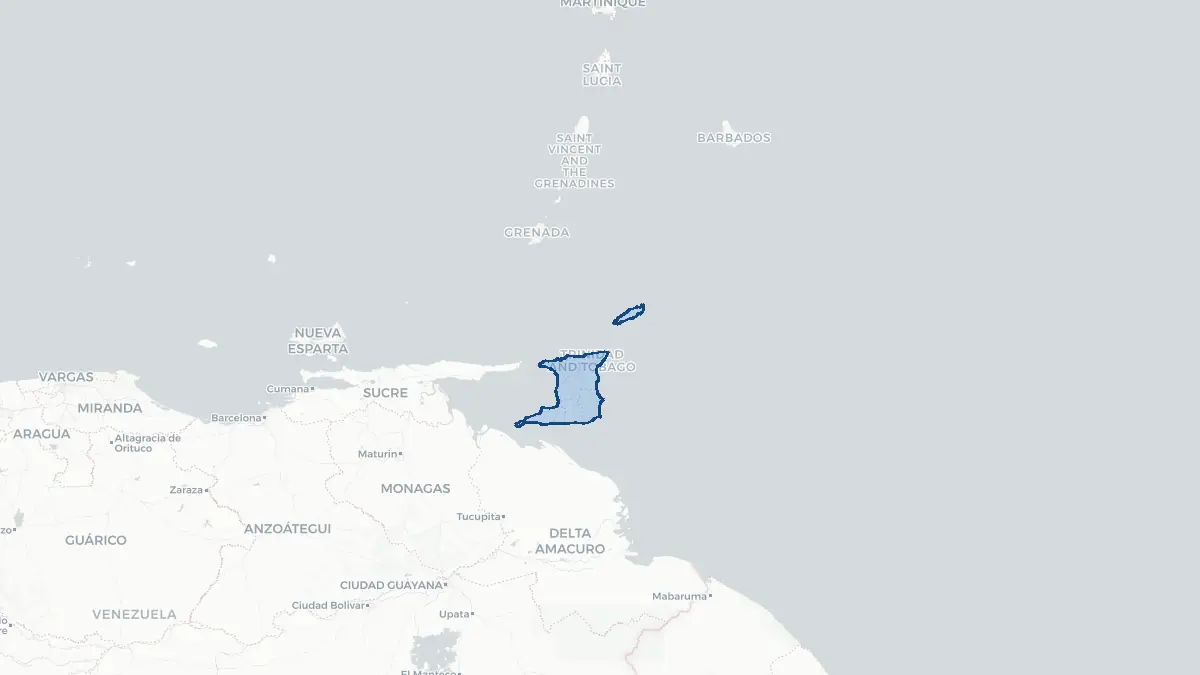
Here you find a map of Trinidad and Tobago, capital Port of Spain, currency Trinidaddollar and quick links to more facts about the country in North America.
About the country
Trinidad and Tobago on the map
About Trinidad and Tobago
Trinidad and Tobago is a twin-island Caribbean nation located at the southern end of the Lesser Antilles, just off the northeastern coast of Venezuela. Port of Spain serves as the capital and largest city, situated on the northwestern coast of Trinidad. The country has a population of approximately 1.4 million people and operates as a parliamentary republic within the Commonwealth. Trinidad and Tobago is one of the most prosperous nations in the Caribbean, driven by substantial petroleum and natural gas reserves, including major offshore fields. The economy is heavily industrialized compared to its neighbors, with a thriving petrochemical sector centered around the Point Lisas Industrial Estate. The country is renowned globally for its vibrant Carnival celebration, considered among the world's greatest festivals, as well as for being the birthplace of calypso music, soca, and the steel pan instrument. The population is ethnically diverse, with significant communities of Indo-Trinidadian and Afro-Trinidadian descent, alongside smaller Chinese, Syrian-Lebanese, and European communities.
Geography and Landscape
Trinidad, the larger of the two main islands, covers about 4,768 square kilometers and is geologically an extension of the South American continent rather than a volcanic Caribbean island. The Northern Range, a chain of mountains running east to west across the island's northern edge, contains the highest point, El Cerro del Aripo, at 940 meters. The island's central and southern areas are dominated by rolling plains and low hills, with significant swampland along the west coast including the Caroni Swamp, famous for its scarlet ibis colonies. The Pitch Lake near La Brea is one of the world's largest natural deposits of asphalt. Tobago, the smaller island located roughly 30 kilometers northeast of Trinidad, is more mountainous and forested, with Main Ridge Forest Reserve, one of the oldest protected rainforests in the Western Hemisphere. Tobago's coastline features coral reefs and pristine beaches. Both islands experience a tropical climate with a wet season from June to December and a dry season from January to May.
History
Trinidad was inhabited by Arawak and Carib peoples before Christopher Columbus sighted the island in 1498, naming it La Trinidad after the Holy Trinity. Spanish colonization followed, though the island remained relatively underdeveloped for over two centuries. In 1797 the British captured Trinidad from Spain, formally acquiring it by the Treaty of Amiens in 1802. Tobago changed hands numerous times between European powers before becoming a British possession permanently in 1814. The two islands were merged into a single Crown Colony in 1889. After the abolition of slavery in 1834, indentured laborers from India arrived in large numbers between 1845 and 1917, fundamentally shaping the nation's cultural and ethnic composition. The independence movement gathered momentum in the 1950s under Eric Williams, historian and founder of the People's National Movement. Trinidad and Tobago gained independence on August 31, 1962, and became a republic in 1976. Williams served as the first Prime Minister until his death in 1981, and the country has maintained democratic governance throughout its post-independence history.
Geo Quiz
Think you know your capitals, flags, and continents? Take the quiz!
Neighbouring countries
Continue to nearby countries
There are no registered neighbouring countries for Trinidad and Tobago in the current database.
More countries in the same part of the world
North America index
Open the continent hub for North America to see the full country list, capitals and frequently asked questions on one page.
Interactive map
Zoomable map of Trinidad and Tobago
Country index
All countries by continent
Jump directly to the right section or keep scrolling.
Africa
58 countries- Algeria
- Angola
- Benin
- Botswana
- Burkina Faso
- Burundi
- Central African Republic
- Djibouti
- Democratic Republic of the Congo
- Egypt
- Equatorial Guinea
- Ivory Coast
- Eritrea
- Ethiopia
- Gabon
- Gambia
- Ghana
- Guinea
- Guinea-Bissau
- Cameroon
- Cape Verde
- Kenya
- Comoros
- Republic of the Congo
- Lesotho
- Liberia
- Libya
- Madagascar
- Malawi
- Mali
- Morocco
- Mauritania
- Mauritius
- Mayotte
- Mozambique
- Namibia
- Niger
- Nigeria
- Reunion
- Rwanda
- Saint Helena
- Sao Tome and Principe
- Senegal
- Seychelles
- Sierra Leone
- Somalia
- Sudan
- Swaziland
- South Africa
- South Sudan
- Tanzania
- Chad
- Togo
- Tunisia
- Uganda
- Western Sahara
- Zambia
- Zimbabwe
Asia
52 countries- Afghanistan
- Armenia
- Azerbaijan
- Bahrain
- Bangladesh
- Bhutan
- British Indian Ocean Territory
- Brunei
- Myanmar
- Philippines
- United Arab Emirates
- Georgia
- Hong Kong
- India
- Indonesia
- Iraq
- Iran
- Israel
- Japan
- Yemen
- Jordan
- Christmas Island
- Cambodia
- Kazakhstan
- China
- Kyrgyzstan
- Cocos Islands
- Kuwait
- Laos
- Lebanon
- Macau
- Malaysia
- Maldives
- Mongolia
- Nepal
- North Korea
- Oman
- Pakistan
- Palestinian Territory
- Qatar
- Saudi Arabia
- Singapore
- Sri Lanka
- South Korea
- Syria
- Tajikistan
- Taiwan
- Thailand
- Turkey
- Turkmenistan
- Uzbekistan
- Vietnam
Europe
53 countries- Albania
- Andorra
- Belgium
- Bosnia and Herzegovina
- Bulgaria
- Cyprus
- Denmark
- Estonia
- Finland
- France
- Faroe Islands
- Gibraltar
- Greece
- Guernsey
- Ireland
- Iceland
- Isle of Man
- Italy
- Jersey
- Kosovo
- Croatia
- Latvia
- Liechtenstein
- Lithuania
- Luxembourg
- Macedonia
- Malta
- Moldova
- Monaco
- Montenegro
- Netherlands
- Norway
- Poland
- Portugal
- Romania
- Russia
- San Marino
- Switzerland
- Serbia
- Slovakia
- Slovenia
- Spain
- United Kingdom
- Svalbard and Jan Mayen
- Sweden
- Czech Republic
- Germany
- Ukraine
- Hungary
- Vatican
- Belarus
- Aland Islands
- Austria
North America
42 countries- U.S. Virgin Islands
- Anguilla
- Antigua and Barbuda
- Aruba
- Bahamas
- Barbados
- Belize
- Bermuda
- Bonaire, Saint Eustatius and Saba
- British Virgin Islands
- Cayman Islands
- Costa Rica
- Curacao
- Dominica
- Dominican Republic
- El Salvador
- Grenada
- Greenland
- Guadeloupe
- Guatemala
- Haiti
- Honduras
- Jamaica
- Canada
- Cuba
- Martinique
- Mexico
- Montserrat
- Netherlands Antilles
- Nicaragua
- Panama
- Puerto Rico
- Saint Barthelemy
- Saint Kitts and Nevis
- Saint Lucia
- Saint Martin
- Saint Vincent and the Grenadines
- Saint Pierre and Miquelon
- Sint Maarten
- Trinidad and Tobago
- Turks and Caicos Islands
- United States
South America
14 countriesOceania
27 countries- American Samoa
- Australia
- Cook Islands
- Fiji
- French Polynesia
- United States Minor Outlying Islands
- Guam
- Kiribati
- Marshall Islands
- Micronesia
- Nauru
- Niue
- Northern Mariana Islands
- Norfolk Island
- New Caledonia
- New Zealand
- Palau
- Papua New Guinea
- Pitcairn
- Solomon Islands
- Samoa
- Tokelau
- Tonga
- Tuvalu
- Vanuatu
- Wallis and Futuna
- East Timor